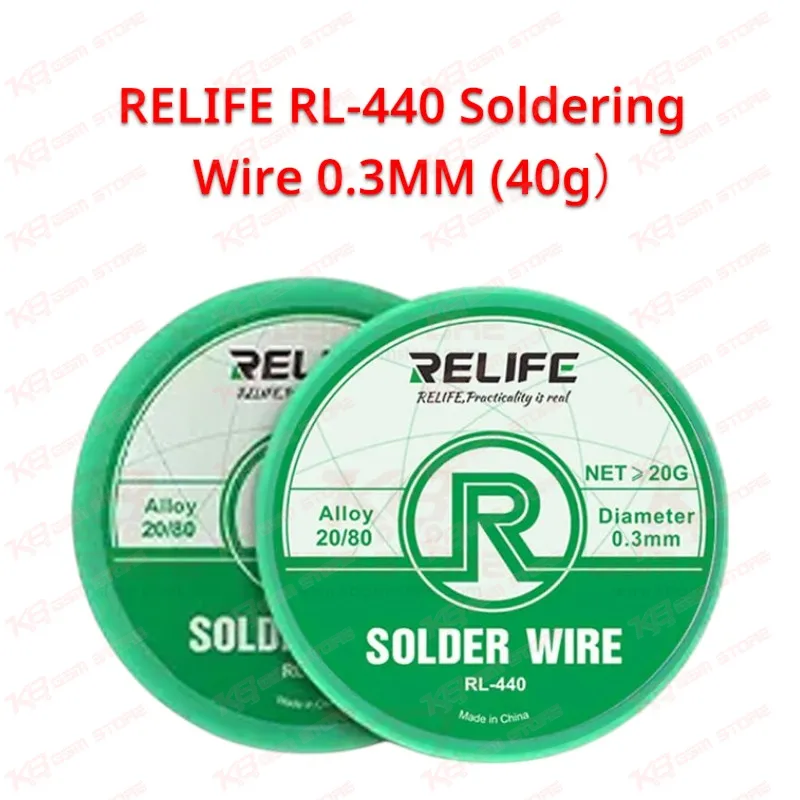
A repair bench that handles motherboard-level work needs solder wire that matches the scale of the components being touched, and the RELIFE RL-440 0.3mm is built for exactly that gap between full-size solder and micro rework paste. At 0.3mm diameter, the wire feeds in small, controllable increments, so you avoid the classic problem of a thick wire dumping too much solder onto a fine-pitch IC pad or a delicate connector pin. The rosin core running through the center of the wire activates the moment your iron tip touches it, which means you get flux and solder in one motion instead of dipping into a separate flux pot for every joint. This matters on a busy bench doing IC change, jumper lagana, or connector re-soldering back to back, where stopping to re-flux each point slows the whole repair down. The alloy is formulated for low spatter and smooth flow, so joints come out bright and consistent rather than dull or grainy, which is the visual cue technicians rely on to judge a clean solder without needing a microscope for every single point. Anti-oxidation stability in the alloy also means the roll holds up in normal workshop conditions without the tip of the wire turning dull or hard to melt after weeks of sitting on the bench. For network issue and charging issue repairs where a charging IC or a small RF component needs to be reworked, the fine gauge lets you tack a lead precisely without bridging adjacent pads, which is the difference between a clean fix and a board that comes back with a new fault. The same applies to display problem repairs involving flex connector re-tinning, where the tip of the connector pin is often less than a millimeter wide and a standard 0.5mm or 0.6mm wire simply cannot be dosed accurately. Technicians working dead phone and dead after flash cases where the board itself needs physical rework, not just software marna, reach for a thin gauge wire like this specifically because IC-level and CPU-level repair depends on controlled, minimal solder application rather than bulk soldering. The 40g roll size is a practical middle ground for a working repair shop: enough wire to get through weeks of daily jobs without needing frequent restocking, but not so large that it sits unused and degrades before it's finished. Pairing this wire with a temperature-controlled soldering iron gives the most consistent results, since the rosin core is designed to activate cleanly at typical rework temperatures rather than requiring excessive heat that can lift pads on multilayer mobile boards. It fits naturally into a technician's kit alongside ISP pinout tools, eMMC programmers, hot air stations, and reballing kits, since board-level diagnostics and rework almost always end in a soldering step, and having the right gauge of wire on hand determines whether that final step is fast and clean or messy and time-consuming. Whether you're reattaching a jumper after tracing a hardware fault, repairing a charging port, or doing general PCB cleaning and rework on a service center bench, the RL-440 0.3mm gives you the fine control that mobile-scale components demand, without switching between multiple wire gauges for different jobs.