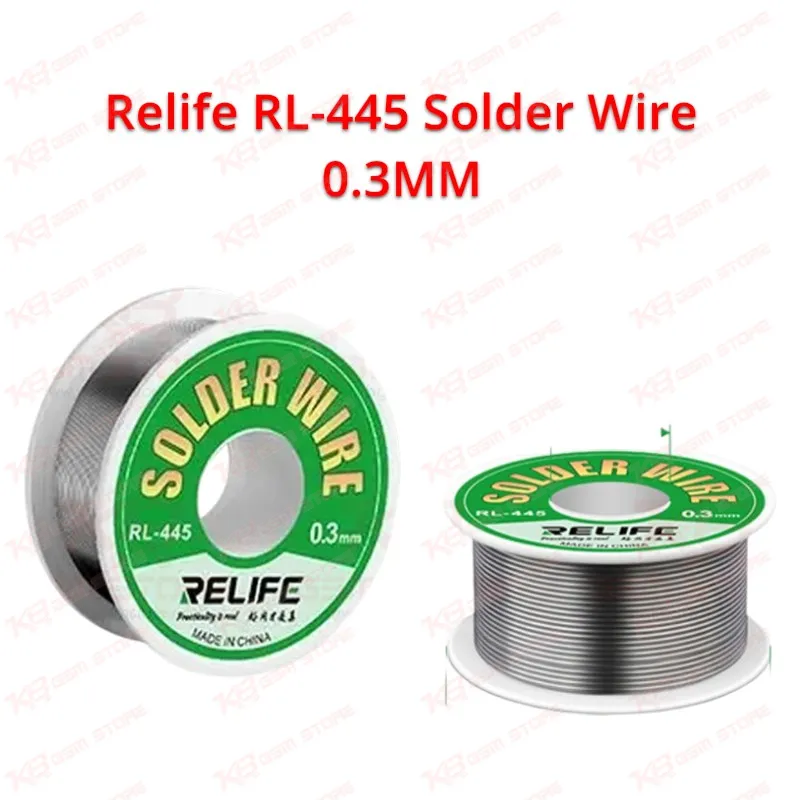
Soldering at the board level demands a wire that flows predictably, bonds cleanly, and doesn't overload a joint with excess material, and the RELIFE RL-445 in its 0.3mm diameter delivers exactly that kind of control for technicians working on mobile phone motherboards and other compact electronics. Built from a 63/37 tin-lead alloy with a purity level around 99.3%, this wire keeps impurities low so each joint forms with better conductivity and stronger mechanical hold, which matters directly when you're reattaching an IC or repairing a hairline trace on a densely packed board. The rosin core running through the center carries a 2.0% flux content, enough to clean the metal surface as you work and encourage the solder to wet evenly across the pad without pooling or dragging tin where you don't want it. A melting point of 183°C puts this wire in a practical range for repair work — hot enough to bond quickly and cleanly, cool enough that you're not putting unnecessary thermal stress on nearby components while you work close to a chipset or connector. On a repair bench, that combination shows up in everyday tasks: reflowing a lifted pad, running a jumper wire between two points on a board, tacking down a charging port pin, or building up a bridge after cleaning corrosion off a water-damaged board. The fine 0.3mm gauge is what makes this wire suitable for that kind of close-pitch work in the first place — a thicker wire dumps too much solder onto a small pad and risks bridging adjacent points, while 0.3mm lets you feed just enough material to complete a joint without cleanup afterward. Technicians handling dead phone boards, boards stuck in a boot loop, or units with intermittent charging faults often trace the fault down to a single lifted pad or broken jumper, and having a wire this fine on hand means the fix stays precise instead of turning into a bigger rework job. The low residue formula also plays into workflow speed: since the flux content is tuned to leave minimal buildup, boards come out cleaner and don't always need a full isopropyl wipe-down before reassembly, which saves time on high-volume repair days. Packaged as a 25g roll, the wire is sized for a repair shop that goes through solder steadily but doesn't want to store bulk spools taking up bench space — it fits into a drawer or tool kit alongside your iron, flux pen, and tweezers without adding weight or bulk. Because this is a general-purpose rosin core wire rather than a device-specific part, it isn't tied to one phone brand or chipset family; it works across Android and iOS boards alike, and applies equally to Qualcomm and MediaTek platforms, power board repairs, and general microelectronics assembly outside the mobile repair space. For a shop running multiple repair stations, standardizing on a single fine-gauge wire like the RL-445 also simplifies training — new technicians get consistent results because the wire behaves the same way across every board they touch, rather than adjusting technique for a different alloy or flux ratio each time they pick up a different spool. Whether the job is a straightforward IC reflow, a full board-level rework after liquid damage, or routine maintenance soldering on connectors and shields, this 0.3mm RELIFE RL-445 gives a repair technician a dependable, fine-control option that fits directly into an existing soldering workflow without requiring a change in iron temperature or technique.