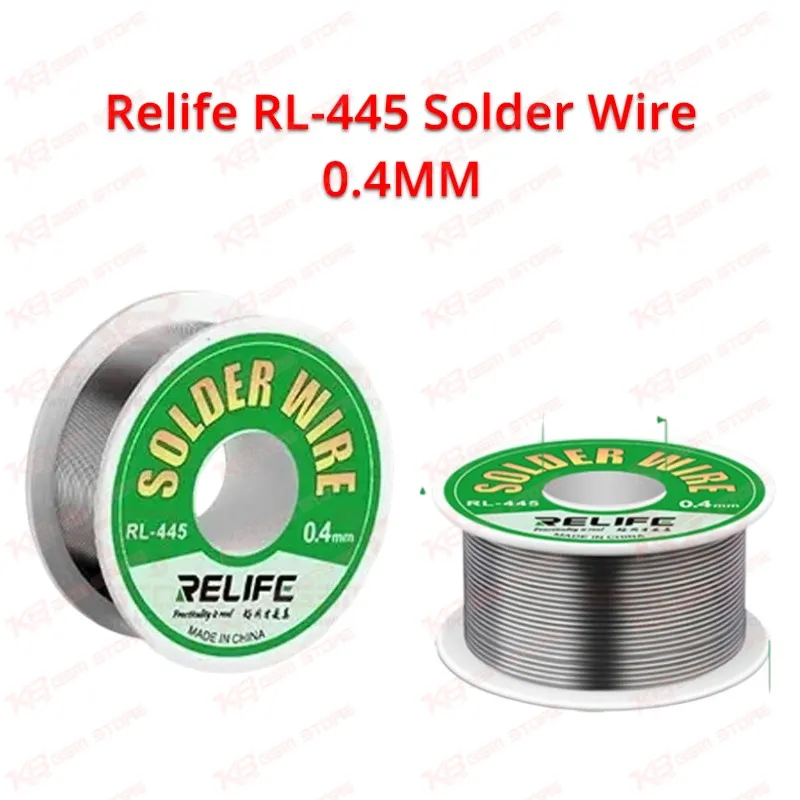
RELIFE RL-445 solder wire in 0.4mm gauge fills a specific gap on the repair bench: joints small enough for mobile PCB pads, IC legs, and connector pins where a standard 0.8mm or 1.0mm wire simply deposits too much solder. You get a fine, controllable feed that lets you tack down a charging port pin or bridge a jumper without flooding neighboring pads, which matters most when you are working a board that already has a dead after flash symptom or a hardware fault traced to a lifted trace. The wire carries a rosin flux core, so as it melts under your iron tip, the flux activates on contact with the pad, breaks down surface oxidation, and pulls the molten tin into a clean, shiny fillet rather than a dull, grainy blob. That wetting behavior is what separates a joint that holds up on a phone repair after weeks of daily use from one that comes loose the next time the board flexes. High tin purity in the alloy keeps the melt flowing evenly along the wire, so you are not fighting inconsistent feed rates mid-joint, and the reduced impurity level lowers the chance of a brittle, high-resistance connection that later shows up as an intermittent charging issue or a network issue traced back to a bad solder point. Because the flux is a no-clean rosin formula, residue left after soldering stays minimal and does not need an isopropyl wipe-down before you move to the next pad, which speeds up repetitive work like IC change karna across multiple boards in a shift. The 25g roll size is enough for sustained daily use without constantly restocking, and the compact spool fits easily into a drawer or tool roll alongside your hot air station, microscope, and PCB holder. On the workbench, this wire slots into several stages of a typical repair: reflow and reballing prep where you tin pads before placing an IC, jumper work when a trace has lifted or a via needs bridging, connector and flex cable pin repair, and general touch-up after board cleaning when you spot a cold joint under the microscope. It pairs naturally with a temperature-controlled soldering iron rather than a fixed-heat pencil iron, since dialing in the right tip temperature for 0.4mm wire gives you cleaner control over how much solder actually reaches the pad. Technicians handling boot loop issues, FRP lock troubleshooting that requires opening the board, or hang on logo faults tied to a cracked solder joint on a PMIC or CPU pad will find the fine gauge useful for exactly the kind of tight-tolerance rework those repairs demand. It also holds up fine for non-phone microelectronics work, so if your bench also handles small board repair on peripherals or power boards, the same roll covers that too. Store the wire in a cool, dry spot away from direct sunlight, since humidity exposure over time degrades the flux and can lead to oxidation on the wire surface before you even get to use it, a preventable loss on a consumable you are otherwise ready to rely on daily. For a repair shop running multiple technicians and multiple stations, keeping a 0.4mm roll on hand alongside heavier gauges gives your team the right tool for the actual pad size instead of forcing every job through a wire that is too thick for delicate mobile board work. It is a straightforward, low-cost addition to a GSM repair kit that pays for itself the first time it saves you from bridging two pads that were never meant to touch.