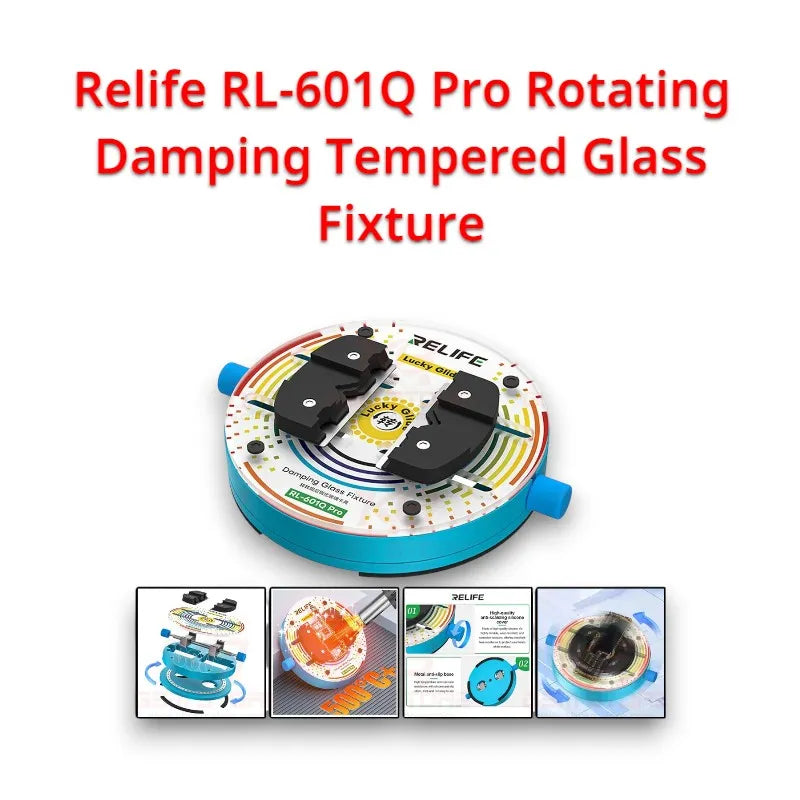
Every experienced GSM technician knows that a shaky or fixed-position clamp is one of the fastest ways to ruin a delicate board during rework, and the Relife RL-601Q Pro Rotating Damping Tempered Glass Fixture exists specifically to remove that risk from your bench. At its core sits a panel of tempered, heat-resistant glass built to handle sustained temperatures beyond 500°C without warping, discoloring, or corroding, which means it survives repeated exposure to hot air stations and reflow work that would degrade cheaper plastic or resin-based fixtures over time. Rather than locking your board into one fixed angle, the fixture rotates a full 360 degrees on a damped base, so under the microscope you can rotate the motherboard smoothly to reach a solder joint or IC pad from any direction without lifting, repositioning, or breaking your line of sight. That damped movement is deliberate: it resists sudden spinning or drift, so the board holds exactly where you leave it while you switch between soldering iron, hot air nozzle, or probe. Clamping itself relies on an inward-angled beveled inner-lock design that grips the edge of the board from underneath rather than pinching it flat, which keeps single-layer and double-layer motherboards secure without crushing connectors or nearby components, and the synthetic stone clamp material used in the jaws carries its own heat and corrosion resistance so it does not degrade from flux residue or repeated thermal cycling. Bidirectional screw adjustment lets you widen or narrow the grip for different board sizes, giving the fixture practical use across phone motherboards, CPUs, hard drives, and a range of other ICs rather than tying it to one specific device family. Around the clamp area, a high-quality anti-scald silicone cover shields your fingers when you are working close to a heated board, offering wear resistance and corrosion protection so it holds up through daily use in a busy repair shop. Underneath, a metal anti-slip base fitted with silicone strips keeps the entire unit planted on the workbench, which matters when you are applying lateral pressure with tweezers or a spudger during chip degumming or reballing and do not want the fixture sliding out from under the board. The compact, portable footprint means it does not crowd a shared workstation, and it stores easily in a toolbox or drawer between jobs, useful for technicians who move between a fixed bench and mobile repair callouts. In day-to-day workshop terms, this is the kind of fixture you reach for the moment a phone comes in dead after flash, with a suspected IC fault, or displaying a hang-on-logo issue that points to board-level rework rather than a software marna fix, since holding the board rigid and rotatable is what lets you inspect solder joints, reflow a chip, or lift and reball a component cleanly. It fits naturally into ISP and eMMC-adjacent repair workflows too, where a technician has already pulled the board out for diagnostics and needs a secure platform before moving to programming or data recovery steps, and it pairs well on the same bench as a hot air station, soldering station, microscope, and PCB holder as part of a complete rework setup. Because the clamp does not depend on adhesive, magnets, or single-purpose molds, it adapts as your board inventory changes, making it a durable addition to a technician's kit rather than a single-device accessory that gets shelved once a particular phone model goes out of circulation.