


Brand:
RELIFE
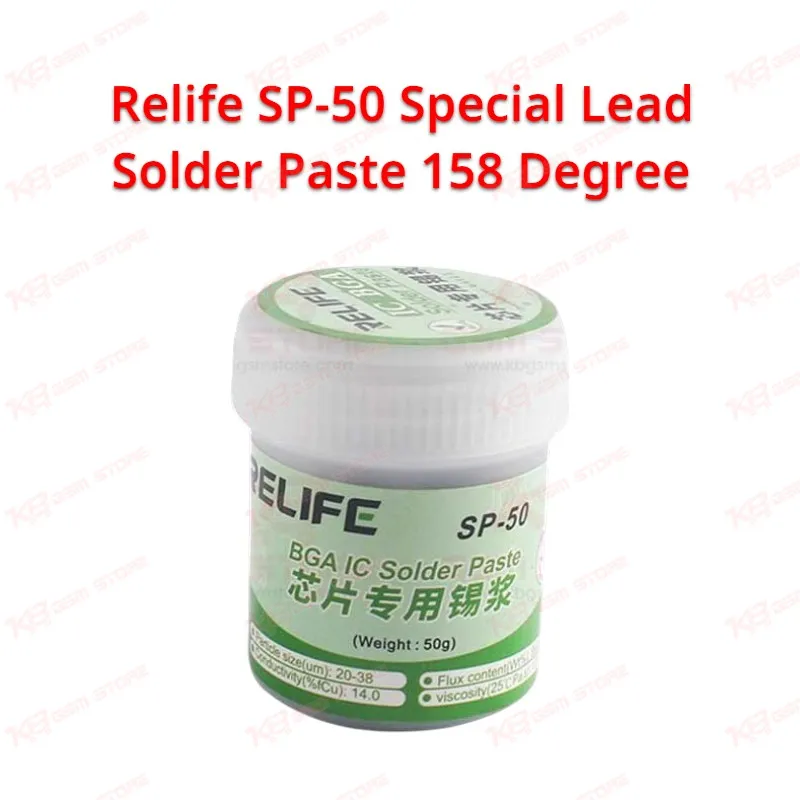
Relife SP-50 Special Lead Solder Paste 158 Degree
Relife SP-50 Special Lead Solder Paste 158 Degree
Regular price
Rs.1.00 PKR
Regular price
Sale price
Rs.1.00 PKR
Shipping calculated at checkout.
Quantity
Couldn't load pickup availability
Relife SP-50 is a specialized 158°C low-temperature solder paste built for BGA and CPU rework on mobile phone motherboards. With a fine 20–38μm particle size, it delivers smooth flow and consistent solder joints when reballing ICs or reflowing CPUs. The low melting point reduces heat stress on nearby components, making it a safer choice for dense PCB layouts. Technicians use it during IC change, CPU reball, and board-level rework where precision and clean results matter. Ideal for your repair bench when working on dead-after-flash boards, hang-on-logo boards, or any job needing controlled, low-temperature reflow.
SKU:MST-SOLDERING-ACCESSORIES-100
⚖️ Weight: 0.15 kg
- Safe & Secure Payment
- Fast Delivery
- WhatsApp Support


Description
FAQ
What is the product name?
The product name is Relife SP-50 Special Lead Solder Paste 158°C.
What is the brand of this product?
The brand of this product is Relife.
What is the model of this product?
The model of this product is SP-50.
What is this product used for?
This product is used for BGA IC reflow, CPU reballing, and general SMD soldering on mobile phone motherboards.
Which devices are compatible with this product?
This product is universal and works with BGA ICs, CPUs, and SMD components across mobile phone motherboards, not limited to a specific device or brand.
Who should use this product?
This product is suitable for mobile repair technicians, repair shops, service centers, and professional users.
What is the melting point of Relife SP-50 solder paste?
Relife SP-50 has a low melting point of 158°C, designed for reduced heat exposure during BGA and CPU rework.
Is Relife SP-50 suitable for CPU reballing on mobile motherboards?
Yes, its particle size and viscosity make it well-suited for CPU reballing and BGA IC rework on phone PCBs.