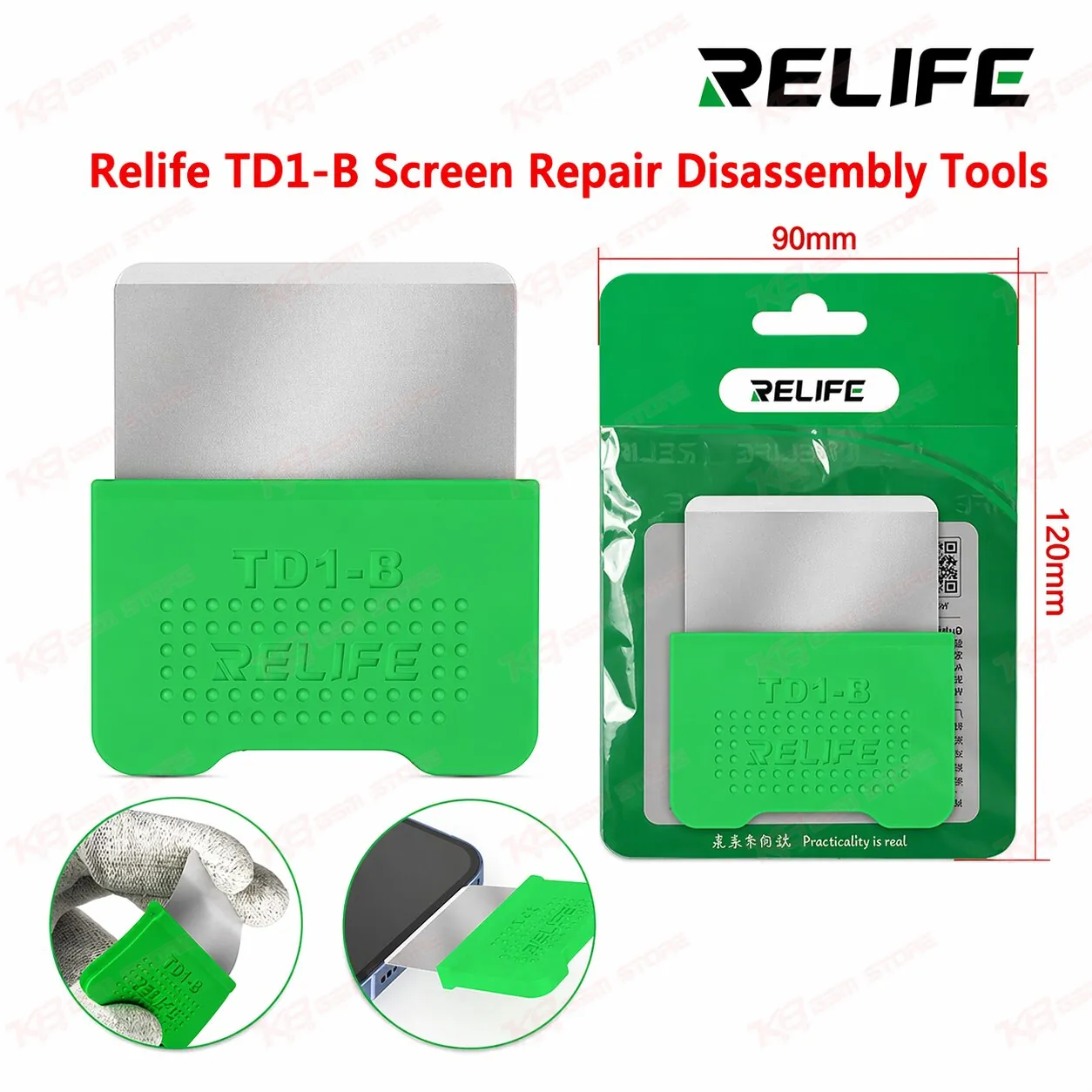
Opening a phone or tablet without leaving marks on the frame or cracking the display is one of the most repeated tasks on a repair bench, and the RELIFE TD1-B is built specifically to handle that job with less risk than a plain metal spudger. The blade is machined from selected high-quality steel that keeps its shape after repeated flexing, so it springs back straight instead of bending out of true the way cheaper pry tools do after a few teardowns. That high toughness rebound matters most when you're working through glass back covers, mid-frames, and glued display assemblies where the tool needs to flex into a gap and pop back into position without losing its edge geometry. The body carries a soft silicone wrap with a fine concave and convex texture, which keeps your grip locked in even when your hands are covered in flux residue or isopropyl alcohol, and it takes the pressure off your fingers during long sessions of separating adhesive-bonded screens. Every edge on the TD1-B is finished smooth and rounded rather than left sharp or burred, so you can work close to a display bezel or a plastic clip without gouging the housing or scratching the glass, which is exactly the kind of small detail that separates a clean teardown from a warranty-losing repair. Beyond straightforward prying, the tool is shaped to support multi-angle chip and CPU tinning, so the same blade that pops open a back cover can also be turned to scrape and prep pads before reflow work, cutting down on how many separate tools you need laid out during an IC change or board-level repair. This dual role is particularly useful on a busy bench where dead phone diagnostics, display swaps, and chip-level rework often happen back to back, and reaching for one dependable pick instead of switching between three loose blades keeps the workflow moving. The design follows RELIFE's standard multifunctional dismantling series, meaning the blade profile is angled to match common maintenance habits rather than sitting flat like a generic flathead tool, giving better leverage when you're working around camera modules, battery flex cables, or charging port assemblies. It's suitable across a wide range of phone and tablet disassembly work, from separating LCD screens and glass frames to lifting glued rear covers, and it holds up equally well whether it's used daily in a high-volume service center or kept as a backup pick in a technician's personal toolkit. Because it's a hand tool with no electronics or software dependency, there's no learning curve involved, it fits into any existing repair workflow, and it pairs naturally with heat guns, screen separator machines, and other opening tools already on a technician's bench. For shops handling FRP lock resets, pattern unlock jobs, or board-level dead-after-flash repairs, having a reliable disassembly pick on hand cuts down disassembly time significantly and reduces the chance of cracked frames that come from forcing a stiff or dull blade into a tight seam.