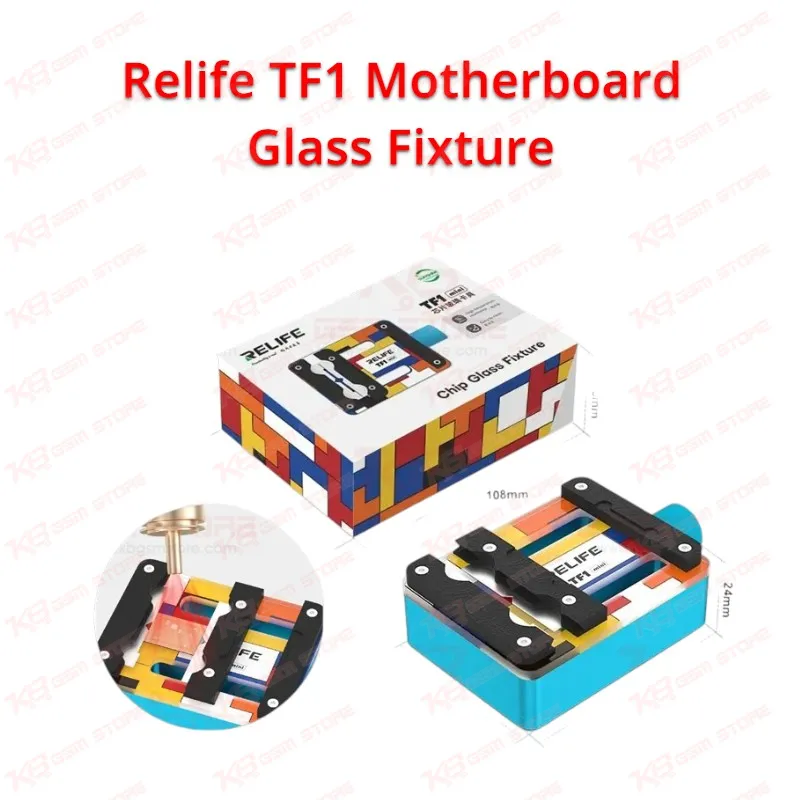
Every technician who has tried to hold a motherboard steady with one hand while running a hot air gun with the other knows how much a proper fixture changes your workflow. The RELIFE TF1 Mini solves exactly that problem. It clamps the board along its inward bevel edges and lifts it clear of the work surface, so heat from your soldering iron or hot air station stays concentrated on the chip you're working on instead of bleeding into the bench or the board's other components. This matters most during IC removal, BGA chip degumming, and reballing jobs, where uneven heat transfer can damage nearby components or leave residual adhesive that's hard to clean. The fixture's glass panel is made from high-strength tempered glass rated to withstand over 500°C without deforming, so you can run repeated high-heat cycles on it without losing shape or clarity, and cleanup stays simple since solder flux and adhesive residue don't bond to glass the way they do to plastic or painted metal — a quick wipe gets it back to a clean working state between jobs. Clamping flexibility is where the two-way sliding rail earns its place on the bench, since motherboards from different phone and tablet models vary in length and width, and the TF1 Mini's rail lets you adjust the clamp span to match the board in front of you rather than forcing you to own multiple fixtures for different device sizes, holding small mid-range Android boards or slightly larger tablet motherboards just as securely without slipping mid-job, which is the exact moment you don't want the board to move. For Pakistani repair shops handling dead phone diagnosis, IC change karna jobs, and board-level faults, this fixture sits at the diagnostic and repair stage rather than the flashing or software stage, since it's the tool you reach for before running your box or programmer, when the actual hardware fault — a cracked IC, a lifted pad, a component that needs reballing — has to be isolated and reworked physically, and holding the board rigid during this stage reduces the risk of new dry joints or hairline cracks forming from hand movement, a common cause of boards coming back with a fresh fault after a repair that should have fixed the original one. The build itself stays practical for shop use, compact enough to sit on a crowded workbench without taking up the space a full rework station would need, light enough to move between stations if more than one technician needs it during a shift, with no wiring, no power draw, and no calibration required — you place the board, adjust the rail, and start working. This fixture fits naturally alongside your existing ISP pinout tools, UFS adapters, and eMMC programmers as part of a complete hardware repair workflow: diagnose the fault, stabilize the board on the TF1 Mini, rework the affected IC or component, then move to flashing or programming once the hardware side is confirmed sound, making it a low-cost addition for any shop doing regular board-level repair that removes one of the most common points of failure in manual rework — an unstable board.