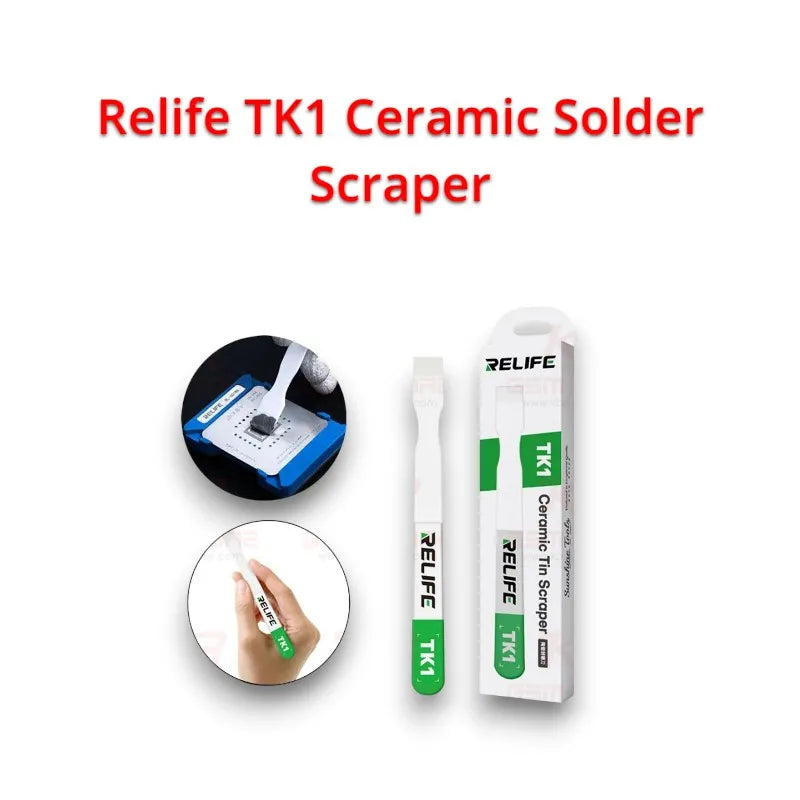
When you're working on a dead phone board or clearing solder bridges before an IC reflow, the last thing you want is a metal scraper that drags magnetic filings across your pads or builds up static near sensitive components — this is exactly the gap the Relife TK1 Ceramic Solder Scraper fills on a GSM technician's bench. Built entirely from high-grade ceramic forged at high temperature, the blade is thickened and hardened so it holds its edge through repeated scraping without chipping, oxidizing, or wearing down the way cheaper metal tools do after a few weeks of daily use. Because ceramic carries no magnetic properties, you can scrape solder off a board sitting right next to loose screws, springs, or small metal components without worrying about accidental attraction pulling parts out of place mid-repair — a real problem when you're juggling tiny screws on a cramped workshop table. The anti-static, anti-adsorption surface also matters more than it sounds: static discharge from a standard tool can quietly damage a sensitive IC or CPU without any visible sign, and you only find out when the board won't boot after reassembly, so working with a scraper that doesn't hold or transfer static keeps your rework process safer around delicate chipsets. In day-to-day use, the TK1 handles smooth, even scraping strokes that clear old solder, flux residue, and tin buildup from PCB pads and traces, which is exactly what you need before reballing a chip, prepping a pad for a new IC, or cleaning a board after a failed hardware fault repair. The soft gel-like handle with its rounded tail is shaped for extended sessions — when you're running through several boards back-to-back, an ergonomic grip cuts down on hand fatigue in a way a hard plastic handle can't match, and the compact, lightweight body means it sits easily in your tool roll alongside your hot air station accessories, tweezers, and soldering iron without taking up space. This scraper isn't tied to one phone brand or chipset, so whether you're on a Samsung, Oppo, Vivo, Infinix, Tecno, or an iPhone board with a boot loop issue, hang-on-logo fault, or charging issue traced back to a dirty solder joint, the TK1 works the same way because its job is the board surface, not the device model. In a typical repair workflow it sits alongside your ISP pinout tools, UFS adapters, and eMMC programmers as a basic-tier prep tool — you'll usually reach for it right after removing an IC with your hot air station and before running a multimeter check or reballing kit, since a clean pad gives you a reliable reading and a solid reflow. For shop owners stocking a bench for junior technicians, it's also one of the safer first tools to hand over, since there's no heating element, no calibration, and almost no learning curve compared to a soldering station or microscope. Pair it with a good reballing kit and PCB holder, and you've covered the full tin-removal-to-reflow cycle without switching between mismatched tools. Genuine Relife accessories like the TK1 are made to work reliably inside a full board-level repair setup, which is why most Pakistani repair shops running IC and PCB work keep more than one on the bench as a routine consumable rather than a specialty item.