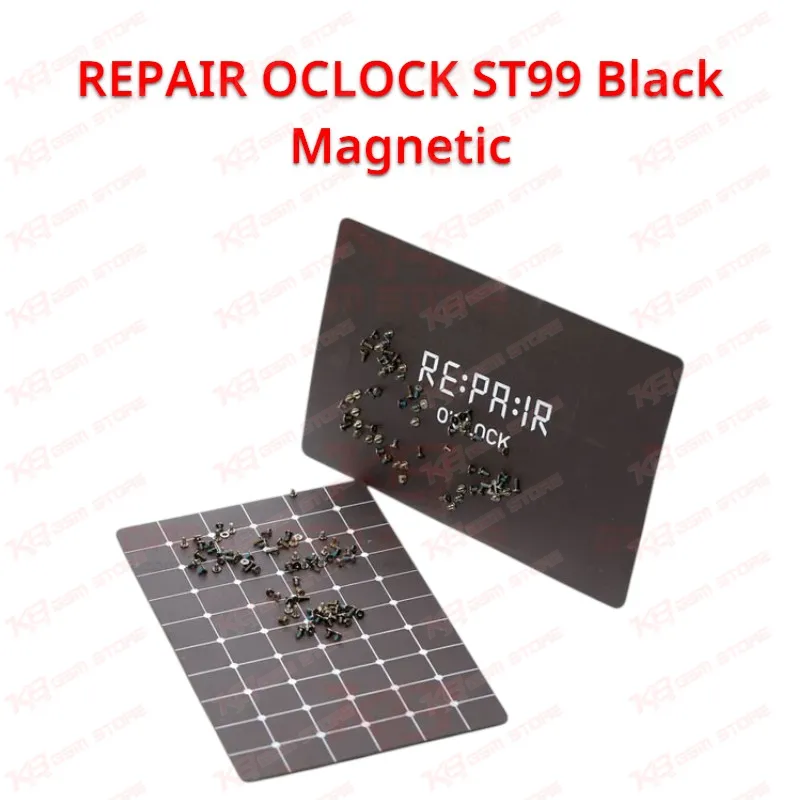
Every technician who has knocked over a screw tray mid-repair knows how much time a single missing screw can cost, and the 2UUL Repair Oclock ST99 exists to remove that risk from your repair bench. This black magnetic screw mat gives you a dedicated 155mm x 98mm workspace where screws stay put the moment you set them down, whether you are stripping a back cover, pulling a motherboard, or working through a full teardown on a dead phone. The magnetic surface holds ferrous screws and small metal parts securely against the pad, so a bumped table or an accidental sleeve brush does not send parts rolling across the workshop floor. That reliability matters most during multi-step jobs like display replacement, charging port repair, or battery swaps, where dozens of screws in different sizes need to stay separated and identifiable until reassembly. The printed grid lines on the mat give you a built-in reference system: you can lay screws out in rows that match the order you removed them, or group them by size and thread type, cutting down the guesswork that leads to stripped housings or leftover screws after a job. Because the surface is double-sided, you get two working areas from a single mat, useful when you want a clean layout for a fresh job without wiping down mid-repair. The balanced magnetism is a deliberate design choice rather than a byproduct — strong enough to keep screws locked in place during normal bench handling, but calibrated so a magnetic screwdriver or tweezers can still lift a screw cleanly when you need to reinstall it. This balance is what separates a proper repair mat from a basic magnetic sheet that either lets parts slide or grips them too hard to retrieve easily. The erasable surface is another practical detail for shops running high repair volume: after finishing a board or a device teardown, you wipe the mat down and it is ready for the next job, with no permanent marks or residue buildup that would make grid lines unreadable over time. At just 1.6mm thick, the mat sits flat on any bench surface without adding bulk, and its compact footprint means it fits inside a repair toolkit or drawer alongside screwdrivers, spudgers, and opening tools without taking up dedicated space. For technicians who work across mixed repair types — phones one day, laptops or tablets the next — the mat's universal design means it is not locked to a single brand or device category, so it stays useful across whatever teardown lands on the bench. This is especially relevant in a Pakistani repair shop or service center setting, where technicians often handle a wide mix of devices in a single shift and need tools that carry over between jobs rather than being replaced for each brand. During board-level work, the mat also earns its place as a staging area for screws pulled during IC change, connector reseating, or charging port replacement, keeping the workspace organized while a technician focuses on the more delicate parts of the repair. Shops that train new technicians also find value in a mat like this, since organized screw placement during teardown makes it far easier to walk a junior technician through correct reassembly order without relying on memory alone. Overall, the ST99 addresses a small but constant pain point in repair work — screw loss and disorganization — with a simple, durable, reusable tool that fits into daily bench operations rather than sitting unused after the first job.