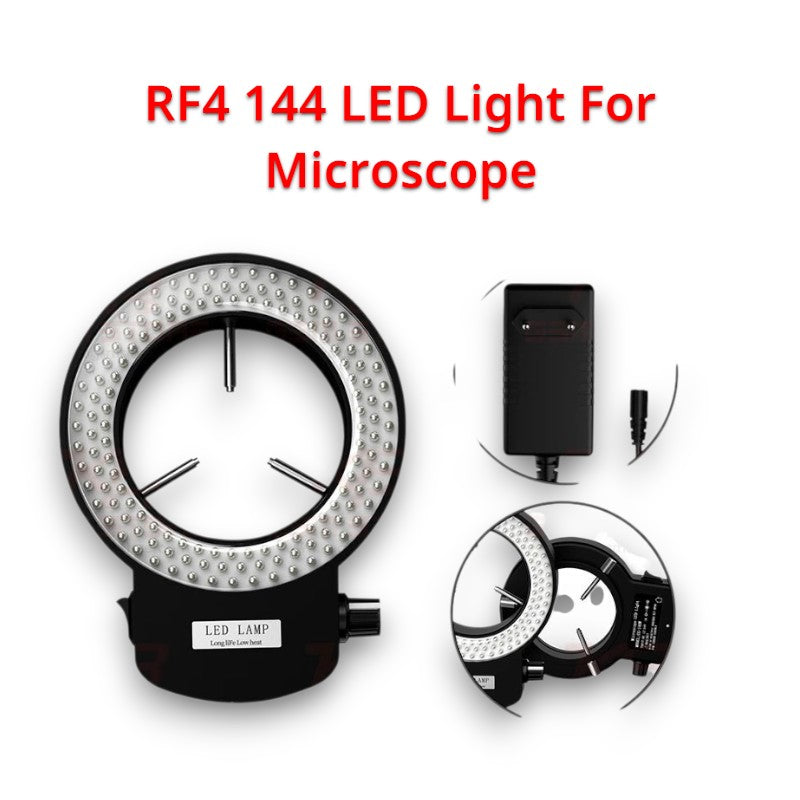
Board-level work depends on what you can actually see, and the RF4 144 LED Light For Microscope fixes the most common visibility problem on a Pakistani repair bench: dim, uneven, shadow-heavy lighting under the lens. When you trace a short on a dead phone, inspect the underfill edge around a CPU, or check whether a tiny capacitor sits flat after rework, weak stock lighting leaves dark pockets between tall components, and those pockets hide cracked solder joints, lifted pads, and corrosion trails. This ring light mounts directly around the objective of your binocular or trinocular stereo microscope and places 144 LEDs in a full circle above the board, so light reaches the PCB from every angle at once and the LEDs on one side fill the shadow that the other side creates. The ring has a 60mm inner diameter, the same size RF4 pairs with its own trinocular models such as the RF-7050 and RF-6565 series, and adjustable fixing screws let you centre and lock it on the objective housing so it never slides into your work area during a long job. Power comes through an external adapter that accepts AC 100-240V at 50/60Hz and delivers DC 12V at a maximum of 700mA, so the unit runs on standard Pakistani mains, and total output stays in the 4.5W to 6W range, which means you can leave it on through a full shop day without the heat that older halogen illuminators pushed onto the board and onto your hands. A brightness dial gives you control from 0 to 100 percent, and that control matters more than most technicians expect: reflective surfaces like shielding cans, gold-plated test points, and the glossy top of a UFS or eMMC chip throw glare straight into the eyepieces at full brightness, while a matte black PCB coating near a charging IC needs more light to reveal hairline track damage. You set the level once for the surface in front of you and keep working. The LEDs produce a cool white light in the 6000K to 7000K colour temperature range, which shows copper, solder, flux residue, and green or black solder mask close to their true colours, so you can tell oxidised solder from fresh solder and spot the brown tint of a burnt component before you even touch it with a multimeter probe. Pair it with a trinocular microscope and camera, and the even illumination gives your video output a cleaner, brighter image for recording repairs or showing a customer the exact fault on their board. In daily workflow terms, this light supports almost every stage of hardware repair: diagnostics, when you scan the board for water damage and visual faults on a phone with a charging issue, network issue, or hang on logo problem; removal, when you watch the solder melt under your hot air station while lifting a PMIC or audio IC; reballing, when you check stencil alignment and ball uniformity on a CPU or memory chip before placing it back; soldering, when you run a fine tip from your soldering station across a charging connector or add a jumper wire to a broken line; and final inspection, when you confirm no solder bridges remain before you power the phone on. It fits naturally into a complete bench setup alongside your microscope, PCB holders, reballing kits, and multimeters, and it gives technicians who already own a stereo microscope with weak built-in lighting a direct upgrade path without replacing the whole microscope. Repair shops and service centres in Lahore, Karachi, Islamabad, and every smaller market that handle a steady daily flow of Samsung, Oppo, Vivo, Infinix, Tecno, and iPhone boards gain the most here, because faster visual fault finding shortens every single job. Before you order, check the outer diameter of your microscope objective housing and confirm it fits inside the 60mm ring opening, so the light seats securely and centres over your working field.