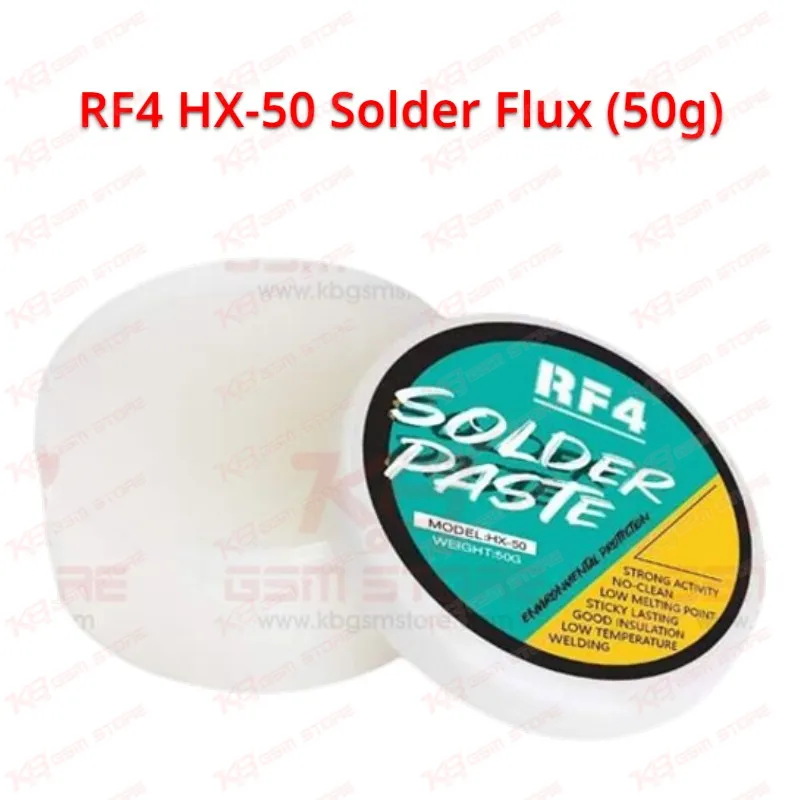
RF4 HX-50 solder flux paste gives mobile repair technicians a dependable no-clean formula for everyday PCB rework, and the 50g jar size fits comfortably on a busy repair bench without running out mid-job. The paste carries strong activity, which means it breaks down oxidation on pads and IC legs quickly, letting solder settle and bond without you needing to reheat the same joint multiple times. That matters most when you're handling a dead phone board where the pads have already oxidized from age or a previous failed repair attempt, since weak flux activity forces extra heat cycles that stress the PCB and surrounding components. HX-50 works at a low melting point, so it activates fast under the tip of a soldering iron or the airflow of a hot air station, and this lower thermal demand protects delicate parts like PMICs, audio ICs, and RF modules that sit close to the work area during IC change or reballing jobs. The paste stays sticky and holds its tack for an extended period, which gives you a real advantage when placing tiny SMD components, connectors, or BGA chips under magnification, since the part won't drift before reflow locks it in place. This tack strength also helps during jumper wire work, where a wire needs to sit exactly on a pad while you solder it, and any movement means a redo. Once the joint cools, HX-50 leaves a residue that stays non-corrosive to both the IC and the PCB, so you're not risking long-term board damage or shorted traces from leftover flux acid. The residue also delivers good insulation, reducing the chance of unwanted continuity between closely spaced pads, which is a common cause of hardware fault symptoms appearing weeks after a repair. Because it's a no-clean formula, you save time on post-soldering cleanup, though a light wipe with isopropyl alcohol still improves the board's cosmetic finish for a professional handover. HX-50 works across common repair scenarios: IC removal and reinstallation, BGA reballing, charging port repair, screen connector resoldering, and board-level cleaning before diagnostics. Its stable performance and low volatility mean the paste doesn't dry out or thicken quickly once opened, so a single jar lasts through many jobs rather than hardening after a few uses like lower-grade fluxes often do. The formula produces no irritating smell during application, which technicians appreciate in small workshop spaces without strong ventilation, and it's compatible with both leaded and lead-free solder, so it fits into whatever soldering material your bench already uses. For technicians dealing with boot loop issues traced back to a failed IC, or a board that shows dead after flash symptoms from a cracked solder joint, having a reliable flux like HX-50 in the workflow reduces the guesswork around whether a reflow will actually take. The paste's smooth welding surface result also matters for quality control, since a clean, shiny joint is often the first visual sign that a repair was done correctly, while a dull or grainy joint signals a flux or heat problem. RF4 has built a reputation in the mobile repair tools segment for consistent paste behavior across batches, which technicians rely on when repeat results matter for shop reputation. Whether you're running a solo repair bench or training junior technicians at a service center, HX-50 offers a predictable, low-maintenance flux option that fits into ISP, eMMC, UFS, and general motherboard repair workflows without requiring a change in soldering technique.