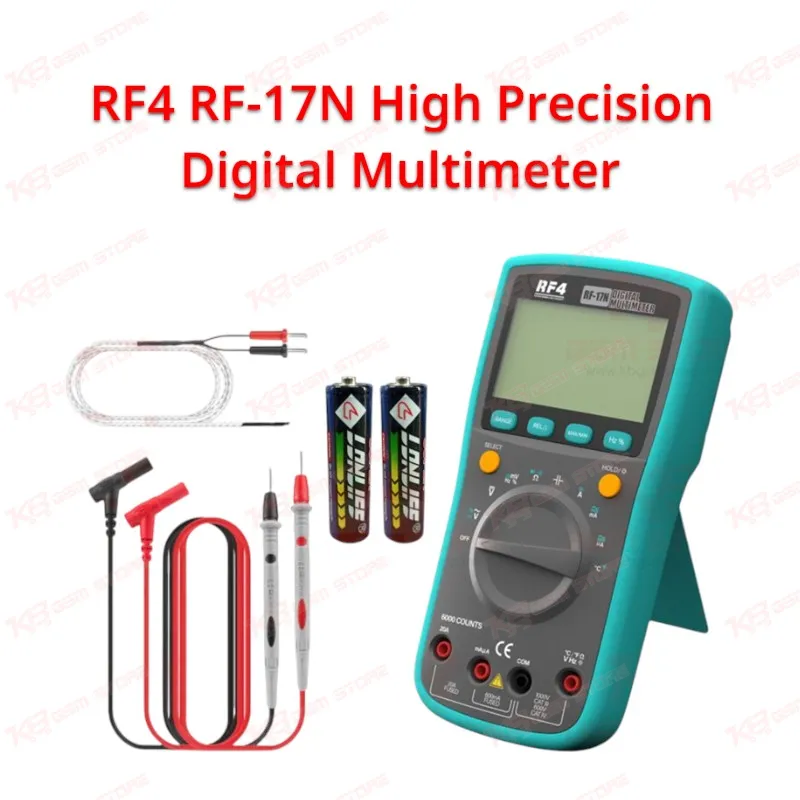
Every GSM technician reaches a point in board-level repair where guessing stops working and measuring starts. The RF4 RF-17N handles that moment. It's an auto-ranging digital multimeter built around a 6000-count display and true-RMS measurement, giving you accurate readings whether you're checking a battery connector's DC voltage or hunting for a short on a power rail after a board goes dead. The double-integral style A/D transform is what separates this meter from cheaper units you find on repair benches. It filters out noise and settles faster, so when you're probing a suspected shorted IC or tracing a charging issue, you're not second-guessing a flickering number. Automatic polarity identification means you don't waste time flipping probes when you're not sure which lead touches positive — the meter figures it out and shows you correctly. For a Pakistani repair shop, the practical value shows up in daily diagnostics. When a phone comes in dead after flash, the first move is almost always continuity and voltage checks before touching a soldering iron. The RF-17N covers AC/DC voltage and AC/DC current, resistance, capacitance, diode testing, and continuity — every mode you need to confirm whether a fault sits on the power IC, a blown fuse, or a broken trace. The continuity beep alone saves time when you're chasing a hairline crack under a microscope; you don't have to look at the screen, just listen while you probe.Temperature measurement from 20°C to 1000°C adds a function most basic meters skip. With a K-type thermocouple probe, this range covers reflow checks and hot air station calibration, useful when you're setting temperature profiles for BGA reballing or confirming your hot air gun isn't running hotter than the display claims. Frequency measurement rounds out the mode list, handy when you're testing oscillator output on a board or verifying a signal is actually present before you condemn a component. The 6000-count auto-range display means you rarely touch a range dial mid-diagnosis. Point the probes, read the number, move to the next test point. That speed matters when you're working through a stack of boards in a busy workshop, not just running one repair at a time. Over-range indication (OL) tells you immediately when a reading exceeds the meter's range instead of showing a false low number, which matters when you're checking for shorts and need to trust what the screen tells you. Low voltage indication warns you when the internal battery is running down, so you're not caught mid-diagnosis with an inaccurate reading from a weak power source — a real problem on cheaper meters that don't flag this at all. Auto power-off extends battery life between sessions, since most technicians forget to switch a meter off between jobs. The backlit LCD is worth mentioning specifically because workshop lighting isn't always great, and squinting at a dim display while you're holding two probes steady on a tiny IC pad is not where you want to be. The backlight makes late-shift diagnostics and dim corner workbenches manageable without extra desk lighting. Build quality on the RF-17N keeps it lightweight and portable enough to carry between a repair counter and a field service call, without feeling flimsy in daily use. The sample rate of roughly 3 readings per second keeps the display responsive enough for real-time probing rather than lagging behind your hand movements. This isn't a specialty tool limited to one repair category — it's the meter you reach for constantly, whether you're confirming a charging port's voltage output, checking resistance across a coil, verifying a diode's forward drop, or testing capacitance on a suspect capacitor before ordering a replacement. For anyone running a GSM repair bench, board-level diagnostic work, or a training setup teaching new technicians the fundamentals of fault-finding, the RF-17N earns its place as a daily-use instrument rather than a backup tool.