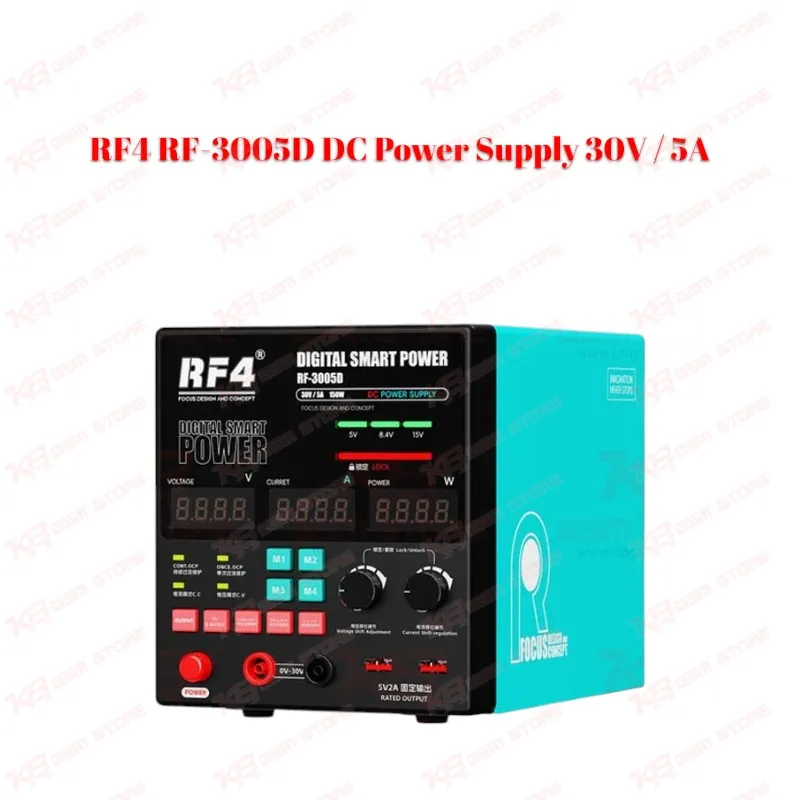
Every board-level diagnosis starts with one question: how much current does the board pull when you give it power, and the RF4 RF-3005D DC Power Supply 30V / 5A exists to answer that question with numbers you can trust. Instead of connecting a battery and guessing, you feed the motherboard a controlled voltage through a DC power cable and let the ammeter tell the story. A dead phone that draws zero current points you toward the power button line, the battery connector, or a missing supply to the PMIC. A board that jumps straight to a high current and stays there points toward a shorted capacitor or a failed IC on the main battery rail. A current reading that climbs, stops, and falls back in a loop reveals a boot loop issue or a phone that hangs on logo because of a storage or baseband fault. Reading these patterns fast is the core skill of hardware troubleshooting, and this unit gives you a clean display and fine resolution to read them properly. The RF-3005D delivers 0 to 30V output and 0 to 5A current with a total rating of 150W, and it runs on 110V or 220V AC input, which suits Pakistani workshops running on 220V mains. Both voltage and current adjust continuously across the full range, so you work in constant voltage (CV) mode for normal board powering and switch to constant current (CC) mode when you need the supply to hold a fixed current. Voltage resolution sits at 10mV and current resolution reaches 1mA, and the automatic A/mA range switching matters more than it sounds: when a board draws only a few milliamps of standby or leakage current, the display drops into the mA range on its own, so you catch a 20mA leakage that a coarse ampere readout would hide. That detail decides whether you find a slow battery-drain fault or miss it completely. Control happens through two encoder knobs. You twist the V knob to set voltage and the A knob to set current, and when you press either knob, a level indicator flashes so you can jump to the digit you want to change and reach the exact value quickly instead of spinning through the whole range. A lock function lets you long-press the V knob to freeze every control except the power switch, which stops an accidental bump from sending 12V into a phone board that expects around 4V. For repeat jobs, the storage keys hold voltage, current, and protection mode together, and a short press recalls the stored profile, so switching between an Android board setting, an iPhone board setting, and a laptop board setting takes one press. A dedicated fixed-voltage button cycles between 5V, 8.4V, and 15V, three values technicians use daily for USB-level testing, two-cell battery circuits, and higher-voltage board sections. Protection separates a bench power supply built for repair from a basic lab unit, and the RF-3005D carries overcurrent, overvoltage, and overtemperature protection. The overcurrent system runs in two modes that suit two different repair situations. Continuous overcurrent protection cuts output when current crosses your limit and restores power automatically once the fault clears, which fits routine board powering where you just want a safety ceiling. Single overcurrent protection cuts output once, holds it off, and displays the overcurrent value until you press the button again, and this mode protects fragile circuits that cannot survive repeated current surges, such as a board where you just fitted a PMIC or charging IC reballed with your reballing kit and want to confirm the fix without risking the new chip. When you hunt a short on a main rail, you set a safe voltage for that rail, limit the current manually, and inject power while you check the board with freeze spray, rosin smoke, or a thermal camera for the component that heats up, then remove the culprit with your soldering station or hot air station. A fixed 5V 2A USB port on the front panel adds everyday convenience: you charge a customer phone, power a small LED light, or run any 5V USB device without occupying the main output. The cooling fan stays quiet under light load and starts automatically when internal temperature reaches its set point, which keeps noise down during long diagnosis sessions and protects the unit when you push current for extended periods. Conversion efficiency sits around 88 percent, so the supply wastes little energy as heat on a crowded bench. This unit belongs first in your diagnostic chain, before you touch a programmer or a flash box. You power the board, read current, and decide whether you face a hardware fault or a software problem. If the board draws normal boot current but still shows no picture, you move toward display problem checks on the backlight and display connector lines. If it stops at a fixed current step, you suspect eMMC or UFS storage and move to your eMMC programmer, UFS adapter, test box, or ISP pinout tools to read the chip before choosing a software solution. If current jumps to a dead short, you reach for your multimeter, microscope, and PCB holder to trace the rail. This sequence saves hours, because you stop flashing boards that carry a hardware fault and stop replacing ICs on boards that only need a firmware fix. For shops handling charging issue complaints, the RF-3005D also helps you test charging sections by feeding a controlled input and watching current draw, and its 30V ceiling covers laptop motherboards in the 19V to 20V range within the 5A limit. Mobile service centers that train new technicians gain a practical teaching tool, because students learn current-draw patterns on a readable display with protection that forgives beginner mistakes. Pair the supply with a DC boot cable matched to the phone model, a PCB holder to keep the board steady, and a stereo microscope to inspect components, and your bench covers the full diagnosis stage from first power-on to fault location. If you run a repair shop in Lahore, Karachi, Islamabad, or any city where dead phone and board repair jobs make up a large share of your income, a dependable adjustable supply with fine current resolution and layered protection pays for itself quickly through faster, safer diagnosis. Order the RF4 RF-3005D DC Power Supply 30V / 5A from KB GSM Store and give your repair bench an accurate, protected power source for everyday board-level work.