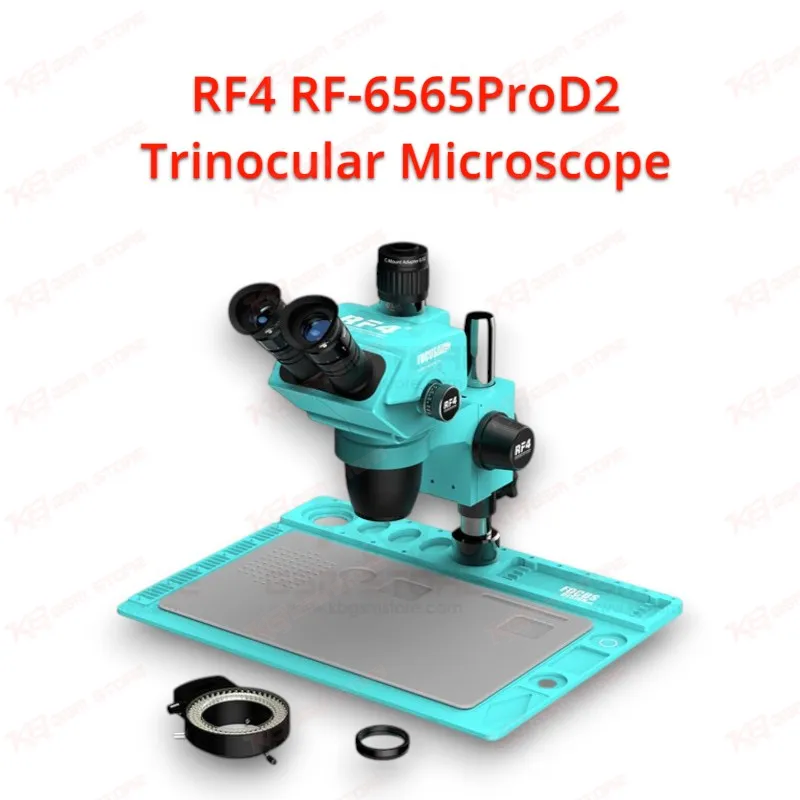
Board-level repair depends on what you can actually see, and the RF4 RF-6565ProD2 Trinocular Microscope With Aluminum Alloy Base gives your repair bench a sharp, stable view of the smallest parts on a modern smartphone motherboard. RF4 builds this stereo zoom microscope around a continuous 6.5X to 65X magnification range, which a 0.65X–6.5X zoom objective delivers together with WF10X/23mm wide-angle eyepieces, so you can move from a full view of the logic board down to a single tiny capacitor without swapping lenses or losing your working position. That range matters in real workshop conditions. At the low end you scan a dead phone board for burnt components, lifted pads, liquid damage corrosion, or a shorted rail near the charging IC. At the high end you inspect solder joints around a PMIC, check the edge alignment of a BGA chip after reballing, and confirm that no solder bridge sits between the pins of an audio IC before you apply power again. The D2 revision focuses on the changes technicians notice every day. The magnification knob now uses a 9-gear locking precision zoom, so you pick a step, lock it, and the optics stay exactly where you set them while your hands work with tweezers, a soldering iron, and hot air. A free-spinning zoom knob can shift the moment your wrist brushes against it during an IC change. The locking gear design removes that risk and gives you repeatable magnification steps you can return to on every job. RF4 makes the zoom knob from metal, so it handles the constant turning that a busy service center puts it through. RF4 also redesigned dust control inside the D2 body. Dust that reaches internal lens surfaces shows up as dark spots and haze across your field of view. In Pakistani repair markets, where street dust, flux smoke, and open shop fronts are part of the daily environment, that problem appears quickly on poorly sealed microscopes. The internal dust prevention structure keeps the optical path cleaner for longer, which means less time chasing blurry images and more time finishing repairs. The optical system uses a multi-layer lens structure for clearer imaging, and the 23mm eyepiece field gives you a wider view of the board around your target component. That extra field helps when you trace a line from the charging port toward the charging IC while you diagnose a charging issue. It also helps when you follow the antenna path to track a network issue back to an RF component, or when you inspect a damaged display connector behind a recurring display problem. The binocular head sits at a 45-degree inclination and rotates through 360 degrees. The eyepieces offer adjustment, and the interpupillary distance covers 54mm to 76mm, so every technician on a shared bench can set the head to fit their own eyes and posture. Long hours at a microscope with poor ergonomics quickly lead to neck and eye strain, and this adjustability keeps you comfortable through a full day of board work. The third optical port turns this unit into a true trinocular microscope. RF4 includes a newly upgraded 0.5X C-mount (CTV) adapter matched to the 6.5X–65X zoom body, and the camera path zooms in sync with the eyepieces. If you mount a compatible C-mount microscope camera, you can display the live board on an external monitor. You can also record a repair for a customer who wants proof of the work, capture before-and-after images of a liquid damage board, build training material for students at a repair institute, or produce short videos for your shop's social media pages. The monitor view and eyepiece view zoom together, so you can switch between the eyepieces and the screen without re-adjusting magnification. That makes teaching and teamwork inside a service center far smoother. The stand forms the other half of this product. The aluminum alloy base gives the microscope a heavy, rigid platform that resists vibration, so your image stays steady during micro-soldering or when you run a fine jumper wire across a broken trace. The multi-function base measures 410 × 300 mm, which gives you room to organize screws, small parts, and hand tools directly under the optics. RF4 fits a silicone pad on the base so boards and components rest on a non-slip surface. The focusing bracket offers a 50mm lifting range, and you can set the handwheel tension so the head holds its height without drifting. In a typical repair workflow, this microscope sits at the center of every hardware fault job. You start with a low-magnification visual inspection and check suspected short circuits with a multimeter. You then locate the heating component and zoom in to remove and replace the faulty IC with your hot air station and soldering station. When a job involves CPU or eMMC work, you use the microscope to clean the pads, apply fresh solder balls with a reballing kit and stencil, align the chip correctly, and verify every joint before reassembly. Software technicians gain just as much. A phone may arrive dead after flash, stuck in a boot loop issue, or hanging on the logo, and the fix may need a direct storage connection. In that case you need a precise view of tiny test points to attach ISP pinout tools and read or write the chip with your eMMC programmers and UFS adapters. A steady mid-range view makes those fine wire connections far more reliable and prevents the pad damage that turns a software job into a hardware repair. Pair the microscope with a sturdy PCB holder to lock the board flat, and keep a test box and power supply within reach. Set up this way, the unit becomes the anchor of a complete board-level repair station. If you currently rely on a magnifier lamp or a basic USB camera, the RF4 RF-6565ProD2 is the natural upgrade to true stereo optics with real depth perception, which a flat screen image cannot give you. Stereo vision lets you judge the height of a solder ball, the gap under a lifted IC corner, and the position of your iron tip relative to nearby capacitors and shield frames. That cuts down on accidental damage to surrounding components. For shops that handle Samsung, iPhone, Oppo, Vivo, Infinix, Tecno, and Xiaomi boards every day, that depth control means fewer returned jobs and faster turnaround. Order it from KB GSM Store and equip your bench in Lahore, Karachi, Islamabad, or anywhere across Pakistan with a microscope suited to the daily pace of professional mobile repair.