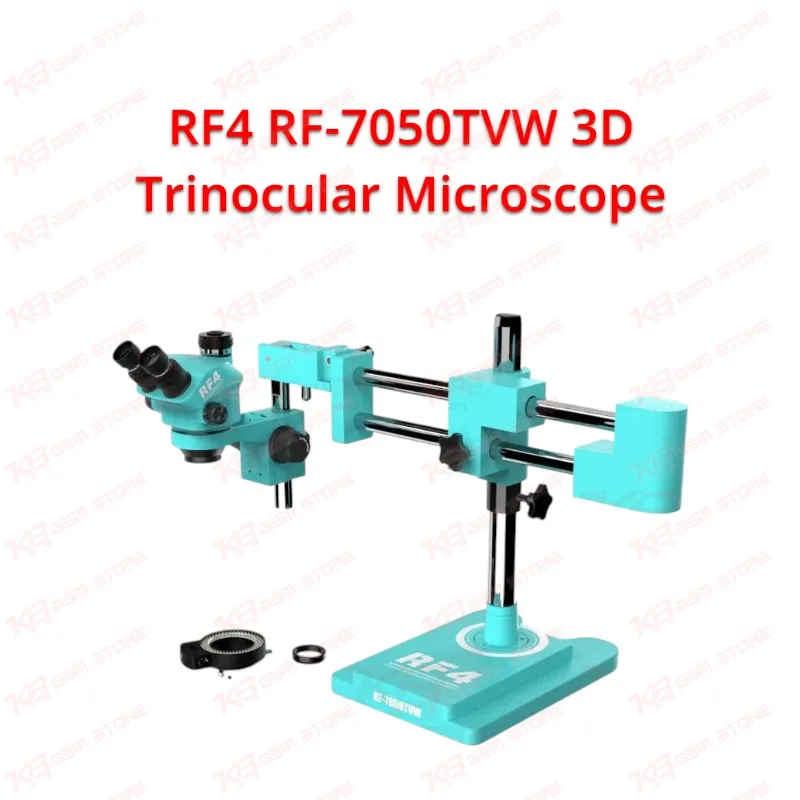
Board-level repair lives or dies on what you can see, and the RF4 RF-7050TVW 3D Trinocular Microscope gives your repair bench the stereo depth and optical range that modern phone motherboards demand. Current Samsung, Oppo, Vivo, Infinix, Tecno, and iPhone boards pack tiny passive components, stacked sandwich layers, and fine-pitch BGA chips that the naked eye or a basic magnifier cannot resolve, so a proper stereo zoom microscope stops being a luxury the day you start taking on dead phone and no-power jobs. RF4 builds this unit around a 7X to 50X continuous zoom range, which means you turn one knob and move smoothly from a wide overview of a whole board section down to a close look at a single cracked solder joint, without swapping lenses or losing your place on the PCB. At 7X you scan for burnt components, corrosion trails from water damage, and lifted shields; toward the top of the range you inspect individual BGA balls along the edge of a CPU, check whether a PMIC pad lifted during removal, or confirm that a small filter capacitor on the charging line sits flat after resoldering. The 3D in the name refers to true stereo vision: two separate optical paths feed your left and right eyes, so your brain reads height and depth the same way it does in normal sight. That depth perception matters more than most buyers expect, because it tells you whether your tweezer tip hovers above a component or already touches it, whether solder wicked onto a pad or just sits beside it, and how high a jumper wire arcs over neighbouring parts. A flat single-camera USB microscope cannot give you that, and the difference becomes obvious on your first serious micro-soldering job. The head uses a trinocular design, and this is where the RF-7050TVW separates itself from a standard binocular model. Two eyepiece tubes handle your direct viewing while a third vertical port accepts a camera through a 1/2 CTV connector, and the zoom stays synchronised between the eyepieces and the monitor feed, so what you see through the optics matches what appears on screen. The camera is an optional choice, so you pick the HDMI or USB industrial camera that fits your budget and add it now or later. That third port turns the microscope into a documentation and teaching tool: you show a customer the exact corroded trace that killed their phone, record a reballing job for training or social media content, or let a junior technician follow your hands on a monitor while you work. For a Pakistani repair shop, that on-screen view gives customers visible proof of a board fault before you quote a repair charge. The eyepieces are WF10X/22mm widefield units with a high eyepoint, which lets technicians who wear glasses keep them on and still see the full field, and the head sits at a 45-degree incline and swivels a full 360 degrees, so you rotate the view toward whichever side of the bench you work from without moving the whole stand. Behind the eyepieces, the 0.7X to 5.0X zoom objective delivers the magnification range, and a working distance of around 100mm leaves genuine room between the lens and the board. That clearance decides how comfortably you work: you need space for a hot air nozzle, a soldering iron tip, tweezers, and a flux syringe at the same time, and a microscope with a cramped working distance forces awkward hand angles that end in knocked-off components. The stand deserves its own mention, because the RF-7050TVW uses a double-arm boom configuration rather than a simple fixed pillar. The boom arm measures 51cm with an overall reach of 76cm, the pillar stands 41cm tall, and a solid cast steel base of 200 × 245mm anchors the whole assembly. The double-arm design lets you move the head across three axes, side to side, forward and back, and up and down, so you swing the optics over a large PCB holder, park it above a separation machine, or push it aside when you need the full bench for a screen replacement. Because the base sits off to one side instead of directly under the lens, your working area stays clear for a heat-resistant mat, board fixture, and tools. Lighting comes from a 144-LED ring light that fits around the objective with a 60mm inner diameter. It runs on AC 100–240V input with a 12V DC output, draws roughly 4.5 to 6 watts, and delivers 30,000 to 35,000 lux at a colour temperature of 6000–7000K. That cool-white, shadow-free illumination makes flux residue, hairline trace cracks, and short-circuit burn marks stand out clearly, and the adjustable brightness lets you drop the intensity when a shiny shield or glossy chip surface throws glare back into the eyepieces. The wide input range suits workshops that run equipment on mains, UPS, or inverter power. In the real repair workflow, this microscope sits at the centre of almost every hardware job you take on. On a dead phone, you inspect the main power line for shorted capacitors before injecting voltage, then zoom in to locate the component that heats up. On charging issue cases, you check the charging IC, the connector pins, and the small filter parts around the USB port for corrosion. For network issue and no-service faults, you examine the RF section and antenna switch area. When a phone shows hang on logo or boot loop issue behaviour after a previous repair attempt, you trace for missing components or bridged pins near the eMMC or UFS chip before you move to your eMMC programmer, UFS adapter, or ISP pinout tools for software-level recovery. Display problem jobs often come down to a damaged FPC connector or a blown backlight filter, and both need clear magnification to diagnose with confidence. The microscope also forms the viewing core of a complete rework station. Pair it with a quality hot air station and a temperature-controlled soldering station for IC removal and replacement, add a reballing kit with stencils for BGA work, and mount the board in a stable PCB holder so it stays fixed under the lens. A digital multimeter and DC power supply complete your diagnosis setup, while test boxes and programmers handle the software side once you confirm the hardware is sound. Technicians who start with a basic magnifier or a USB digital microscope typically move to a trinocular stereo model once CPU reballing, PMIC replacement, and jumper wire jobs become regular work, and the RF-7050TVW makes a sensible step because it accepts a camera later without replacing the optics. For training institutes and service centres, stereo optics plus a camera port mean one instructor demonstrates board-level repair to a whole class through a monitor, while students still practise at their own benches through the eyepieces. For a solo shop owner, it means faster diagnosis, fewer damaged boards, less eye strain across a long working day, and the ability to take on higher-value micro-soldering work. If your current setup leaves you guessing about pad damage or solder bridges, this RF4 trinocular microscope gives you the clarity, depth, and working room to replace guesswork with confident, verifiable repair.