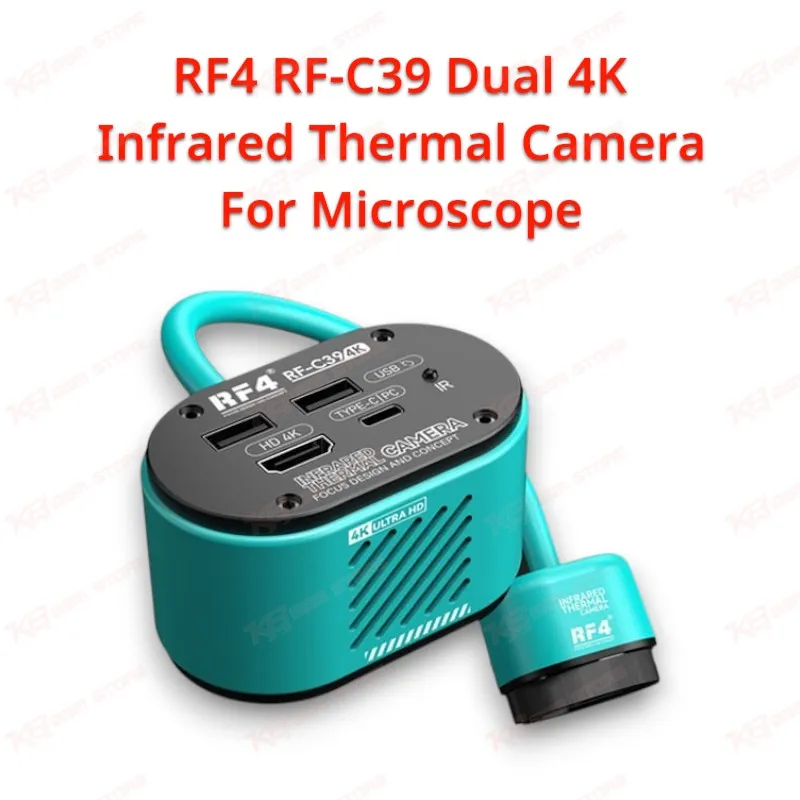
Every board-level technician knows the moment: a dead phone lands on the bench, the power supply needle jumps the instant you connect the battery line, and somewhere among hundreds of tiny capacitors one part has failed short. The RF4 RF-C39 Dual 4K Infrared Thermal Camera For Microscope turns that search from guesswork into a visual process, because it combines a 4K visible-light camera and an infrared thermal imager in a single unit that mounts on your trinocular stereo microscope. Instead of spraying freeze spray across the board, touching components with your fingertip, or lifting parts one by one with hot air, you inject a controlled voltage, watch the thermal view, and let the heat spot show you exactly where the current flows. The visible channel runs on a 1/2.8-inch Sony CMOS sensor with 8.29 megapixels and a 1.45μm pixel size, and it outputs 3840×2160 at 30 frames per second or 1080P at 60 frames per second over HDMI, so your monitor shows fine solder joints, lifted pads, cracked BGA edges, and corroded micro components with genuine clarity. A dedicated image processing DSP with 3D noise reduction keeps colors natural rather than washed out, which matters when you judge flux residue, water damage, or oxidation under the microscope ring light. The camera attaches through a standard CS lens interface, so it fits the trinocular port setups that most Pakistani repair benches already run, and you keep your existing microscope station instead of rebuilding it. The biggest workflow advantage comes from the dual-spectrum design. On a typical short-circuit job you switch to the thermal view, feed low voltage into the shorted line from your DC power supply, and the failed capacitor, damaged PMIC, or leaking charging IC glows against the cooler board around it. Then you switch back to the 4K visible view to see the exact part, its neighbors, and the pads beneath it before you pick up your hot air station or soldering iron. Your eyes stay on one monitor and one field of view, so you avoid the classic mistake of lifting the wrong capacitor on a crowded Qualcomm or MediaTek board. Picture-in-picture comparison supports a quarter-screen PIP along with left-right and top-bottom split views, and full-screen freeze lets you hold an image while you compare it against a known-good board or a boardview diagram. For charging issue, hang on logo, boot loop issue, and network issue complaints that trace back to a leaking power rail, this comparison approach saves real bench time. The RF-C39 runs standalone, which suits a busy workshop counter. You do not need a computer or a phone to operate it: connect a monitor over HDMI, plug a mouse into one of the two USB 2.0 ports and a USB flash drive into the other, and you control the full menu, record video, and save JPG photos directly. When you prefer a PC setup, the USB output delivers 3840×2160 at 30 frames per second with no driver installation, so you can capture footage into your own recording software for training videos or customer proof. Many shop owners in Lahore, Karachi, and Islamabad like to show customers the thermal footage of the faulty part before quoting a price, and saved photos build trust when you explain why a board needs an IC replacement rather than a simple software fix. Exposure and white balance both offer manual and automatic modes, with one-click exposure and one-click white balance for fast setup, adjustable brightness, and separate red, green, and blue channel control when your LED light shifts the color tone. The overlay tools help with alignment work: you get a center crosshair you can show or hide plus up to eight reference lines with adjustable color, thickness, and position, which helps when you center a CPU for reballing, align a stencil, or mark a point on the board before jumper work. Horizontal and vertical image flip lets you match the monitor orientation to the way your microscope sits on the bench, and the camera keeps your parameter settings after shutdown, so you do not reconfigure it every morning. The menu supports English, Simplified Chinese, Traditional Chinese, and Spanish, with English as the default language. Power comes through a Type-C DC 5V 2A input, which keeps cabling simple on a crowded bench where your power supply, hot air station, and soldering station already compete for sockets. The body measures 86×53×55mm and weighs just 0.322kg, a comfortable load for a standard trinocular port. One practical note before you buy: the RF-C39 comes without the fixed trestle bracket that ships with the RF-C39L variant, and you cannot buy that bracket separately because it carries its own dedicated data cable, so the RF-C39 suits technicians who want the camera on their existing trinocular microscope rather than on a separate stand. Inside a complete repair workflow, this camera sits at the diagnostics stage, right after your multimeter and DC power supply readings confirm a short or abnormal current draw, and right before rework with your hot air station, soldering station, and PCB holder. It pairs naturally with microscopes, test boxes, reballing kits for CPU and eMMC work, and precision tweezers for removing the faulty part you just located. Technicians who already run ISP pinout tools, eMMC programmers, or UFS adapters for software and data jobs gain a hardware-side diagnostic partner, because many dead after flash complaints and phones that refuse to boot actually hide a shorted rail that no box can fix until you clear the hardware fault. For shops that still rely on freeze spray or rosin smoke to find shorts, this camera marks the clear upgrade path: faster fault localization, less collateral heat on neighboring components, and a recorded image you can share with the customer. Thermal detection responds to heat rather than brand, so it works on motherboards from Samsung, Oppo, Vivo, Infinix, Tecno, Xiaomi, and iPhone alike, and it extends to tablet boards, laptop motherboards, and general electronic PCBs. KB GSM Store supplies genuine RF4 tools to Pakistani technicians who want dependable microscope accessories, and the RF-C39 slots straight into the professional repair bench you already built.