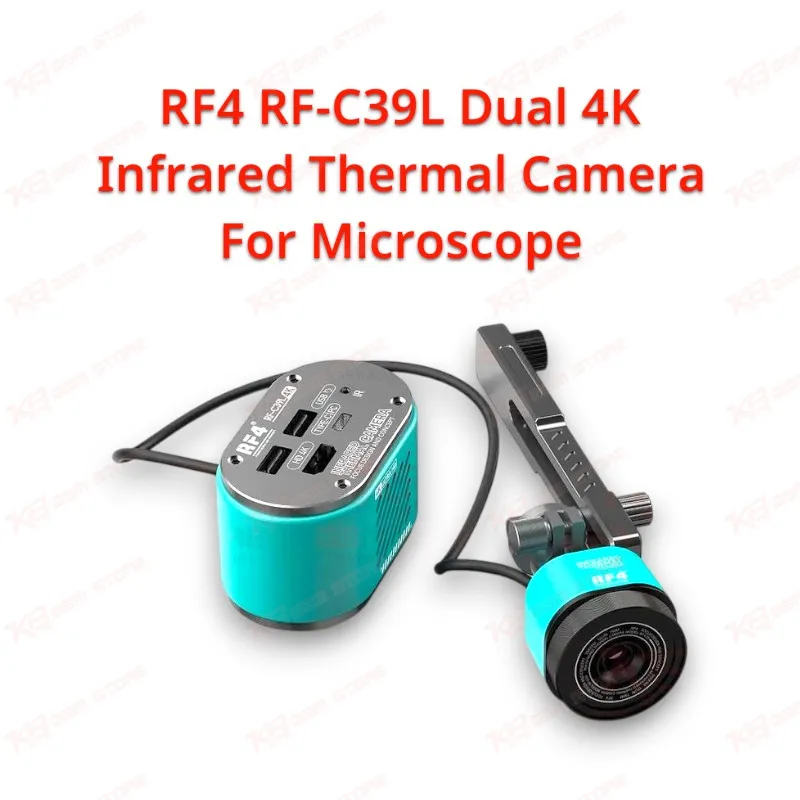
Every board-level technician knows the moment: a dead phone lands on the bench, the multimeter shows a short on the main rail, and dozens of tiny capacitors sit between you and the fault. The RF4 RF-C39L Dual 4K Infrared Thermal Camera For Microscope turns that search into a visual job by combining a 4K visible-light camera and an infrared thermal imager in one compact body that mounts on your trinocular stereo microscope. Instead of lifting components one by one or burning time on guesswork, you inject a controlled voltage from a DC power supply, watch the board through the camera, and let the heat signature point straight at the shorted part. Thermal imaging works because a faulty component draws current and heats faster than its neighbours, and the RF-C39L shows that temperature distribution across the board surface so you can separate a failed capacitor, a leaking PMIC, or a damaged charging IC from healthy parts in seconds. The visible channel runs on an 8.29-megapixel SONY CMOS image sensor in a 1/2.8-inch format with a 1.45 µm pixel size, and a dedicated image processing DSP with 3D noise reduction keeps colours accurate and fine detail sharp, which matters when you inspect solder joints along a BGA edge, lifted pads after a hot air job, or corrosion around a charging port connector. Through the HDMI port the camera outputs 3840×2160 at 30 frames per second or 1080P at 60 frames per second, so you choose between maximum detail for inspection and a smoother live feed while you solder under the lens. The USB 2.0 output delivers the same 3840×2160 at 30 frames stream to a computer without any driver installation, which helps shops that train apprentices on a large screen or record repair videos for customers and social media. What sets the RF-C39L apart from the standard RF-C39 is the removable fixed trestle, a bracket that lets you adjust the angle and orientation freely so the camera stays locked on the exact area you work on; RF4 builds a dedicated data cable into this bracket, which explains why the C39L version ships with it and why the plain C39 cannot accept it. The camera runs as a standalone unit, so you need no laptop and no mobile phone app to operate it, and the included mouse plugs into one of the two USB 2.0 ports to control the on-screen menu while a USB flash drive in the second port stores your photos and videos, with images saved in JPG format. For diagnosis, the full-screen freeze function lets you capture a frame the moment a component heats up and study it after you cut power, which protects the board from overheating during long checks. The picture-in-picture comparison modes, left-right, up-down, and quarter-screen, let you place a known-good reference beside the live view or compare the board before and after a repair, a practical advantage when you check whether a replacement IC now runs at a normal temperature. You also get one-click exposure plus manual and automatic exposure with adjustable brightness, one-click and automatic white balance with separate red, green, and blue control, and up to eight on-screen reference lines with adjustable colour, thickness, and position alongside a centre crosshair that you can show or hide, which helps you align pins, check component placement, and keep reballing work straight. Horizontal and vertical mirror flip lets you match the screen orientation to your microscope setup, the CS lens interface fits standard microscope camera optics, and the camera saves your settings at shutdown so your preferred exposure and line layout return every morning without reconfiguration. Power comes through a Type-C DC 5V/2A input, the body measures 86 × 53 × 55 mm and weighs 0.322 kg, and the menu supports English, Chinese, Traditional Chinese, and Spanish, with English as the default. In a Pakistani repair workshop, this tool earns its place on the complaints customers bring in every day: a dead phone with a shorted main power line, a charging issue caused by a heating charging IC, a phone stuck in a boot loop issue or a hang on logo after liquid damage, and devices that go dead after flash where the technician needs to rule out a hardware fault before blaming software. Instead of removing shields and heating half the board with a hot air station, you locate the exact heat source, then replace only that component with your soldering station, which reduces collateral damage, saves flux and solder, and shortens turnaround time for your customers. The RF-C39L fits into a complete board repair workflow alongside the tools you already keep on the bench: a quality trinocular stereo microscope from our Microscopes category gives it the optical base, PCB Holders keep the motherboard steady under the lens, Multimeters confirm the short and measure resistance before you power up, Hot Air Stations and Soldering Stations handle the component replacement, and Reballing Kits take over when the fault leads to a CPU or memory chip. When a thermal check clears the hardware and the fault points to storage, you can move to eMMC Programmers, UFS Adapters, or ISP Pinout Tools for direct chip access, and Test Boxes cover the software side once the board powers up normally. That mix makes the camera a natural upgrade path for technicians who started with a basic microscope camera and now want thermal diagnostics without buying a separate handheld imager. Service centers that handle Samsung, Oppo, Vivo, Infinix, Tecno, Xiaomi, and iPhone motherboards benefit most, because the thermal method works the same on any PCB regardless of brand, chipset, or board layout; the camera reads surface heat, not a specific device model. Training institutes gain a clear teaching tool, since students watch the fault appear on a large 4K monitor instead of taking turns at one eyepiece. Shop owners who document repairs for warranty disputes can save before-and-after images straight to a flash drive and share them with customers as proof of work. Keep in mind that the package contains the camera, a USB cable, an HDMI cable, and a mouse, while the microscope and microscope base in product photos serve only as a reference, so pair the camera with a compatible trinocular stereo microscope you already own or pick one from our catalog. For technicians who spend hours hunting shorts with alcohol, rosin smoke, or finger-touch methods, this dual-spectral camera replaces that guesswork with a clear thermal picture, and it records the whole process in 4K so you can review, teach, and prove every repair.