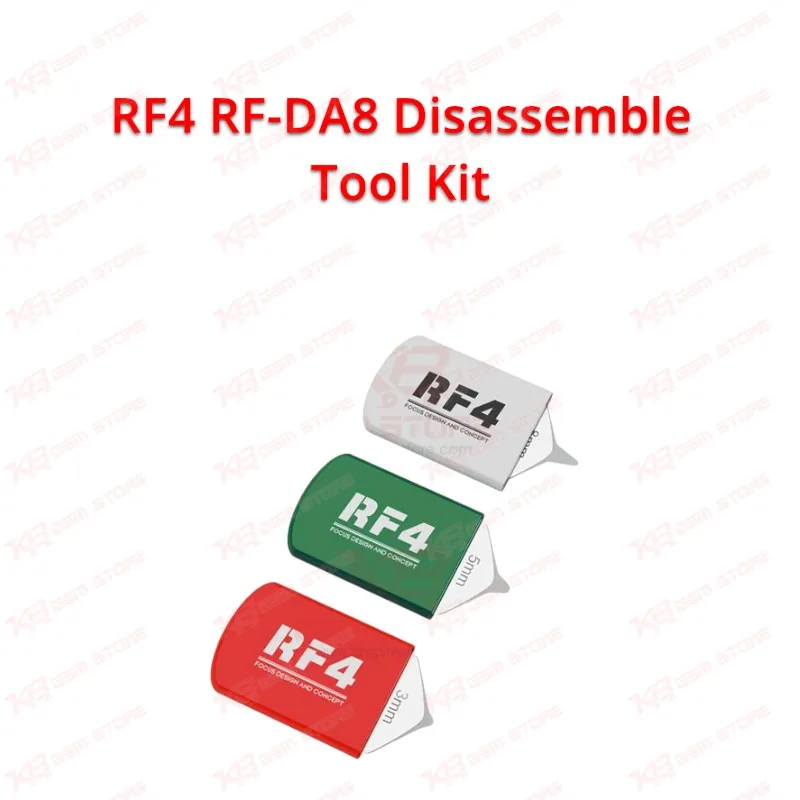
Every mobile repair technician runs into the same problem at some point: a screen that won't separate cleanly, a back cover glued down tighter than expected, or an IC that needs careful tin planting before reballing. The RF4 RF-DA8 handles all three situations with one compact 3-piece set. You get three ultra-thin stainless steel blades at 3mm, 5mm, and 8mm cutting depths, each one shaped for a specific job on the bench. The thinner 3mm blade slides into tight gaps around screen edges and frames without forcing the joint, which matters when you're working on a device where the display is already stressed or partially lifted. The 5mm blade handles general prying duty on back covers and mid-frame separation, and the 8mm blade gives you the reach needed for thicker glue lines or deeper cavity work. What separates this kit from throwaway pry tools is the blade material. RF4 uses a high-toughness steel alloy that flexes under load and returns to its original shape instead of deforming or cracking, so a blade that gets bent during a tough disassembly job doesn't end up in the bin after one use. That rebound property extends the working life of each piece and keeps your tool cost down over hundreds of repairs. Handle comfort is often overlooked in cheaper opening kits, but RF4 wraps each blade grip in silicone. This gives you better control during precision work like separating a curved-edge screen or working around a small FPC connector, and it reduces hand fatigue when you're running through several units back to back. The silicone also cuts down on slip, which lowers the risk of the blade skating off the target surface and scratching a frame or cracking an already-fragile panel. On the workshop floor, this kit fits into more workflows than just screen jobs. Technicians doing IC change karna on a board use the thinner blades to lift components cleanly before reballing, since a stable, non-slip edge reduces the chance of lifting a pad along with the chip. When you're separating a back glass panel that's stuck with strong adhesive, the mid and higher-depth blades cut through the bond without needing heat first in most cases, though warming the panel slightly still helps on stubborn units. For technicians handling volume repair work — phone shops doing screen replacement, back cover swaps, and general teardown all day — having three depth options in one set means less time swapping tools and more time on the actual repair. The RF-DA8 is not built as a heavy-duty prying bar for thick middle frames on larger tablets; for that kind of job a deeper-cut blade or a dedicated frame tool works better. Where it earns its place on the bench is precision separation work: LCD screens, back covers, curved edges, and IC-level tin planting where control matters more than raw leverage. Pair it with a heat gun or hot air station for glued panels and you cover most day-to-day disassembly needs without reaching for a full toolbox. For a repair shop building out a bench from scratch, or a technician replacing a worn-out set, the RF-DA8 covers the core opening and tin planting tasks that come up on almost every job.