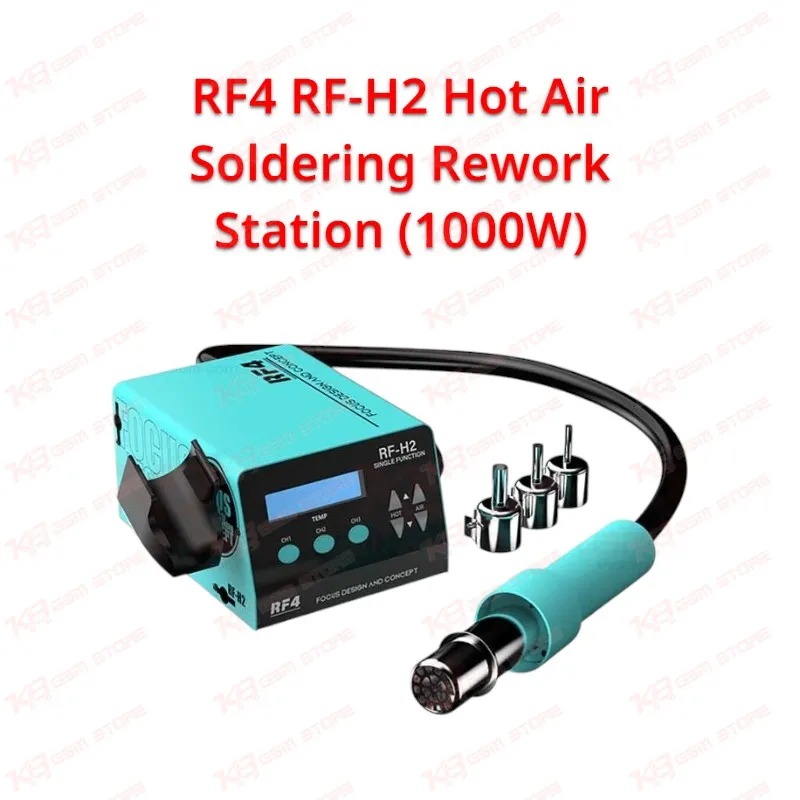
Every board-level repair on a dead phone starts with one question: can you lift the faulty component without cooking the chips around it? The RF4 RF-H2 Hot Air Soldering Rework Station (1000W) answers that question with a 1000W heating element, a high-speed turbofan spinning at 15,000 RPM, and a constant temperature system that holds your set point within ±2°C. For a technician in Lahore, Karachi, or Islamabad who opens motherboards all day, that combination translates into shorter heating cycles, cleaner IC removal, and fewer lifted pads. The station covers a working range of 100°C to 480°C, which gives you enough room at the low end for gentle jobs like softening adhesive or shrinking heat-shrink tubing, and enough headroom at the top end for lead-free solder joints under large BGA packages. Airflow reaches 50 L/min, and you can trim it anywhere from 5% to 100%, so you can pull a tiny SMD capacitor with a soft breeze or push a strong, even column of air across a CPU without blowing neighbouring components off the board. That airflow control matters more than most buyers realise: too much air on a crowded logic board scatters resistors and filters, while too little air forces you to raise temperature and risk overheating the PCB layers. The RF-H2 lets you balance both variables independently, which matches how experienced technicians actually work at the bench. Three programmable channels, CH1, CH2, and CH3, each hold their own temperature and airflow settings. A practical setup many repair shops follow keeps one channel for small SMD parts and connectors, one for charging ICs, audio ICs, and PMICs, and one for high-mass BGA work such as CPU, eMMC, or UFS memory. Recalling a saved channel spares you from re-dialing numbers between jobs, and that saves real time when you move from a charging issue on one phone to a network issue on the next. The digital display shows your parameters clearly at a glance, so you always know exactly how much heat you put onto the board. A magnetic switch in the handle holder sends the gun into sleep mode as soon as you rest the handle, and you can adjust the sleep parameters to suit your working rhythm. This intelligent sleep function protects the heater, cuts electricity waste during long workshop hours, and reduces the chance of an accidental burn on a busy bench. The anti-static design guards sensitive chipsets against electrostatic discharge, an important point when you rework CPUs, baseband chips, and memory ICs that cost far more than the repair charge itself. Inside the typical repair workflow, the RF-H2 sits at the centre of the rework process. Diagnosis usually begins with a DC power supply, a multimeter, and a thermal check to locate a shorted capacitor or a hot IC. Once you identify the faulty component, the hot air station takes over: you preheat the area, apply flux, lift the chip, clean the pads with a soldering iron and desoldering wick, and then reflow the new or reballed part. For BGA packages, the station works hand in hand with reballing kits and stencils, and for fine-pitch work a stereo microscope lets you inspect every solder ball and pad before you power the board up again. A solid PCB holder keeps the motherboard level and stable during heating, which stops components from sliding when the solder turns liquid. This explains why KB GSM Store places the RF-H2 alongside Hot Air Stations, Soldering Stations, Microscopes, Reballing Kits, PCB Holders, and Multimeters: each tool handles one stage, and the hot air station connects them all. Software technicians benefit too. When a phone shows dead after flash, hang on logo, or a boot loop issue that no firmware can fix, the fault often traces back to a failing eMMC or UFS chip. Removing that memory for direct programming on eMMC Programmers or UFS Adapters demands precise, even heat that protects both the chip and the board beneath it. The same applies when you need to lift shields to reach test points and ISP pads for ISP Pinout Tools and Test Boxes. The RF-H2 gives you controlled heat for those steps, so your hardware and software workflows stay connected on one bench. Beyond chip-level rework, the station handles the everyday jobs that fill a Pakistani repair shop: display connector replacement, charging port and flex connector swaps, shield removal, and the glue softening that comes with housing and screen work. RF4 lists SOIC, CHIP, QFP, PLCC, and BGA surface-mount packages within the station's intended scope, along with mobile phone connector and holder rework, plus heating, drying, paint removal, glue removal, bonding, heat-shrink work, and thermal testing on plastics. That breadth means one unit covers most of what a mobile service centre needs from a hot air gun, from a single SMD fuse to a full CPU reflow. The turbofan design deserves specific attention. A turbine-style fan delivers a steadier, more concentrated air column than a basic diaphragm-pump gun, and that consistency keeps heat where you aim it rather than spreading it across the whole board. The 1000W rating gives the heater enough reserve to hold temperature when you work on thick multilayer boards, where low-wattage guns tend to lose heat into the copper ground planes and force you to heat the area for much longer. Longer heating lifts pads and damages nearby ICs, so stable power directly protects the board you repair. For shop owners planning an upgrade, the RF-H2 fits the path neatly. Technicians who start with a basic analogue hot air gun often move to a digital station like this once their workload includes CPU, PMIC, and memory work, where accuracy starts to matter more than raw heat. Pair it with a quality soldering station for pad cleaning and jumper work, a microscope for inspection, and a set of reballing stencils, and you have a complete rework bench capable of handling hardware fault repairs that many shops still send elsewhere. Training institutes also value the clear display and channel memory, because students can see and repeat exact settings as they learn safe heat control. The machine weighs around 2.1 kg, which keeps it stable on the bench without eating up workspace, and the interface stays simple enough for daily use without complicated menus. RF4 builds the RF-H2 as a lead-free rework station, so you can work confidently on modern motherboards that use higher-melting-point solder alloys. Whether you face a display problem, a charging issue, a network fault after a drop, or a full dead phone board repair, this station gives you the repeatable, controlled heat that professional rework demands, making the RF4 RF-H2 a practical balance of power, precision, and safety for repair technicians, service centres, and training labs across Pakistan.