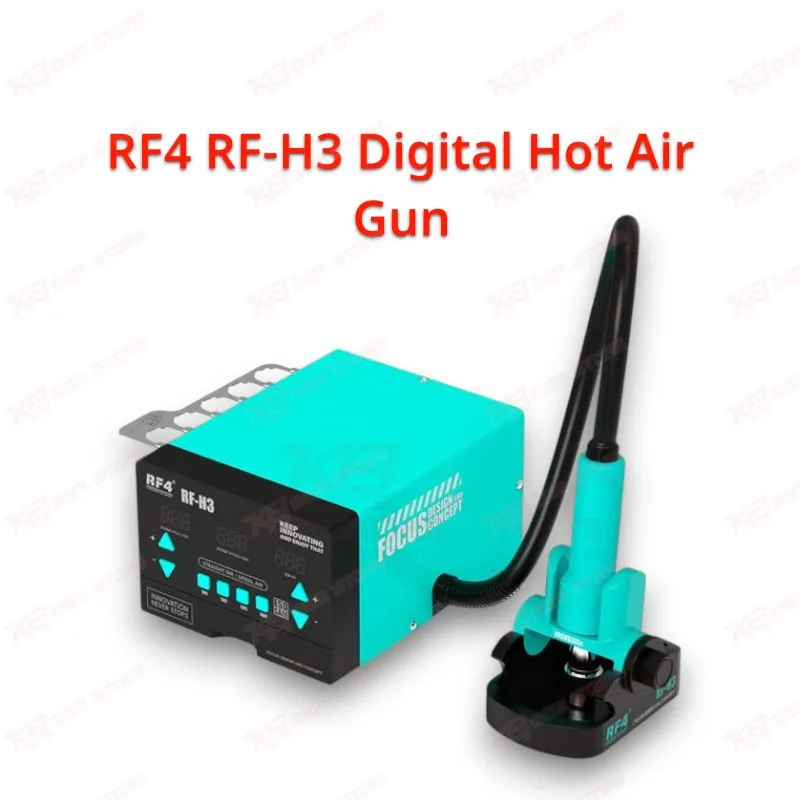
Every board-level repair comes down to one question: can you move heat exactly where you need it, at a temperature the component can handle, without cooking everything around it? The RF4 RF-H3 Digital Hot Air Gun answers that question with a 1200W heating system, a 100°C to 480°C working range, and a high-speed turbo fan spinning at 15,000 RPM that pushes up to 50 litres of air per minute through the nozzle. For a technician in Pakistan who handles a steady flow of dead phones, charging issues, network issues and display problems every day, those numbers translate into shorter IC removal times, cleaner solder reflow, and fewer lifted pads. The station works on a simple principle: heat and airflow must stay independent and stable. A closed-loop temperature sensor feeds the microcomputer controller, and zero-crossing trigger control regulates the heater, so the set temperature holds steady even when you push the airflow high. Airflow adjusts from 5% to 100%, which effectively gives you two different tools inside one handle. At the low end, a gentle stream lets you warm a small PMIC, a charging IC or a tiny SMD capacitor without blowing neighbouring 0201 parts off the board. At the high end, the full 50 L/min flow saturates a large shield area, a CPU underfill zone or a stacked logic board quickly, so you spend less time waiting and more time working. Three programmable channels, CH1, CH2 and CH3, sit at the core of the RF4 RF-H3 workflow. You save a temperature and airflow combination on each channel, then switch between them with a single press. A practical bench setup looks like this: one channel for connector and small-component work, one channel for mid-size ICs such as audio, charging and PA chips, and one channel for heavy jobs such as CPU, eMMC or UFS removal. When a customer walks in with a phone stuck in a boot loop or hanging on logo and your software attempts fail, you move to the hardware side, and the channel system means you never waste time re-dialing settings between steps. The magnetic switch in the handle holder adds real speed to that routine. Place the handle in the holder and the station drops into sleep immediately; lift it out and it returns to your working parameters. The heater never sits at full temperature while you pick up tweezers, apply flux or check a trace under the microscope, which protects the heating element and reduces heat build-up around your bench. An automatic sleep function covers the moments when you step away, and the station still lets you adjust parameters while it sleeps. The cooling system deserves attention from anyone who has burned out a cheaper hot air gun. After you finish, the brushless vortex blower keeps running to cool the heating element and handle, which extends element life and protects the handle internals. A brushless fan also avoids the brush wear that makes older blowers lose airflow after months of daily use. Password protection and key lock answer a problem every shared workshop and training institute knows well: an apprentice or a second technician changes your carefully tuned settings. Lock the panel, and your channel values stay exactly where you left them. The package includes five nozzles in 4mm, 5mm, 7mm, 9mm and 11mm sizes, along with a handle stand and power cable. The 4mm and 5mm nozzles focus heat on individual components, capacitors on a charging line, or a single filter near the antenna section when you chase a network issue. The 7mm nozzle suits most mid-size ICs. The 9mm and 11mm nozzles spread heat across larger packages such as CPU, memory and RF modules, and they help with adhesive softening where you want broad, even warmth rather than a hot spot. Lead-free capability matters because most modern phone boards leave the factory with lead-free alloys that melt at higher temperatures than older leaded solder. The RF4 RF-H3 reaches the temperatures lead-free reflow demands, and the digital display shows real-time temperature and airflow so you can confirm the station holds its setting before you start lifting a chip. The ESD-safe design protects sensitive CMOS components from static discharge during handling. Think of this station as one link in a complete repair chain. For CPU and memory work, pair it with a PCB Holder to keep the board flat and secure, a Microscope for inspection, and a Reballing Kit with the correct stencil for BGA reballing after removal. For eMMC and UFS data or firmware jobs, you lift the chip with hot air and move it to eMMC Programmers or UFS Adapters for reading, writing or repair; when a chip should stay on the board, ISP Pinout Tools let you connect directly and skip the heat altogether. Soldering Stations handle jumper wire work and fine touch-ups after reflow, Multimeters confirm continuity and short circuits before and after the job, and Test Boxes finish the software side once the hardware fault clears. If you currently run a basic analog hot air unit, the RF4 RF-H3 makes a natural upgrade inside the Hot Air Stations category: you gain digital control, memory channels and higher power without moving to a large, expensive BGA machine. For Pakistani repair shops, the practical value shows up in daily turnover. A busy market shop handles charging IC replacements, backlight and display IC faults, audio IC swaps and network PA changes in volume. Each of those jobs demands controlled heat, and every minute you save per job adds up across a month. The 1200W heater and 15,000 RPM fan bring board sections up to reflow temperature faster than low-power units, which also shortens total heat exposure and lowers the risk of secondary faults such as delaminated layers or damaged nearby components. The 220V operation matches standard Pakistani mains supply, so the station plugs straight into your workshop outlet. Dead phone repairs benefit most from precise control, because a dead phone often traces back to a failed PMIC, a shorted capacitor on the main power line, or a cracked BGA joint under the CPU. Each fault calls for a different heat profile: a quick low-airflow burst to remove a shorted capacitor, a longer controlled cycle with flux to reflow a suspect BGA, and full removal and reballing for a failed chip. The three memory channels keep those profiles ready at your fingertips. Whether you run a single-bench shop, manage a service center with several technicians, or teach board-level repair at a training institute, the RF4 RF-H3 Digital Hot Air Gun gives you the controlled heat, stable airflow and workflow speed that professional micro-soldering demands.