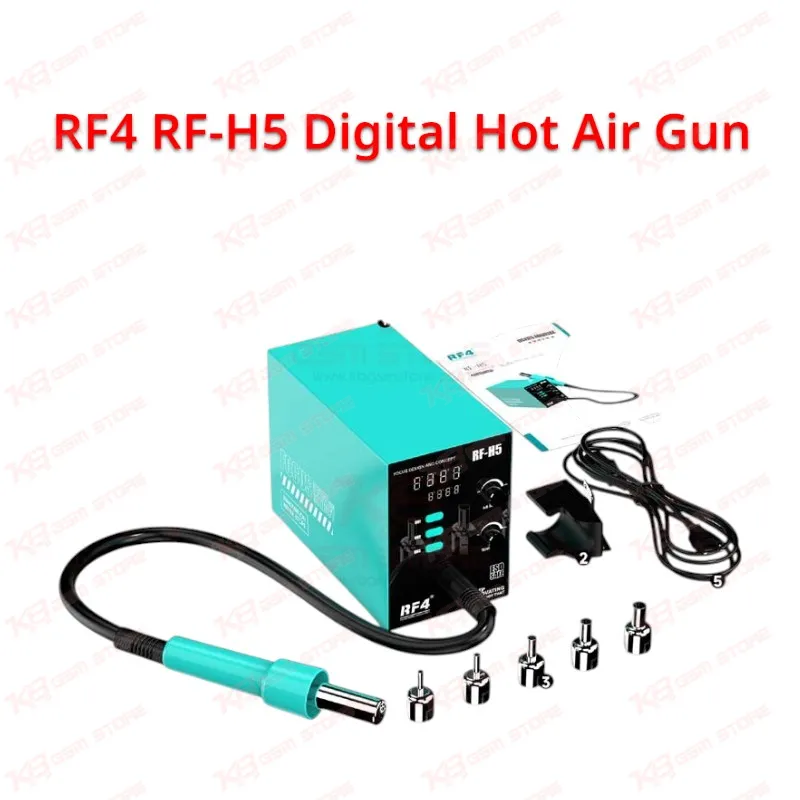
Every board-level job on your repair bench follows the same rhythm of preheat, lift, clean, place, and reflow, and the RF4 RF-H5 Digital Hot Air Gun keeps that rhythm steady from the first component to the last. RF4 builds this 800W hot air rework station around a high-speed brushless turbine fan that spins at around 13,000 RPM, so the air leaving the nozzle stays strong and even instead of pulsing the way older pump-driven units often do. You set temperature anywhere between 100°C and 480°C and adjust airflow from 5% to 100%, which gives you a wide working window: low heat and soft air for tiny SMD capacitors and resistors near plastic connectors, and higher heat with firmer air for shielded CPU, PMIC, eMMC, and UFS packages that sit on large ground planes and soak up heat fast. The station holds its set point within about ±2°C, and that stability matters more than the peak number on the display, because an unstable heater is exactly what cooks pads, lifts traces, and turns a simple charging IC swap into a dead phone. The digital LCD shows your set and actual values, so you watch the heater climb to target instead of guessing, and you know when the air at the nozzle matches what you dialled in. Three memory channels, CH1, CH2, and CH3, let you save complete temperature and airflow combinations for the jobs you repeat every day. A practical workshop setup keeps one channel for gentle flex connector and small-component work, one for mid-size ICs such as charging, audio, and power management chips, and one for heavy work on underfilled CPUs and memory chips, so switching between tasks takes one button press instead of re-tuning two values every time a new phone lands on the counter. When a customer brings in a phone with a boot loop issue or a hang on logo fault that traces back to a cracked memory solder joint, you move from channel to channel as the repair progresses: warm the board evenly, lift the shield, remove the chip, clean the pads, and reflow the replacement without breaking concentration. The handle uses a magnetic switch, so the moment you rest it in the holder the RF4 RF-H5 Digital Hot Air Gun drops into sleep, and the moment you lift it the station heats back toward the saved channel. That behaviour protects the heating element, cuts wasted power during long diagnostic sessions, and stops a hot nozzle from blowing across your bench while you probe lines with a multimeter or inspect the board under a microscope. The rest mode also carries its own adjustable parameters, so you decide how the station behaves while it idles and balance energy saving against how quickly you want full temperature back in your hand. Nozzle choice shapes every hot air job, and the RF-H5 works with 5 mm, 6 mm, 8 mm, 10 mm, and 12 mm nozzle sizes, giving you a tight stream for single components beside sensitive parts and a wider stream for large BGA packages that need uniform heat across the entire body. Pair a narrow nozzle with low airflow when you work beside camera connectors, display FPC sockets, and plastic-bodied parts, and switch to a wider nozzle with higher airflow when you need every ball under a CPU to melt at the same moment, which stops one corner from releasing early and tearing pads on the opposite side. The RF-H5 fits into almost every stage of the mobile phone repair workflow. On the pure hardware side, you use it to remove and replace charging ICs, PMICs, audio ICs, network and RF chips, and backlight components when a phone arrives with a charging issue, a network issue, or a display problem that points to a failed chip rather than a bad panel. On the software-to-hardware crossover side, it supports the jobs that start on a test box and finish on the board: when a device goes dead after flash and access through ISP pinout tools fails, you lift the eMMC or UFS chip with the RF-H5, read or write it directly on eMMC programmers and UFS adapters, and reflow it back once the data work is complete. It also handles the reballing stage, working alongside reballing kits and stencils to reflow fresh solder balls onto CPUs and memory chips before reinstallation. For a clean and safe workflow, clamp the board in a PCB holder, apply quality flux, preheat the area before you raise the temperature, and keep a temperature-controlled unit from our soldering stations range beside the hot air station for pad cleaning, jumper wire work, and touch-up joints that hot air alone cannot finish. Mount a microscope over the work area so you inspect every joint after reflow, and confirm the repair with a multimeter before you close the phone. The station runs on 220V, which matches standard Pakistani mains supply, and its 800W draw keeps circuit load manageable in small shops that run several tools at once. Technicians moving up from a basic analogue hot air unit notice the difference immediately: the brushless fan runs smoother, the digital readout removes guesswork, and saved channels bring consistency to every repeat job, which is exactly what a busy counter in Lahore, Karachi, or Islamabad needs when customers expect same-day returns. Repair shop owners, mobile service centres, and training institutes gain from it too, because a stable, repeatable hot air platform lets trainees learn correct heat profiles without risking customer boards. As your work grows toward heavier BGA rework, the RF-H5 gives you a dependable foundation to build around, and our Hot Air Stations category lets you compare other rework options side by side whenever you expand your bench.