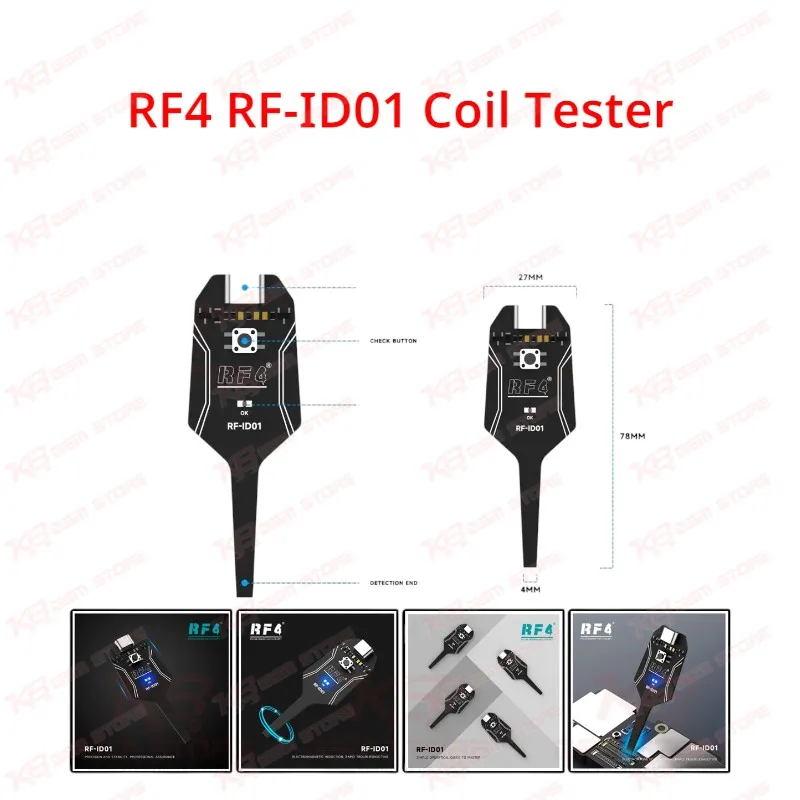
When you're staring at a dead phone on the bench and you're not sure whether the fault sits in the power section or somewhere deeper in the board, the RF4 RF-ID01 Coil Tester takes the guesswork out of that first diagnostic step. You connect it through its Type-C interface, touch the probe to each inductor or buck coil across the motherboard, and read the result instantly from the LED — light stays on for a normal inductor and switches off the second it detects an abnormal one, so you know exactly where the fault sits before you commit to reflowing or swapping any component. This is the kind of tool that earns its place on a repair bench because it shortens the diagnostic phase, and in a workshop where every minute matters for turnaround, cutting that phase down directly affects how many jobs you close in a day. The RF-ID01 works across mobile phone motherboards, tablet boards, and smart electronic device circuit boards, which makes it a general-purpose diagnostic tool rather than something limited to one brand or chipset family, so whether you're dealing with a dead-after-flash Android board, a boot loop issue on an older device, or a charging problem you suspect traces back to a power inductor, this tester gives you a fast first checkpoint. Its plug-in operation means there's no lengthy setup or calibration routine standing between you and the actual test — you power it on, position the probe, and start checking coils one after another, which is exactly the kind of workflow a busy GSM technician needs when customers are waiting and the queue of dead boards keeps growing. The electromagnetic induction detection method behind the RF-ID01 is built specifically for rapid fault point locking rather than lab-grade inductance value logging, so it's suited to the practical reality of repair work: you don't always need the exact microhenry reading, you need to know fast whether a coil is good or bad so you can move to the next diagnostic step, whether that's IC change karna, jumper lagana, or tracing the fault further into the board. Strong stability during testing means you're not second-guessing false positives or inconsistent readings when you're working through a batch of boards, and the compact black housing keeps it easy to store in a tool tray or carry between benches without adding bulk to your existing setup. For shops that handle a high volume of hardware fault and dead phone cases, having a dedicated coil tester like the RF-ID01 alongside your multimeter and hot air station rounds out the early diagnostic stage of your workflow, letting you separate coil-related faults from IC-level or software-level problems before you invest time in board-level rework. It pairs naturally with your existing ISP pinout tools, eMMC programmers, and reballing kits once a coil fault has been ruled out or confirmed, keeping your bench moving from diagnosis into the actual repair step without unnecessary delays. Whether you're running a service center handling walk-in repairs or training junior technicians on proper fault-isolation habits, the RF-ID01 gives a clear, visual pass/fail signal that's easy to read and easy to teach, making it a practical entry point into coil-level diagnostics without requiring specialized measurement expertise.