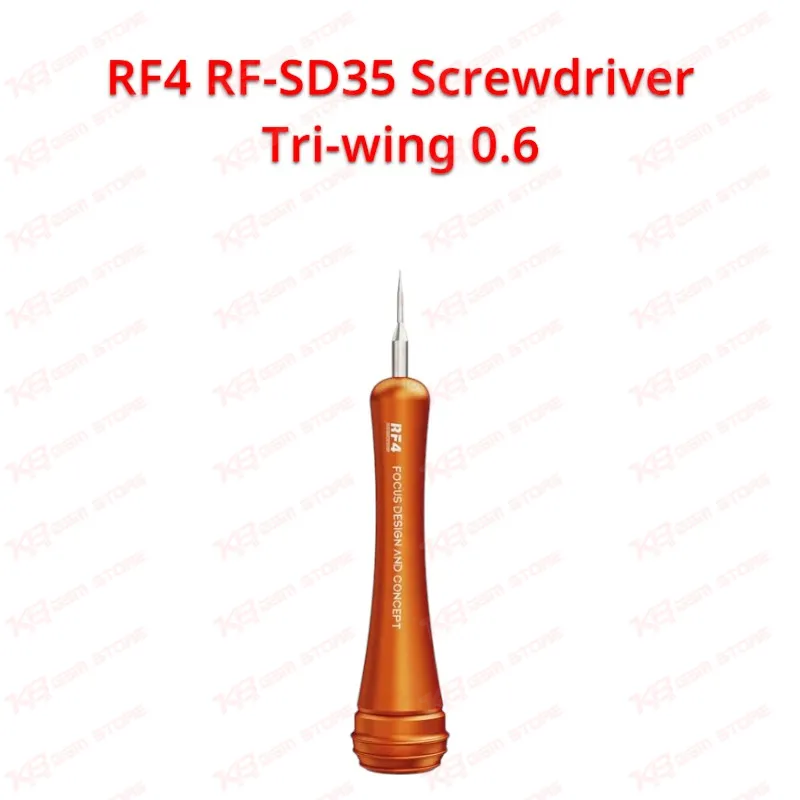
Tri-wing screws show up in places where standard Phillips or flathead drivers simply will not work, and the RF4 RF-SD35 exists to solve exactly that problem on the repair bench. Built with a 0.6mm tri-wing tip, this screwdriver gives you access to the small, tamper-resistant fasteners manufacturers use to discourage casual disassembly, which means you need a properly sized, hardened bit rather than a generic multi-tool if you want clean engagement without stripping the screw head. The bit itself is made from S2 alloy steel, a tool steel known for its toughness and resistance to shearing under torque, with hardness rated up to HRC 60. That level of hardness matters on a repair bench because tri-wing screws are frequently seated tight from the factory, and a softer bit will round out after a handful of uses, leaving you with a stripped screw and a stuck panel. S2 steel also holds an edge longer than chrome vanadium alternatives, so the RF-SD35 stays sharp through repeated daily use rather than degrading after a few dozen jobs. Magnetic adsorption built into the tip is a small feature that saves real time during actual repair work: once you back a tri-wing screw out, it stays attached to the bit instead of rolling off the bench or dropping into a device chassis, which is especially useful when you are working on boards with multiple tiny screws in close proximity. The handle incorporates an embedded metal bearing, which lets the shaft rotate independently of your grip. This noise-reducing bearing design means you can spin the screwdriver smoothly during fast, repetitive unscrewing work without the friction and clicking you get from cheaper fixed-shaft tools, and it also reduces strain on your wrist during longer repair sessions. The body finish uses a colorful, non-slip coating that improves control, particularly useful when your hands have flux, solder residue, or screen adhesive on them from earlier steps in the repair. Within a typical mobile repair workflow, a tri-wing driver like the RF-SD35 usually comes into play during the disassembly phase, before you reach board-level diagnostics or component-level rework. Technicians use it to remove tri-wing security screws holding down brackets, connector covers, or casing panels on devices that use this fastener type, clearing the path to battery connectors, charging port flex cables, or internal shielding that needs to come off before further repair. Because it is a precision driver rather than a bulk tool, it is best suited to controlled, single-screw removal rather than high-torque applications, and pairing it with a proper bit holder or handle grip extends its working life. For a repair shop juggling multiple device types and fastener standards, having a dedicated tri-wing driver on hand avoids the workflow interruption of hunting for the right tool mid-job or improvising with an ill-fitting bit that risks damaging the screw or the surrounding housing. The RF-SD35 fits into a broader precision screwdriver lineup from RF4, meaning it works well alongside other bit sizes and types when a repair calls for handling several fastener standards on the same device. For Pakistani repair shops and mobile service centers handling a steady stream of walk-in repairs, having reliable, correctly sized tools like this reduces turnaround time and prevents the kind of screw-head damage that turns a simple job into a harder one. Overall, the RF-SD35 is a straightforward, well-built addition to a technician's screwdriver set, aimed squarely at the practical need to remove tri-wing screws cleanly, quickly, and without damaging either the fastener or the device.