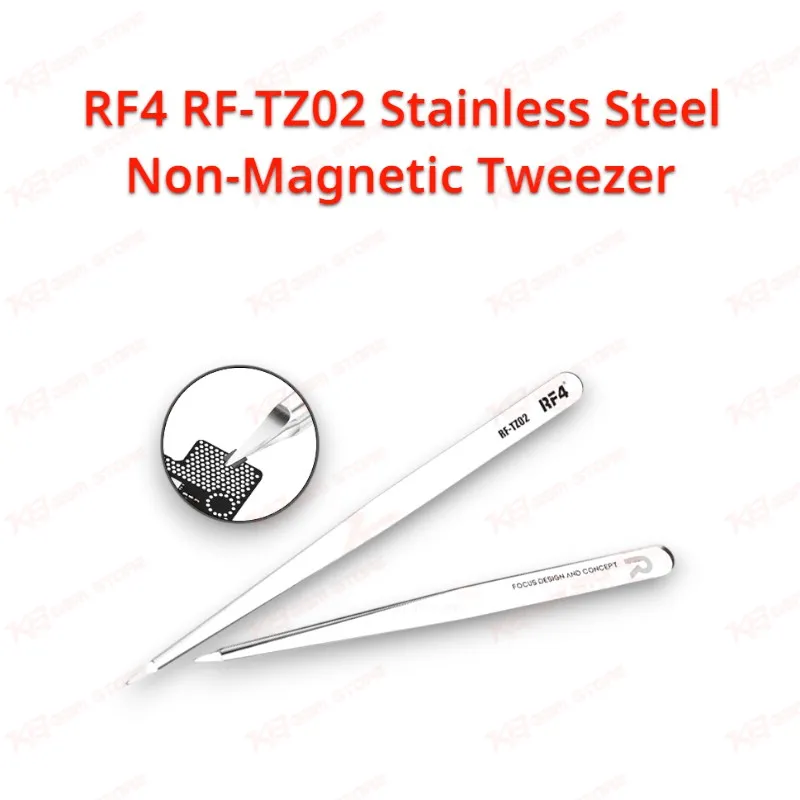
When you're doing IC change karna or running a flying wire jumper across a stripped pad, the tool actually holding the wire or component matters as much as the soldering iron in your hand, and that's the gap the RF4 RF-TZ02 Stainless Steel Non-Magnetic Tweezer is built to close, giving technicians a curved-tip precision tweezer designed specifically for angled component handling rather than the generic straight-tip tweezers that come bundled with cheaper tool kits. The curved profile of the RF-TZ02 lets you approach a pad or component from an angle instead of straight down, which is exactly what you need when you're working around a populated board where a straight tweezer would collide with neighboring components or block your own line of sight under the microscope. Because the tweezer is fully non-magnetic, it stays safe to use near magnetometers, compass ICs, and other magnetically sensitive parts that are common on modern smartphone boards, so you don't have to swap tools mid-repair just because the next component is magnetic-sensitive. The stainless steel construction gives the tips enough rigidity to grip fine flying wires and small passive components firmly without the metal flexing or losing its point over repeated use, and stainless steel's natural corrosion resistance means the tips hold up against flux, isopropyl alcohol, and daily contact with solder residue without pitting or rusting the way lower-grade metal tools eventually do. On the bench, this shows up in practical ways: cleaner flying wire placement on dead-after-flash boards, steadier IC lifting during reballing prep, and less component damage when you're separating a display connector or repositioning a tiny SMD resistor. The tip geometry also makes the RF-TZ02 a natural fit for testing work, since a curved point can probe a specific pad on a populated board at an angle that a straight tweezer simply can't reach cleanly. Technicians handling boot loop issues, hardware fault diagnosis, or charging port rework tend to keep a tweezer like this paired with a soldering station and microscope as part of the same core toolkit, because so much of board-level repair comes down to holding something still and precise while heat or current is applied. The RF4 RF-TZ02 isn't a specialty tool for one repair type — it's a daily-use precision instrument that fits into ISP work, eMMC-related board prep, general SMD handling, and any repair workflow where a slip of the hand can turn a simple job into a burned pad. For a repair shop or service center running multiple boards a day, having a dependable, non-magnetic, corrosion-resistant tweezer like the RF-TZ02 on the bench reduces the small mistakes that come from fighting the wrong tool for the job.