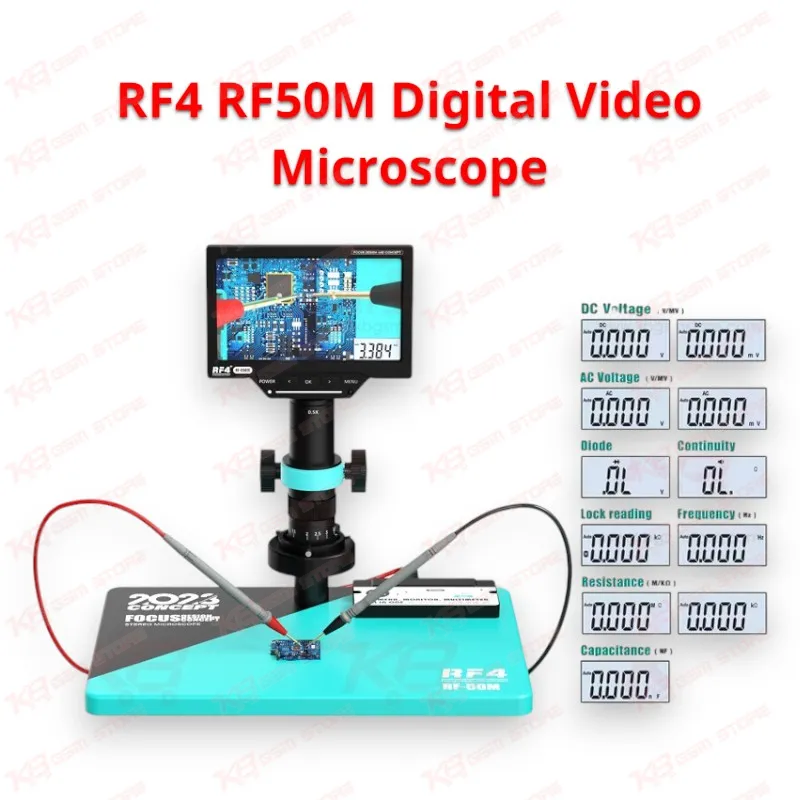
A dead phone on your bench rarely tells you where the fault sits, and on a modern motherboard the answer usually hides in a lifted pad, a cracked capacitor or a solder ball smaller than a grain of sand, which is exactly the gap the RF4 RF50M Digital Video Microscope closes by combining a monocular zoom lens, a 7-inch HD monitor and a working multimeter into one bench station. Instead of bending over eyepieces for hours, you sit upright and read the board on a 1024×600 color screen, which cuts neck strain during long shifts and lets a second technician or a customer watch the same live view without crowding the lens. The optical path gives you a continuous 7X to 50X zoom range, so you can pull back to see the whole logic board layout, then close in on a single tiny SMD capacitor next to the PMIC without changing lenses. On top of the optical zoom, the display software adds digital enlargement from 1X to 16X, which helps when you want a quick closer look at a pad without touching the zoom knob and losing your working height. Inside the camera, a 1/3-inch BSI image sensor with 2µm pixels captures stills at 2688×1512, with an interpolated 5376×3024 mode for detailed reference photos, and it records video at 1080P30 when you want clarity or 720P60 when you need smooth motion while you move the board or work with a soldering iron under the lens. A dedicated image processing DSP with 3D noise reduction keeps colors true, so you can tell healthy tinned pads apart from oxidized copper and burnt solder mask, which matters when you judge liquid damage on a board that came in with a charging issue or a network issue. The 144-LED light floods the work area evenly and helps you read component markings and pad edges around tall shields and inductors. Image controls give you real command over what you see: AE lock and ten-level exposure compensation stop the picture from flickering when your hot air nozzle or tweezers enter the frame, white balance runs in auto mode or manual mode with ten levels each for red, green and blue, and contrast, saturation and sharpness each adjust across ten steps so you can tune the screen for green solder mask, black solder mask or flexible cable work. The feature that sets this unit apart from a standard video microscope is the built-in multimeter controller, which connects to the included test probes and shows readings on the same screen as the magnified board. You measure resistance, DC voltage from 0 to 36V, AC voltage from 0 to 36V, diode values, continuity, capacitance and frequency while the probe tip stays in view, so you place the probe on the exact capacitor pad instead of guessing where it landed. For short circuit hunting on a phone that pulls current the moment you connect the DC power supply, this matters a lot: you check the diode value of each line, compare it against a known good board, and confirm the reading while you watch the probe sit on the right point. The same workflow speeds up ISP work, because you can confirm eMMC or UFS test points under magnification before you solder fine wires from your ISP Pinout Tools, eMMC Programmers or UFS Adapters, and you catch a bridged jumper wire before it damages the storage chip. For comparison work, the picture-in-picture freeze function holds a frozen frame in full screen, left and right, up and down, or quarter-screen layout next to the live image, so you can capture a known good area or a reference board and then line up the faulty board beside it to spot a missing component or a lifted pad in seconds. The on-screen tools add precision to measurement and alignment: the cross cursor switches between off, ruler and center modes, the pointer offers pointer, cross and gesture shapes, and an 8-line grid system lets you set each line as horizontal or vertical with its own position, width and color, which helps you align a CPU or a reballed IC before you reflow it with your hot air station. Photo and video capture works from the preview menu with a single confirm press, so you can record the before-and-after state of a board for customer proof, warranty records or your shop's training content, and the IR remote lets you operate the unit without touching the stand and shaking the image at high magnification. Connectivity covers both a bench monitor and a computer: the HDMI output runs at 720P60 for a larger external display, and the USB output delivers 1080P20, 720P30 or WVGA at 60 frames per second when you want to view or record on a PC, with an HDMI cable and a Type-C cable included in the box. The big base gives the whole assembly a stable footprint, with the complete unit measuring about 380×260×430mm and weighing around 3.38kg, so light bumps from tweezers or a PCB holder adjustment do not send the image swimming. Inside a typical Pakistani repair shop, this microscope earns its place on nearly every hardware job: you inspect charging IC areas on Samsung, Oppo, Vivo, Infinix and Tecno boards after a phone arrives with a charging issue, trace corrosion paths after water damage, check reballed CPUs and eMMC chips for bridged balls before refitting shields, examine display connector pins when a phone arrives with a display problem, and confirm solder joints after an IC replacement on a phone stuck with a hang on logo or boot loop issue that traced back to a hardware fault rather than software. The tool sits naturally between your inspection and rework stages, so it pairs well with Soldering Stations for fine joint work, Hot Air Stations for IC removal, Reballing Kits for BGA restoration, PCB Holders for steady board positioning, and Test Boxes and dedicated Multimeters for deeper diagnostics, and it offers a clear upgrade path for shops still relying on basic magnifiers or entry-level Microscopes. Training institutes gain just as much, because a trainer can run a live demonstration on the built-in monitor or an external HDMI screen while a whole batch of students follows each step, which beats taking turns at a single eyepiece. For service centers that handle high daily volume, magnification, measurement and recording on one base cut the number of tools you move around the bench and shorten the time between fault finding and final repair. KB GSM Store supplies this unit to technicians in Lahore, Karachi, Islamabad and across Pakistan, and it suits both new shops setting up their first board-level bench and experienced hardware engineers who want inspection and electrical testing in a single, reliable workflow.