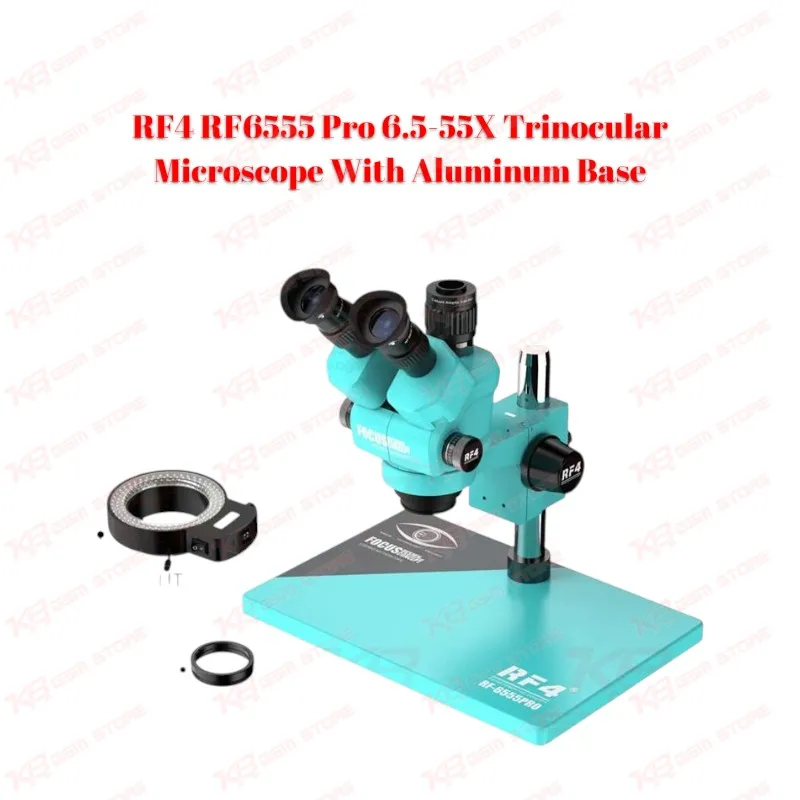
Board-level repair depends on what you can actually see, and the RF4 RF6555 Pro 6.5-55X Trinocular Microscope With Aluminum Base puts a stable, clear, and adjustable optical system right above your repair bench so you can read tiny component markings, trace broken lines, and watch solder flow under a hot air nozzle without guessing. RF4 builds this stereo microscope around a continuous zoom range of 6.5X to 55X, which comes from a 0.65X to 5.5X zoom objective working together with a pair of WF10X/22mm wide-field eyepieces. That range matters in a real workshop because a single job rarely stays at one magnification: you start low at 6.5X to scan the full motherboard of a dead phone and locate the charging section or the PMIC area, and then you climb toward 55X to inspect a single tiny capacitor, a lifted pad, or a cracked solder ball at the edge of a BGA chip. Stereo optics give you true depth perception, so you can judge the height of a solder joint, the gap under a shield frame, and the position of your tweezer tip in three dimensions, something a flat camera screen alone cannot deliver during delicate micro-soldering work. The head sits at a 45-degree incline and swivels through a full 360 degrees, which lets you turn the viewing position to match your seating, your bench layout, or a second technician who needs to check the same board without moving the PCB holder. The trinocular design adds a third optical port for a camera, and RF4 pairs it with a 0.5X CTV adapter that keeps the monitor image and the eyepiece view in synchronous zoom, so when you turn the zoom knob, your screen and your eyes see the same magnification change at the same moment. This synchronous behaviour pays off when you record repair videos for customers, train junior technicians in your shop, or share a live feed on a monitor while you chase a hang on logo or boot loop fault that needs careful component-level checking. The CTV adapter uses an all-metal construction, with an aluminum alloy body and a copper chrome-plated bayonet, and its adapter ring lets you focus the camera image manually to match your eyepiece focus. A transparent mirror inside the adapter supports synchronous zoom between the microscope view and an external display, which keeps your recording aligned with what you see through the eyepieces across the zoom range. The standard package does not include a camera, so you can pick a compatible microscope camera and monitor that suit your budget and recording needs. Zoom control runs through a metal knob with 7 gear positions, which gives you repeatable magnification steps: you can return to the exact zoom level you used for a previous inspection instead of hunting for it by feel, and that consistency saves real time on repetitive jobs like underfill removal, pad inspection after IC removal, or reball quality checks. A limit lock on the stand helps hold your chosen working height, so a small bump on the column during a long rework session does not throw your focus off. The support column measures Φ32mm, the lens aperture measures Φ76mm, the center distance reaches 155mm, and the stand gives you a 50mm lifting range, enough adjustment to fit a PCB holder, a motherboard fixture, or a mid-frame repair jig under the objective and still bring the board into sharp focus. Lighting comes from a 144 LED white ring light that mounts around the objective with a 60mm inside diameter. It accepts an AC 100–240V 50/60Hz input and delivers a DC 12V output at a maximum of 700mA, and that universal input range covers the standard 220V mains supply in Pakistani repair shops. The ring layout spreads even, shadow-free white light across the board, which helps you spot corrosion on a water-damaged motherboard, identify burnt components around a charging IC, and catch solder bridges between fine-pitch pins that a desk lamp would hide in shadow. The package also includes a dustproof lens that shields the objective from flux smoke, solder spatter, and airborne dust, a practical advantage in busy workshops where hot air stations and soldering stations run all day long. Leak-proof eye cups block stray light around the eyepieces and keep your view comfortable during long sessions at the bench. The aluminum alloy base gives the microscope a solid, stable footprint, and stability matters more than most buyers expect, because at 55X even a small table vibration turns into a shaky image, while a rigid metal base keeps the view steady as you work with fine tweezers or a soldering iron tip. Inside a professional repair workflow, the RF6555 Pro sits at the center of the diagnostic and rework stage. You use it to inspect a board after a customer reports a charging issue, network issue, or display problem, to place a multimeter probe exactly on a tiny test point while you hunt for a short, and to guide a jumper wire across a broken trace or a damaged pad. During IC work, it pairs naturally with hot air stations for chip removal, soldering stations for pad cleaning and tinning, reballing kits and stencils for BGA reballing, and PCB holders that lock the board under the objective. Software-side technicians gain from it too: when a phone turns dead after flash and needs ISP or direct eMMC or UFS access, the microscope helps you locate ISP test points, solder fine wires for ISP pinout tools, eMMC programmers, or UFS adapters, and verify every joint before you connect the board to a test box or programmer. That same precision protects you from a hardware fault you create yourself, since a solder bridge on a data line can turn a simple FRP lock or pattern unlock job into a much bigger board repair. For shops that currently work with a basic binocular microscope or a magnifier lamp, the RF6555 Pro offers a clear upgrade path: you gain a camera port with synchronous zoom, a wider 6.5X to 55X range, repeatable 7-gear zoom steps, and a rigid aluminum base in one setup. Repair shop owners, mobile service centers, and technical training institutes across Pakistan use a trinocular stereo microscope like this for daily motherboard repair, iPhone and Android board-level work, micro-soldering training, and quality inspection before a device goes back to the customer. Because a stereo microscope works on any PCB regardless of brand or chipset, the same setup serves Samsung, Oppo, Vivo, Infinix, Tecno, Xiaomi, and iPhone logic boards, as well as tablets, smartwatches, and laptop motherboards. Add a compatible microscope camera and monitor for live display, place a PCB holder and a heat-resistant repair mat under the objective, and your bench becomes ready for high-precision work that separates a professional repair from a risky guess.