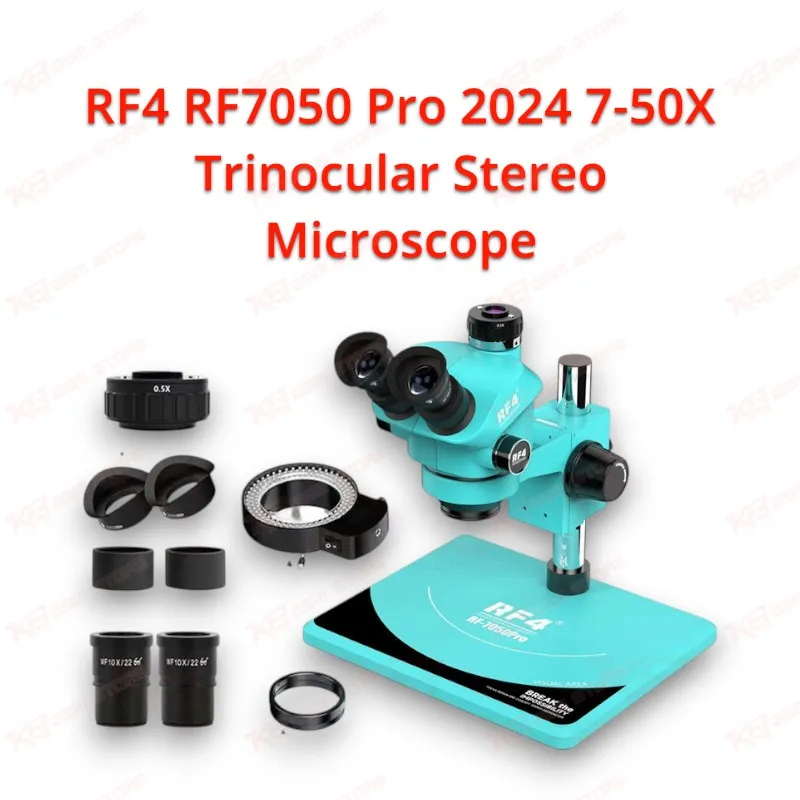
Board-level faults on modern smartphones rarely show themselves to the naked eye, and the RF4 RF7050 Pro 2024 7-50X Trinocular Stereo Microscope gives your repair bench the optical depth it needs to find them. A cracked filter capacitor under the PMIC, a lifted pad beside a charging IC, a hairline trace break near the CPU underfill, or a cold joint on a display connector all sit at a scale where guesswork costs you time and sometimes the board itself. This RF4 stereo microscope combines a 0.7X–5.0X zoom objective with a pair of WF10X/22mm wide-field eyepieces, which gives you continuous magnification from 7X to 50X without swapping any optics. Stereo optics matter at the rework stage because each eye receives a slightly different image, so you perceive real depth and can judge the height of a solder ball, the gap under a shield frame, or the angle of a tweezer tip against a tiny 0201 component. A flat camera feed alone cannot deliver that spatial sense, which explains why experienced micro-soldering technicians keep a true stereo head on the bench even when they own a digital screen. The headline upgrade on the 2024 build sits in the zoom knob. RF4 redesigned it with six gear positions that lock magnification accurately, so you can drop to a wide view for locating a component, click up to high magnification for pad inspection, and return to the exact same setting every time. That repeatability helps when you move back and forth between a hot air station and the microscope during an IC removal, because scale and focus stay predictable instead of drifting with each touch. The trinocular head tilts at 45 degrees and swivels a full 360 degrees, letting you set the eyepieces to suit your posture rather than bending your neck to suit the stand, and the interpupillary range of 55mm to 75mm fits most users comfortably. The high-eyepoint eyepieces also let technicians who wear glasses keep them on through long sessions, and their standard 30mm matching size keeps replacements easy to source. The third port is where this model separates itself from a standard binocular unit. A 0.5X CTV camera adapter connects an industrial camera to the head, and its internal design delivers synchronous zoom, so the monitor shows exactly what you see through the eyepieces at the same magnification. The adapter body uses aluminum alloy with a copper chrome-plated bayonet and supports manual focus against an LCD screen. Repair shops in Pakistan put this setup to work in several practical ways: recording before-and-after footage of board repairs to build customer trust, training junior technicians who watch the monitor while a senior technician works under the eyepieces, and producing sharp close-up content for social media pages that bring walk-in customers through the door. Training institutes gain the same benefit, since an entire class can follow a reballing demonstration on one screen. Lighting often decides whether you catch a fault or miss it, and the 144-LED adjustable ring light handles that job with bright, even illumination around the objective. Reflective surfaces such as solder joints, shield frames, and gold-plated connector pins throw glare under a single-point lamp, while a ring source spreads light evenly so the edge of a crack or the dull grain of a dry joint stands out clearly. You can dim it for glossy boards and raise it for dark underfill residue. A dust-proof lens design helps protect the optics in a workshop where flux smoke, board-cleaning spray, and airborne particles rise every day. The support system follows the same heavy-duty thinking: a Φ32mm column, a Φ76mm lens mounting aperture, a 155mm center distance, and a 50mm lifting range sit on a large aluminum alloy base, which gives the head a stable footprint that resists vibration while you work with a soldering iron or a preheater on the same bench. RF4 lists a standard working distance of up to 100mm, which leaves generous room under the objective for a hot air nozzle, a soldering tip, tweezers, and a PCB holder without any of them bumping the lens. Think about where this microscope fits across a full repair workflow. A dead phone lands on your bench, and you start with a multimeter and a DC power supply to check for a short on the main rail. Once you trace the short to a zone, the microscope lets you spot the burnt or bulged capacitor behind it. For a phone stuck in a boot loop or hang on logo after a drop, you inspect the CPU, eMMC, or UFS chip edges for cracked solder or lifted corners before deciding between a reflow and a full reball with your reballing kit and stencil. When a software technician runs a test box or an eMMC programmer through ISP and the connection keeps failing, the cause often comes down to a poor jumper wire on a tiny test point, and the microscope lets you confirm the ISP pinout alignment, catch a solder bridge, and fix the joint before trying again. Before you seat a removed chip in a UFS adapter, the same inspection confirms clean, level pads so the read succeeds on the first attempt. Charging issues trace back to corroded charging port pins or a damaged charging IC, network issues lead you to the RF shield area and antenna switch components, and display problems frequently start at a torn FPC connector pin that only reveals itself at 20X or higher. Every one of these jobs depends on seeing the board clearly, and every one of them runs faster when magnification locks precisely and the lighting stays even. The upgraded eye cups on recent RF4 production cut light leakage and ease fatigue, which matters in a busy repair shop where a technician may spend six to eight hours a day under the eyepieces. For shop owners weighing an upgrade, the RF4 RF7050 Pro 2024 7-50X Trinocular Stereo Microscope makes the most sense once your workload moves beyond screen and battery replacement into CPU reballing, PMIC replacement, jumper work, and liquid damage recovery. A basic magnifier or entry-level digital microscope covers occasional inspection, while this trinocular stereo platform supports the continuous, high-volume board work that service centers and advanced repair shops handle daily. Pair it with a quality soldering station, a hot air station with stable airflow, a PCB holder that keeps the board level, and a reballing kit matched to your common chipsets, and you have a complete micro-soldering station built around clear, repeatable optics. KB GSM Store supplies this microscope to technicians across Pakistan, including Lahore, Karachi, and Islamabad, for workshops that want reliable magnification, camera-ready documentation, and a stand that handles years of daily bench use.