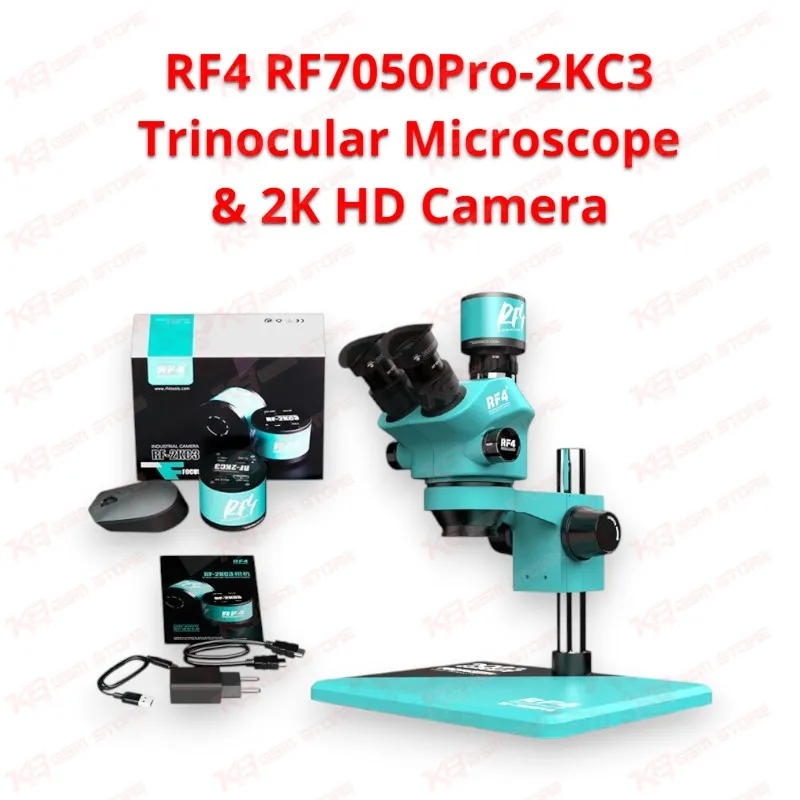
Board-level mobile repair depends on what you can actually see, and the RF4 RF7050Pro-2KC3 Trinocular Microscope & 2K HD Camera takes the guesswork out of every job that happens under the lens. RF4 builds this kit around the RF7050Pro stereo head, a continuous zoom optical system that runs from 7X to 50X through a 0.7X–5.0X zoom objective paired with WF10X/22mm wide-field eyepieces. That range matters in a real workshop: at 7X you see a whole section of the logic board, the PMIC, the charging IC, and the surrounding capacitors in one view, and at 50X you can study a single tiny capacitor, a lifted BGA ball, or a hairline crack in a trace that explains why a phone went dead after a drop. Because the zoom moves continuously instead of jumping between fixed steps, you move from overview to detail without losing your place, which saves real time when you trace a short from a filter capacitor back to the component pulling the rail down. The head sits at a 45-degree inclination and swivels a full 360 degrees, so you can turn the eyepieces toward yourself, a trainee, or a customer without disturbing the board or the stand. The trinocular body gives you a third optical port, and this is where the kit separates itself from a basic binocular microscope. RF4 supplies a 0.5X CTV camera adapter machined entirely from metal, with an aluminum alloy body and a chrome-plated copper bayonet. A transparent mirror inside the adapter splits the image, so the monitor and your eyepieces zoom together in sync. When you turn the zoom knob, the picture on screen follows exactly what your eyes see, and you don't need to refocus the camera every time you change magnification. You focus the adapter manually through its adapter ring, set it once against the monitor image, and then work normally. The bundled 2K HD camera turns the setup into a full video inspection station. It uses a 1/2.8-inch Sony IMX335 CMOS sensor and sends a 1920×1080 signal at 60 frames per second over HDMI straight to a monitor or LED TV, with no computer or driver software in between. Sixty frames per second keeps hand movement smooth on screen, so you can hold a soldering iron tip or a hot air nozzle over a board and watch the display without the lag that makes low-frame-rate cameras frustrating to work with. Two USB 2.0 ports on the camera accept a USB flash drive and a mouse, so you can capture photos and videos of your work and navigate the on-screen menu, which runs in English or Chinese. The camera runs from a DC 5V/2A input. For a repair shop, those captures serve a practical purpose: you can show a customer the corroded connector or burnt IC before you quote the job, keep a record of board condition before and after repair, and build a reference library of board layouts and fault points for training new technicians. Lighting decides whether you actually see what the optics can resolve, so the kit ships with a 144 LED white ring light with adjustable brightness that fits around the objective through a 60mm inside diameter and runs from an AC 100–240V 50/60Hz adapter with a DC 12V, 700mA maximum output. Even ring illumination removes the harsh shadows a desk lamp throws, so you can read IC markings, spot flux residue near shields, and check solder joints for dull, cracked, or bridged finishes. RF4 has upgraded the ring light in this kit from the earlier OK-8 to the OK-9 version. A dustproof lens shields the objective from flux smoke and solder spatter, which matters on a bench where hot air and flux run all day. The big base gives the whole assembly a stable footprint, with a Φ32mm column, a Φ76mm lens holder, a 155mm center distance from column to optical axis, and 50mm of lifting range, all anchored on an aluminum alloy plate that gives you a solid working surface for a PCB holder. That center distance leaves room to work with tweezers and a soldering iron under the lens without your hands hitting the column, and the solid base keeps the image steady when you press on a board during IC removal or scrape underfill from around a CPU. In a Pakistani repair workshop, this microscope earns its place across almost every hardware job that comes through the counter. Dead phone with a shorted VBAT line? You inject voltage, find the warm capacitor, and remove it under clear magnification. Charging issue after water damage? You inspect the charging IC, the USB connector pins, and nearby resistors for corrosion before you replace anything. Network issue with no signal? You check the RF front-end, the antenna switch, and the components under shields for lifted pins or cold joints. Display problem with no backlight? You follow the backlight circuit, check the coil and diode, and run a jumper wire across a broken trace with a precision the naked eye can't match. For CPU, eMMC, and UFS memory work, the 50X end of the zoom lets you inspect pads after chip removal, clean every pad properly, and confirm alignment after reballing before the board goes back under the hot air station. Technicians who read memory through ISP pinout tools, eMMC programmers, or UFS adapters need exactly this kind of view to solder fine test-point wires, and a phone stuck on hang on logo or dead after flash often lands on this bench once software work alone can't bring it back. The RF4 RF7050Pro-2KC3 slots naturally into a complete rework setup: pair it with a hot air station for chip removal, a temperature-controlled soldering station for fine joints, a reballing kit with stencils for BGA work, a PCB holder to keep boards square under the lens, a digital multimeter for continuity and diode-mode checks, and a test box or DC power supply for current-draw testing. Technicians moving up from a basic binocular microscope or a USB digital microscope get a clear upgrade path here, because you keep true stereo depth perception through the eyepieces for soldering and gain a live screen for teaching, customer demonstrations, and documentation. Training institutes in Lahore, Karachi, and Islamabad can connect the camera to a large display so a whole class follows the instructor's hands in real time, while service centers can dedicate one station to inspection and quality checks before a device goes back to its owner. If your current setup forces you to squint, refocus a camera every time you zoom, or work around a shaky stand, this kit fixes all three problems in one purchase and gives your repair bench the clarity that professional board-level repair demands.