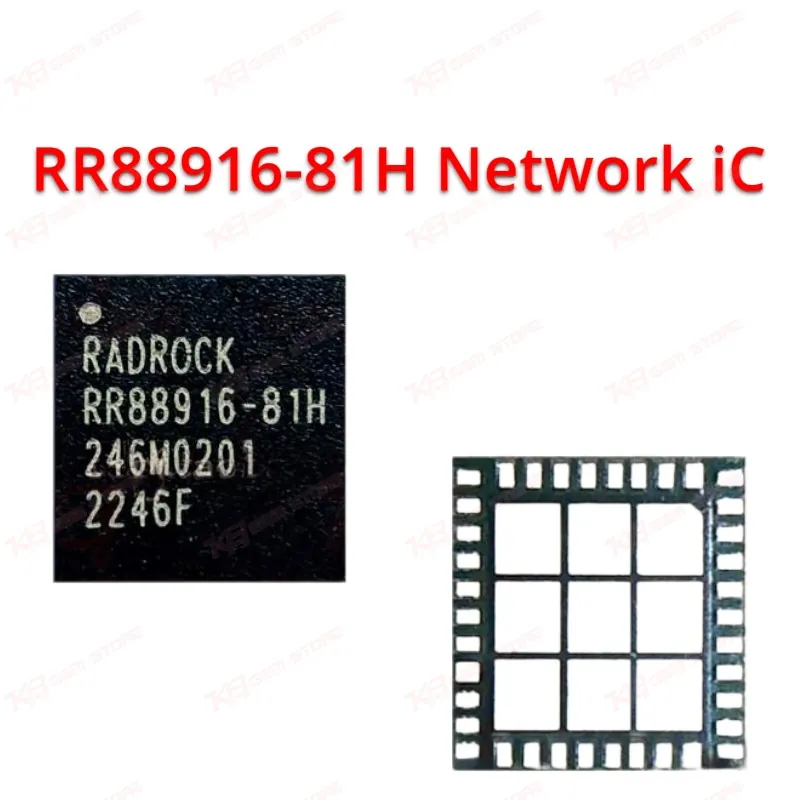
The RR88916-81H is sold across the repair trade as a "Network IC," but its actual function is that of an RF Power Amplifier (PA) IC. It does not process baseband or network protocol data on its own. Instead, it sits in the RF transmit path and boosts the outgoing signal before it reaches the antenna. Because a weak or dead PA directly causes no-service, weak-signal, and network-drop symptoms, the trade name "Network IC" stuck, even though the correct technical classification is RF Power Amplifier. Knowing this distinction matters on the bench: you are diagnosing an RF amplification fault, not a baseband processor fault, so your test approach should focus on signal path continuity and RF section shorts rather than baseband firmware issues.This IC ships in a BGA package with solder balls intact and aligned, which means it needs proper hot air rework and reballing skills for a clean replacement. Supply voltage sits in the 1.0V to 6V range, and dissipation power is rated at 0.6W, both typical for a compact RF PA stage feeding a low-power mobile transmit chain. You will find this part number stamped directly on the chip body, which makes visual identification straightforward during board-level diagnosis.
On the repair bench, you reach for the RR88916-81H when a phone shows no network, intermittent signal drop, weak signal reception, or complete no-service after a fall, liquid exposure, or a board short circuit. Since the PA stage sits close to the antenna connector and RF shield can, it is also one of the more common casualties of moisture ingress. If your diagnostic shows normal SIM detection but poor or absent network registration, and your multimeter or thermal camera points to abnormal current draw or heating around this IC location, replacement is usually the fix.For Pakistani technicians running a busy workshop, this is a straightforward IC change job once you have the right hot air station and reballing stencil for the BGA footprint. Clean the pads fully, avoid overheating the surrounding components, reball with matching solder ball size, and reflow with controlled temperature to avoid a network issue after IC change complaint coming back to your bench. Testing after reflow should confirm signal bars return to normal and network registration holds under different signal conditions.Compatibility spans several budget-segment Realme, Redmi, and POCO boards that share similar RF front-end layouts. Since these devices are heavily used across Lahore, Karachi, and Islamabad repair markets, keeping this IC in stock saves turnaround time on common no-network complaints. Always confirm the exact board revision and IC placement against your existing schematic or boardview file before starting rework, since minor board revisions across the same model name can shift component placement slightly.This part comes new and individually tested for basic functionality before it leaves the supplier, but final performance always depends on correct installation, clean pad preparation, and matching thermal profile during reflow. Store it in an anti-static container until use, and handle it with ESD precautions like any other BGA-package RF component.