


S535 Power IC
S535 Power IC
Regular price
Rs.450.00 PKR
Regular price
Sale price
Rs.450.00 PKR
Shipping calculated at checkout.
Quantity
Couldn't load pickup availability
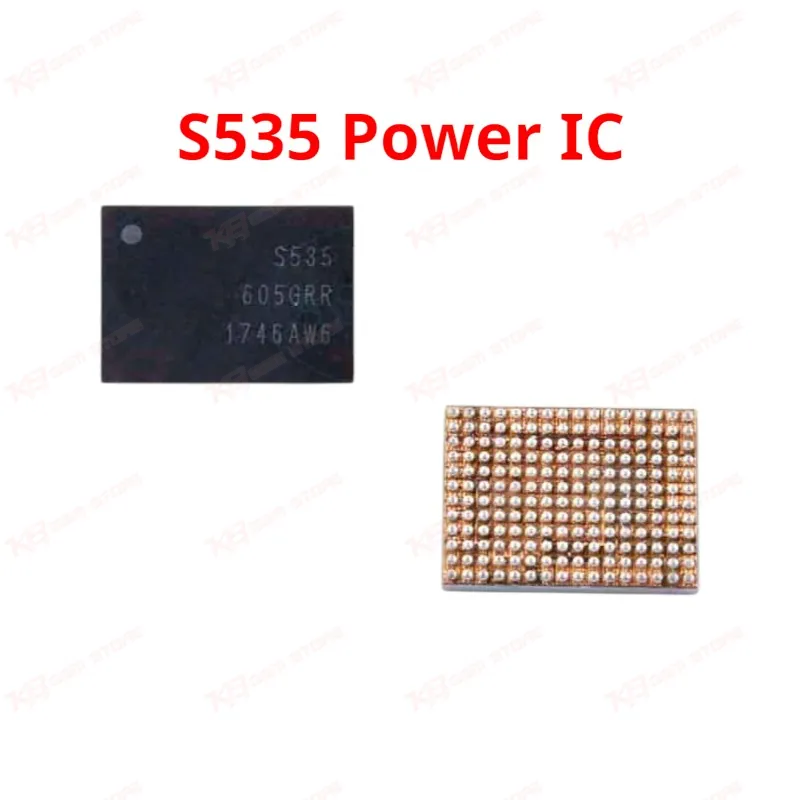
The S535 Power Management IC is the big power supply chip used on Samsung Galaxy S7 Edge (G935F/G935FD) motherboards. This BGA-packaged PMIC controls voltage regulation and power distribution across the board, and it's the go-to replacement when a Galaxy S7 Edge shows dead phone symptoms, no power, or fails to boot after a liquid or short-circuit fault. Technicians reballing or direct-heating this chip use it to restore board-level power delivery without needing a full motherboard swap, making it a standard bench stock item for any Samsung repair workshop.
⚖️ Weight: 0.01 kg
SKU:
- Safe & Secure Payment
- Fast Delivery
- WhatsApp Support


Description
FAQ
What is the product name?
The product name is Samsung S535 Power Management IC for Galaxy S7 Edge.
What is the brand of this product?
This is a compatible replacement power IC manufactured to match Samsung's original S535 chip specifications.
What is the model of this product?
The model is S535.
What is this product used for?
This product is used to replace a faulty power management IC on Samsung Galaxy S7 Edge motherboards, typically for dead phone or no-power faults.
Which devices are compatible with this product?
This product is compatible with the Samsung Galaxy S7 Edge, model numbers G935F and G935FD.
Who should use this product?
This product is suitable for mobile repair technicians, repair shops, service centers, and professional GSM repair businesses.
Is the S535 the same as the S515 or S555 IC?
No, the S535 is the "big" power management IC on the Galaxy S7 Edge board, while the S515 and S555 are separate ICs in the same power cluster with different roles.
What package type does the S535 IC use, and does it need reballing?
The S535 uses a 192-pin BGA package, so it needs to be reballed or replaced using a pre-balled chip matched to that footprint during hot air rework.