Skip to product information
1 of 4

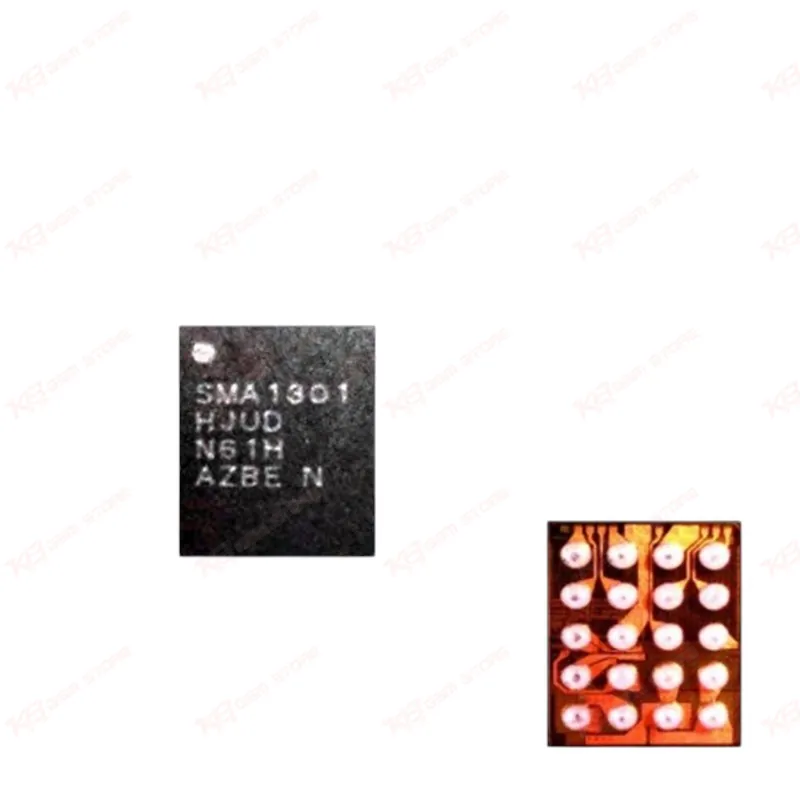
SMA1301 Audio IC for Samsung S10/S10+

SMA1301 Audio IC for Samsung S10/S10+

Regular price Rs.300.00 PKR
Regular price Sale price Rs.300.00 PKR
Sale Sold out
Shipping calculated at checkout.
Quantity

The SMA1301 is the audio amplifier IC responsible for speaker output on Samsung Galaxy S10 and S10+ boards, along with several other Galaxy A-series models. When a board shows no sound, distorted sound, or a dead speaker after a drop or liquid exposure, this chip is one of the first components a technician checks. It runs a Class-G amplifier design with a built-in boost converter, driven over an I2S digital interface. You get a direct hardware replacement for board-level audio faults, not a generic substitute — ready for reflow on affected Samsung motherboards.

⚖️ Weight: 0.01 kg

SKU:MST-IC-89

  • Safe & Secure Payment
  • Fast Delivery
  • WhatsApp Support
View full details

Description

The SMA1301 sits between the application processor and the loudspeaker on the board, and once you understand its job, most "no sound" and "distorted sound" complaints on Samsung S10-series boards start making sense. It's a smart audio amplifier chip built around Class-G control with digital feed-forward processing, paired with an integrated boost converter that lifts the output rail to a typical 5.5V–6.1V range. That boost stage is what lets a phone push loud, clean sound pressure levels out of a small speaker without a separate power supply for the amp. Audio data reaches the chip over an I2S digital interface from the processor, gets converted and boosted, then drives the speaker directly.On your repair bench, this IC becomes relevant in a specific set of situations. A phone that boots normally, shows no liquid or moisture damage on other ICs, but produces zero sound from the loudspeaker while the earpiece still works, is a strong candidate for a dead or cracked SMA1301. Distorted or crackling audio that gets worse at higher volume often points to a partially damaged amp stage rather than a speaker fault — swap the speaker first if it's quick, but don't rule out the IC. Liquid damage cases are the most common cause of failure here, since the chip sits close to the speaker mesh and charging port, both common water entry points.Diagnosis before you commit to a reflow matters. Check board power rails first with a multimeter to confirm the phone isn't shorting elsewhere, then isolate the audio path — if the earpiece and ringer both fail along with the loudspeaker, look at the audio codec or processor before blaming this IC alone. If only the loudspeaker channel is affected and the board is otherwise clean, the SMA1301 is the more likely fault. Reballing this chip needs a controlled hot air station with accurate temperature profiles, since the WLCSP and QFN packages used for this part are sensitive to overheating the substrate underneath — going too hot risks lifting nearby components or damaging board pads.Fitting this replacement is a board-level job, not a plug-in part. You'll need a microscope for alignment, a BGA rework station or precision hot air setup, appropriate flux, and a reballing stencil sized for this package if you're reworking rather than swapping a pre-balled chip. Confirm orientation against the original component before removing it — desolder, clean the pad thoroughly, tin if needed, then reflow the replacement using a profile matched to the package type. Skipping the cleaning step is one of the most common reasons a reflow job comes back with the same fault a week later.This part fits into the broader board-level repair workflow alongside your other audio and power ICs — treat it the same way you'd treat a charging IC or PMIC fault: isolate first, confirm with continuity or power checks where possible, then commit to reflow. For shops handling Samsung Galaxy S10-series and A-series boards regularly, keeping a few of these in stock alongside a compatible charging IC and PMIC saves a return trip for the customer when liquid damage takes out more than one component at once.

Key Features

Class-G amplifier design for efficient, high-output speaker performance

Integrated boost converter removes the need for a separate power rail to the amp

Digital feed-forward control for stable output under varying load

I2S digital interface for direct connection to the processor's audio path

Available in WLCSP and QFN packages to match different board layouts

Direct board-level replacement for Samsung S10-series and select A-series boards

Compact footprint suited for tight motherboard component placement

Reworkable with standard BGA/QFN hot air reflow equipment

Specifications

Brand Entity Silicon Mitus (Iron Device) Product Entity

Compatible Devices

Samsung Galaxy S10e (G970), Galaxy S10 (G973), Galaxy S10+ (G975), Galaxy S10 5G, Galaxy Note10 5G, Galaxy A10 (A105), Galaxy A50 (A505), Galaxy A20 (A205), Galaxy A30 (A305), Galaxy A40 (A405)

Common Repair Uses


Dead loudspeaker repair after liquid damage, distorted or crackling speaker audio fault isolation, board-level audio IC reballing and reflow, no-sound-from-speaker diagnosis where earpiece still functions, audio path troubleshooting during liquid-damage board recovery

FAQ

What is the product name?
The product name is SMA1301 Audio IC for Samsung S10/S10+.
What is the brand of this product?
This chip is designed by Silicon Mitus (Iron Device).
What is the model of this product?
The model is SMA1301. What is this product used for?
Which devices are compatible with this product?
It's compatible with Samsung Galaxy S10e, S10, S10+, S10 5G, Note10 5G, A10, A20, A30, A40, and A50.
Who should use this product?
This product is suitable for mobile repair technicians, repair shops, service centers, and professional users.
Does this IC support I2S digital audio input, or is it analog?
The SMA1301 uses an I2S digital interface for audio data from the processor, not an analog input.
What causes the SMA1301 to fail on a Samsung S10 board?
Liquid damage near the speaker mesh and charging port is the most common cause, since the chip sits close to both entry points; physical board damage from drops can also crack the package.

Ask any Query