


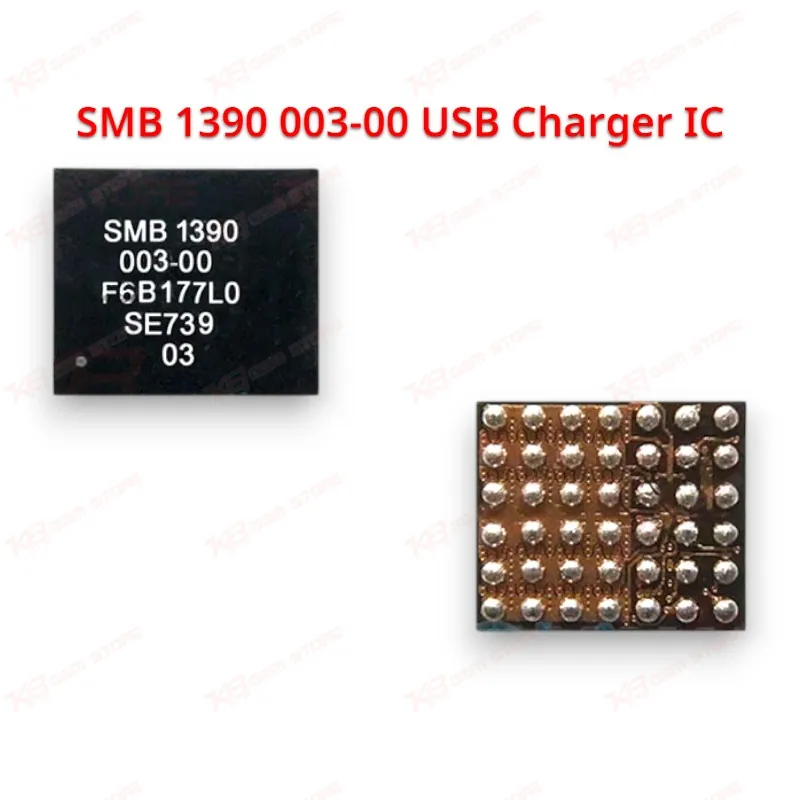
SMB 1390 003-00 USB Charger IC
SMB 1390 003-00 USB Charger IC
Regular price
Rs.450.00 PKR
Regular price
Sale price
Rs.450.00 PKR
Shipping calculated at checkout.
Quantity
Couldn't load pickup availability
The SMB1390 003-00 is Qualcomm's divide-by-2 charge pump IC, built for high-efficiency single-cell Li-ion and Li-polymer fast charging. You'll find this chip on the charging circuit of Snapdragon-based phones running Quick Charge 3.0 and Quick Charge 4. It handles up to 6A output current per device, withstands 28V DC input, and removes the need for bulky inductors on the board. Pick this IC when you're chasing a dead-after-flash charging fault, a "not fast charging" complaint, or a board that heats up on the charge pump line. Genuine part, tested before dispatch, ready for your repair bench.
⚖️ Weight: 0.01 kg
SKU:MST-IC-125
- Safe & Secure Payment
- Fast Delivery
- WhatsApp Support


Description
FAQ
What is the product name?
The product name is SMB1390 003-00 Charging IC.
What is the brand of this product?
The brand of this product is Qualcomm.
What is the model of this product?
The model of this product is SMB1390-003-00.
What is this product used for?
This product is used for high-efficiency fast charging on single-cell Li-ion and Li-polymer battery circuits.
Which devices are compatible with this product?
This product is compatible with Snapdragon-based smartphones using Qualcomm Quick Charge 3.0 / Quick Charge 4 charge pump architecture.
Who should use this product?
This product is suitable for mobile repair technicians, repair shops, service centers, and professional users.
Does the SMB1390 003-00 support Quick Charge 3.0 and Quick Charge 4?
Yes, this IC supports both Qualcomm Quick Charge 3.0 and Quick Charge 4 technology.
What is the maximum input voltage this charge pump IC can withstand?
The SMB1390 003-00 carries a 28V DC withstand rating on the input side.