


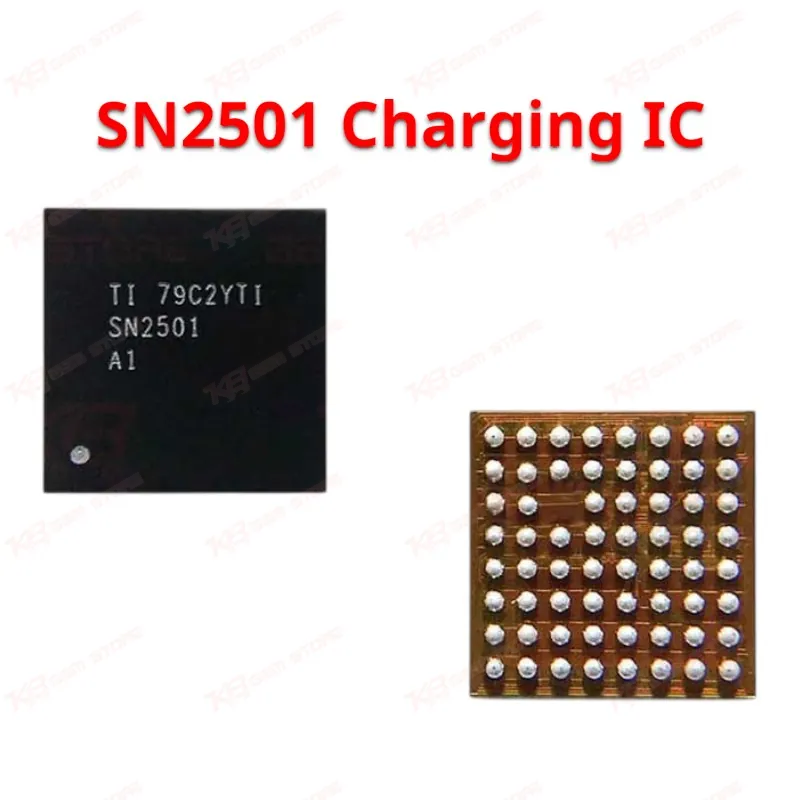
SN2501 Charging IC
SN2501 Charging IC
Regular price
Rs.250.00 PKR
Regular price
Sale price
Rs.250.00 PKR
Shipping calculated at checkout.
Quantity
Couldn't load pickup availability
The SN2501 charging IC, board-marked U3300, controls USB charging on iPhone 8, 8 Plus, and X logic boards. Technicians know it as the Tigris charging chip — the part that decides whether a phone charges at all once the cable and port test clean. When a device shows a dead phone symptom on power, charges intermittently, or stops charging after liquid damage, this IC is often the root cause. KB GSM Store stocks the SN2501 for board-level repair work, tested before dispatch and ready for reflow on your bench.
⚖️ Weight: 0.01 kg
SKU:MST-IC-140
- Safe & Secure Payment
- Fast Delivery
- WhatsApp Support


Description
FAQ
What is the product name?
The product name is the SN2501 Charging IC.
What is the brand of this product?
This IC is compatible with Apple iPhone boards and belongs to the Tigris charging-controller chip family.
What is the model of this product?
The model is SN2501 (also known by its board designation, U3300).
What is this product used for?
It's used to repair no-charging and intermittent-charging faults at the board level on affected iPhone models.
Which devices are compatible with this product?
It's compatible with iPhone 8, iPhone 8 Plus, and iPhone X.
Who should use this product?
This IC suits mobile repair technicians, repair shops, service centers, and microsoldering professionals.
Does this IC need to be reflowed with hot air, or can it be soldered with an iron?
It needs hot air rework — the SN2501 is a leadless package, so a soldering iron can't properly reflow the pads underneath.
Can a bad SN2501 cause a phone to show a dead phone symptom, or only charging issues?
It typically only affects charging behavior — the phone still boots and runs on remaining battery charge, so a true dead phone points elsewhere, usually the PMIC or battery connector.