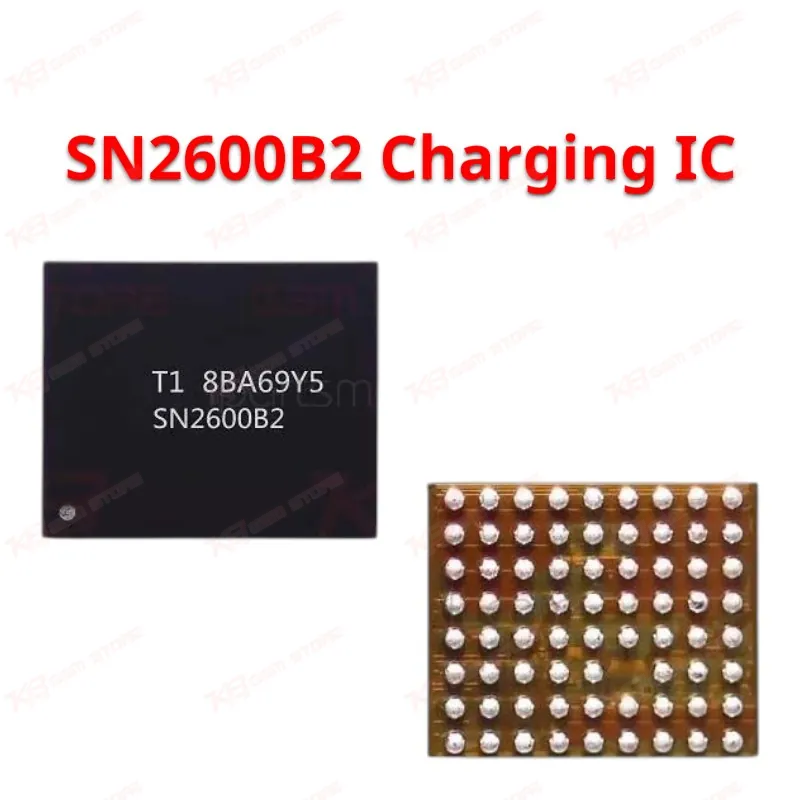
When an iPhone XS, XS Max, or XR comes into your workshop with a charging issue that survives a battery swap, a port cleaning, and a cable test, the fault usually sits deeper on the board — at the U3300 position, where the SN2600B2 Tigris charging IC lives. Texas Instruments builds this chip as part of the Tigris family, the direct successor to the Tristar and Hydra charging controllers used on iPhone 7 and iPhone 8 generation boards. On XS, XS Max, and XR logic boards, the SN2600B2 sits between the Lightning connector's power path and the board's charging and power management circuitry, controlling how charging current gets negotiated and delivered to the battery.You'll typically pull this chip out of the box for one of a few recurring bench scenarios. The most common is a dead phone that draws little or no current on the bench power supply after a full DFU restore and known-good battery — a classic sign the charging controller itself has failed rather than the battery or connector. Slow charging or charging that starts and stops erratically also points here, especially on boards that show visible corrosion or heat damage near U3300 from liquid exposure or a shorted charger. Boards that survived a drop with a cracked or lifted connector sometimes carry secondary IC damage that only shows up once the connector repair is done and the charging fault persists.Because the SN2600B2 sits directly under BGA balls, replacing it means full IC reballing rather than a simple solder-and-swap. You'll need a hot air rework station with tight temperature control, flux, and either a stencil or manual reballing technique to reseat the chip without disturbing neighboring components — the USB-PD controller and any nearby filter capacitors sit close enough that sloppy hot air work risks collateral damage. Before you commit to an IC change, always confirm the fault sits at U3300 rather than at the connector, the battery gas gauge, or the PMU, since those failure modes can present with almost identical symptoms on the bench.This chip ships as an OEM-grade replacement manufactured to the same TI silicon specification as the original part fitted at the factory, so it drops into the existing board layout without requiring firmware changes or board modifications. Boards using SN2600B1 as an alternate revision marking at the same U3300 position are functionally compatible, and many suppliers stock both revisions together for exactly this reason.For a Pakistani repair shop handling a steady flow of XS, XS Max, and XR boards — whether from liquid damage, counterfeit charger burnout, or general board-level failures — keeping SN2600B2 stock on hand cuts turnaround time on one of the more frequent charging-related board repairs you'll see on this generation of devices. Pair it with a proper hot air station and a stencil or paste-based reballing kit, and diagnose down to the U3300 position with a bench power supply before ordering the part, so the IC change actually resolves the fault rather than adding an unnecessary reflow cycle to the board.