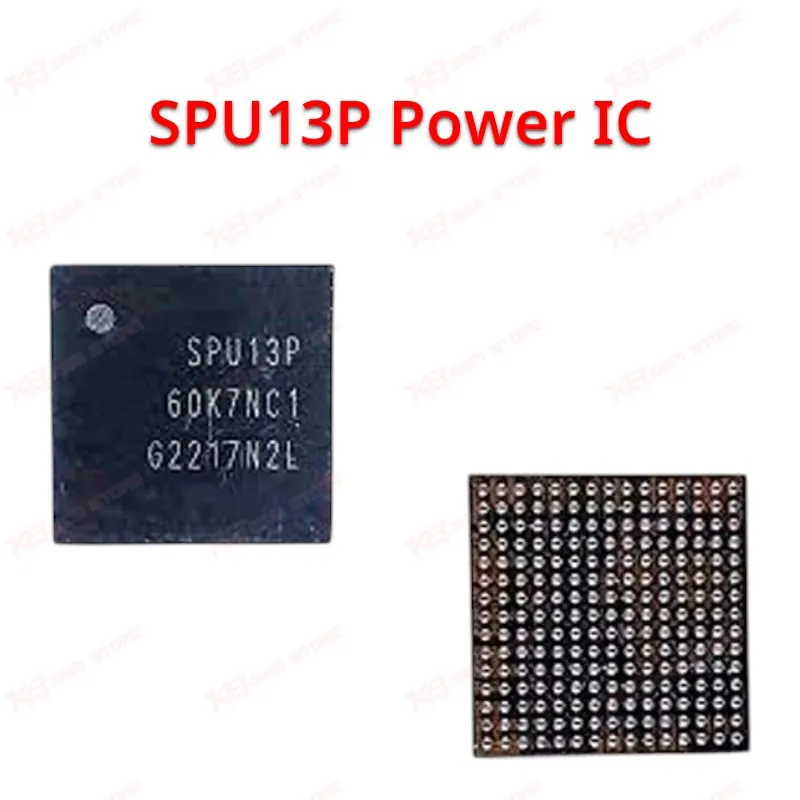
Every power-related fault on a Samsung Galaxy A53 5G eventually leads back to one question: is the power management IC still doing its job. The SPU13P sits at the center of that question. As a BGA voltage regulator, its role is to take raw input from the battery and charging circuit and convert it into the stable, correctly-sequenced voltage rails that every other component on the SM-A536 motherboard depends on. When it fails, the phone doesn't always announce it clearly — you might see a dead phone that won't power on at all, a device that boots and then instantly shuts down, or a board that draws current on your DC power supply but never wakes the display.For a technician working a Galaxy A53 board, the SPU13P becomes a suspect any time diagnostics rule out the battery, the charging port, and the obvious mechanical damage. A board that hangs on logo after a fresh flash, a phone that shows charging issue symptoms even with a known-good cable and adapter, or a unit that keeps resetting under light load are all patterns that point toward the power IC rather than software. Before pulling the chip, check current draw on your bench power supply, confirm there's no short elsewhere on the board, and verify the charging IC and battery connector aren't the actual source of the fault — this keeps you from removing a working SPU13P and chasing the wrong repair.Physically, the SPU13P is a BGA (Ball Grid Array) component, which means it mounts flush to the board with solder balls underneath rather than visible legs. That makes rework more demanding than a standard SMD part. You'll need a calibrated hot air station, the correct nozzle size for the chip footprint, quality flux, and either a matching stencil or a reliable manual reballing technique if you're reusing the original ball pattern. Board cleaning before and after the reflow matters just as much as the reflow itself — residual flux or misaligned balls are a common reason a fresh SPU13P install still leaves the phone dead after flash.Because this IC handles core voltage regulation, precision during removal is non-negotiable. Overheating the surrounding area risks lifting nearby components or damaging solder mask, and under-heating leaves cold joints that produce intermittent faults — the kind that pass a bench test but fail again in the customer's hands. ESD protection through the whole process protects both the new chip and every other component still on the board.The SPU13P is not a universal part. It's built specifically for the Galaxy A53 5G platform and should not be substituted onto other Samsung boards without confirming the exact model match, since power IC pinouts and voltage sequencing vary across chipset families even within the same brand. For shops that handle Samsung A-series repairs regularly, keeping this part in stock alongside your reballing stencils and hot air consumables shortens turnaround on power-related jobs that would otherwise sit waiting for parts.