


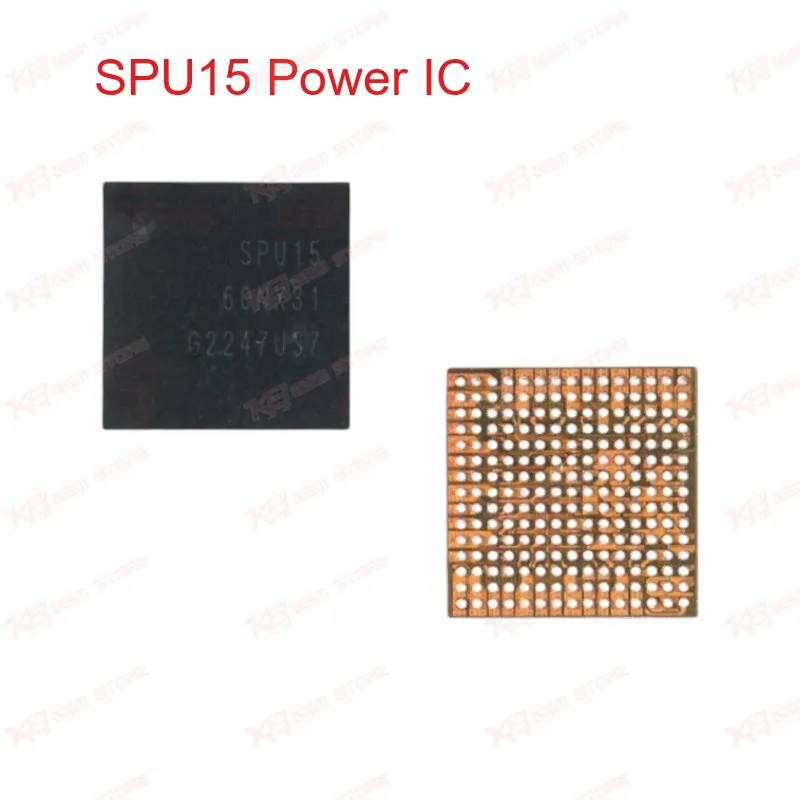
SPU15 Power IC
SPU15 Power IC
Regular price
Rs.900.00 PKR
Regular price
Sale price
Rs.900.00 PKR
Shipping calculated at checkout.
Quantity
Couldn't load pickup availability
The SPU15 Power IC is a power management chip (PMIC) used on Samsung Galaxy A14, A54 5G (A546), M14 5G, and Google Pixel 7/8 motherboards. It regulates voltage distribution to the CPU, memory, and peripheral circuits. Technicians reach for this IC when a board shows dead phone symptoms, no power, boot loop, or unstable current draw linked to PMIC failure. Built in SMD package for direct board-level reflow, it fits straight into your existing hot air rework or IC change workflow without extra adapters. A dependable pick for your repair bench when power-related faults point back to the PMIC stage.
⚖️ Weight: 0.01 kg
SKU:MST-IC-376
- Safe & Secure Payment
- Fast Delivery
- WhatsApp Support


Description
FAQ
What is the product name?
The product name is SPU15 Power Management IC.
What is the model of this product?
The model is SPU15.
What is this product used for?
This IC is used for power rail management on the motherboard, regulating voltage to the CPU, memory, and peripheral circuits.
Which devices are compatible with this product?
This IC is compatible with Samsung Galaxy A14, Galaxy A54 5G (A546), Galaxy M14 5G, and Google Pixel 7/8.
Who should use this product?
This product is suitable for mobile repair technicians, repair shops, service centers, and professional users.
Does this IC fix boot loop and dead phone issues on Samsung boards?
Yes, when the fault traces to PMIC failure on the power rail, replacing the SPU15 restores normal boot and power behavior.
Is the SPU15 compatible with both Samsung and Google Pixel boards?
Yes, it is used across specific Samsung A-series and M-series boards as well as Pixel 7 and Pixel 8 motherboards.