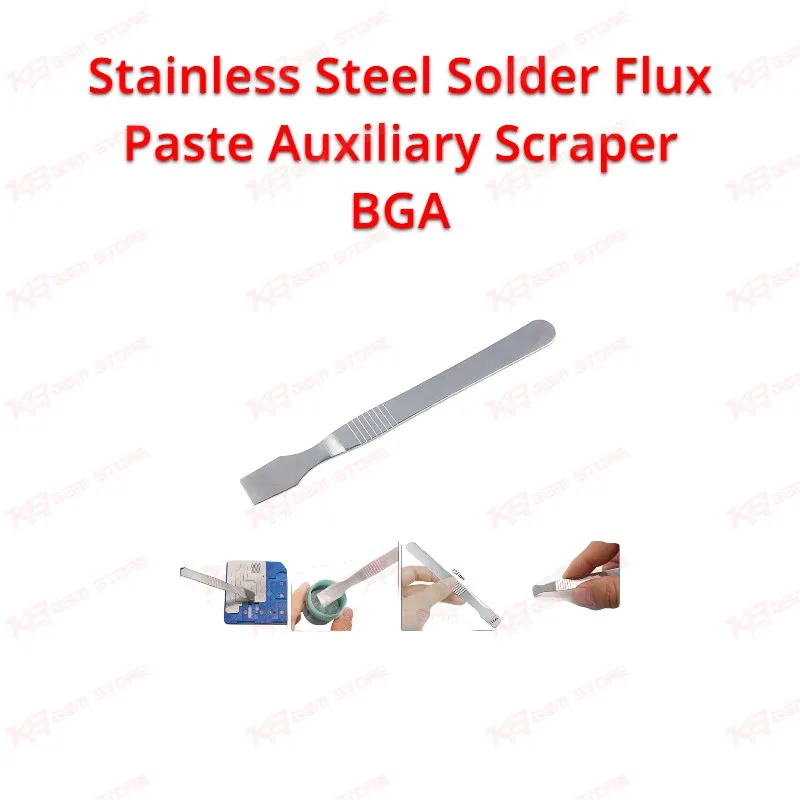
Every BGA rework station needs a dependable scraping tool, and the Stainless Steel Solder Flux Paste Auxiliary Scraper handles that role without complications. This is one of those simple tools that technicians reach for dozens of times a day, whether they're spreading solder paste before reballing a PMIC, cleaning old flux residue off a motherboard, or prying open a phone shell during a screen change.The scraper is machined from stainless steel, giving it enough rigidity to work solder paste evenly across a stencil or chip pad without the blade flexing or bending under pressure. That rigidity matters during BGA paving work, where an uneven scrape leaves inconsistent paste thickness and leads to bridging or cold joints after reflow. A firm, flat edge lets you control paste depth and direction, which keeps your reballing results consistent from one board to the next.Beyond solder paste work, this tool functions as a general-purpose spudger. The thin profile slides into shell seams for opening phone housings without marking the casing, and it works equally well for popping open battery covers, separating LCD assemblies, or lifting adhesive-mounted components. Many technicians keep one dedicated purely for solder work and a second for shell opening, since flux residue can transfer onto plastic if the same tool switches between tasks without cleaning.The handle carries an anti-slip texture and a bright polished finish, so grip stays secure even when your hands pick up flux or isopropyl alcohol during cleanup. Ergonomic sizing means the tool sits comfortably against the palm during extended scraping sessions, reducing hand fatigue on days filled with repetitive board work.Durability is a practical concern with any bench tool that sees daily flux exposure. Stainless steel resists the corrosive effect of no-clean and RA flux formulas far better than plain carbon steel, so the blade edge stays sharp and true without pitting or rust developing over months of use. That corrosion resistance also keeps the scraper safe to use directly against exposed board traces and components without introducing contamination.In a typical repair workshop, this tool shows up across several stages of the workflow. During dead phone diagnosis, it helps separate the board from the housing for testing. During IC change or PMIC replacement, it spreads solder paste evenly before the chip goes down on the hot air station or preheater. During display or charging port repair, it pries open seams and lifts adhesive without scratching the frame. It also earns use during general board cleaning, scraping away hardened flux or old thermal paste before a fresh application.For shops running high repair volume — phone hang on logo cases, charging issue diagnostics, network issue troubleshooting, or board-level component swaps — having a dedicated scraper on the bench cuts down on improvised tool use that risks damaging boards or components. It's inexpensive relative to programmers or hot air stations, but it directly affects the quality of your reballing and paving results.This scraper fits naturally alongside other bench essentials: hot air rework stations, preheaters, tweezers, flux, and solder paste. Pairing it with a quality flux and a stencil kit rounds out a complete BGA reballing setup for technicians handling PMICs, CPU ICs, or NAND chips on a regular basis.Available at KB GSM Store for technicians across Lahore, Karachi, Islamabad, and workshops throughout Pakistan, this scraper is a low-cost, high-utility addition to any repair bench.