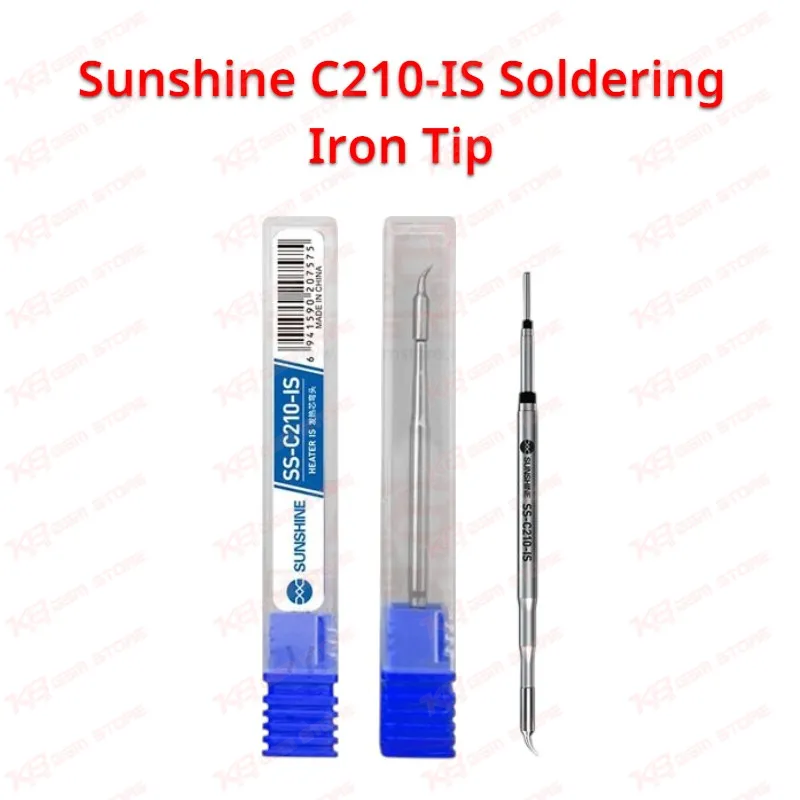
When you're working chip-level repair on a crowded mobile motherboard, the tip you're holding matters as much as the station driving it, and the Sunshine SS-C210-IS earns its place on the bench through a curved, fine geometry built for tight, fiddly joints rather than bulk soldering work. The integrated heating core sits directly behind the tip instead of relying on a separate heating element transferring warmth across a gap, so you get quicker temperature recovery between joints and less lag when you move from one pad to the next on a busy board. That matters most during flying lead desoldering, CPU-adjacent component work, and small IC reattachment, where a slow-recovering tip forces you to hover and wait instead of moving through the job. Sunshine electroplates the tip surface using a nano-layer process aimed at oxidation and corrosion resistance, which keeps the working end brighter and tin-receptive for longer stretches than a plain-plated tip typically manages, and that translates into cleaner joints with less scrubbing on your cleaning sponge or brass wool between solder points. The curved IS profile gives you an angled contact point that's suited to reaching components tucked near connectors, shields, or raised parts on a populated board, a shape that straight I-style tips struggle with when you're trying to keep the iron body clear of surrounding parts. Compatibility runs across the T210 handle family, along with T26, S210, and C210 handpieces, and because these handles follow the same physical interface used across several JBC T12-style stations, the tip also works on Aixun, GVM, and OSS units built to that same handle standard, giving you flexibility if your workshop runs more than one station brand. In day-to-day repair work this tip earns its keep on lead-free solder just as comfortably as leaded, since the fast heat-up and quick recovery reduce the extra dwell time lead-free alloys usually demand, meaning you're not sitting on a pad longer than necessary and risking pad lift or a burnt board. Technicians handling a dead phone that turns out to be a cracked solder joint or a lifted component rather than a chip failure will find the fine tip useful for touch-up work that a general-purpose tip is too blunt to manage cleanly, and the same profile helps when you're reflowing a marginal joint that's causing an intermittent charging issue or a hardware fault that only shows up under pressure on the board. Because the heating core and tip are one integrated unit, there's less internal thermal mass fighting you, which shows up practically as steadier temperature holding through longer sessions of PCB rework, board cleaning follow-up, or reballing-adjacent touch-up soldering where you're moving quickly between several small joints. Stainless steel construction on the housing adds durability against the daily knocks of a busy repair counter, and the tin-plated working surface is designed to stay wettable across repeated tinning cycles rather than degrading after a handful of uses. For a repair shop running multiple technicians on shared stations, having a reliable, fast-recovering tip on hand cuts down on the downtime that comes from swapping to a spare mid-job, and the T210-family compatibility means you're not locked into a single station brand if your workshop mixes equipment. Overall, this tip is built around a straightforward goal: keep chip-level and fine-pitch soldering moving quickly and cleanly, without the tip becoming the bottleneck between you and the next joint on the board.