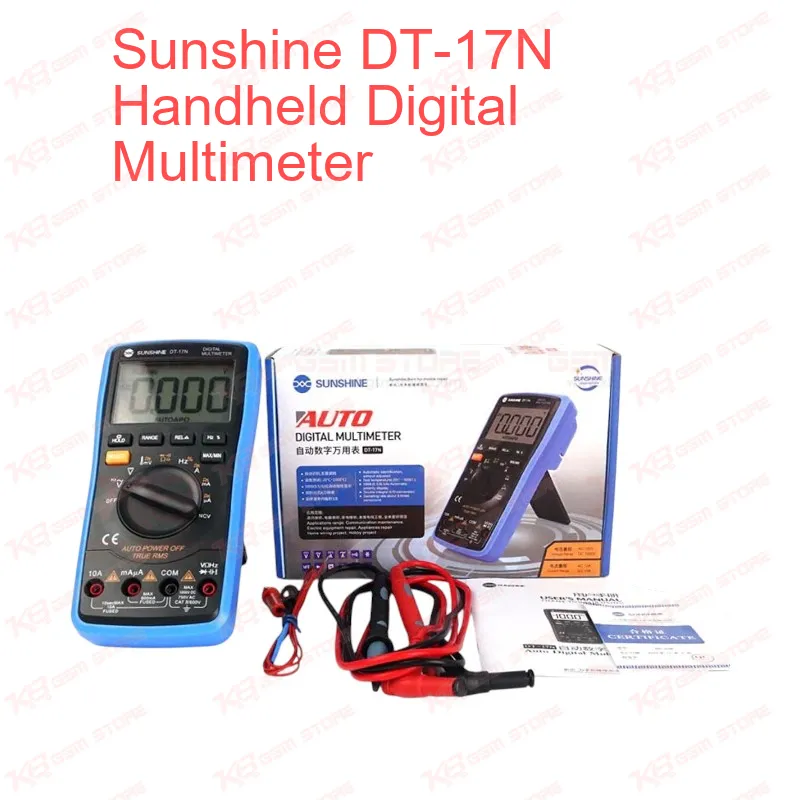
Every repair bench starts with the same question: is the fault power, continuity, or component? The Sunshine DT-17N answers that question fast. Manufactured by Guangzhou Sunshine Electronics Technology Co., Ltd., this auto-ranging true RMS multimeter combines voltage, current, resistance, capacitance, frequency, and temperature measurement into one compact handheld unit, so you stop switching between separate testers for different checks.Auto-ranging is the feature technicians notice first. You touch the probes to a test point and the DT-17N selects the correct range on its own, instead of you cycling through a dial while a customer waits. True RMS measurement means the readings stay accurate even on the noisy, non-sinusoidal signals you find inside phone boards and chargers, where a cheap averaging meter reads wrong. Automatic polarity display removes another manual step — you don't need to worry about probe orientation when checking a diode or a power line on a dead board.The DT-17N reads through a large LCD with backlight, activated by pressing and holding the HOLD button. That backlight matters when you're working under a bench lamp or inside a dim workshop, and the HOLD function itself lets you freeze a reading to note it down without staring at the probes. Non-contact voltage (NCV) detection adds a safety layer most basic multimeters skip — you can sense live AC near a wire or connector before you touch it with a probe, which is useful when tracing wiring on unfamiliar boards or checking mains-side components on a charger.Double insulation protection runs through the housing, giving you a safety margin while testing charging circuits, adapters, and other mains-adjacent points. The multimeter also carries a clear safety threshold: voltages above 30V AC RMS, 42V peak, or 60V DC carry shock risk, so the meter is built to alert and protect you at that boundary rather than leaving you guessing.On a Pakistani repair bench, this is the tool you reach for before you touch a screwdriver. Suspect a dead phone with no power? Check the battery connector voltage first. Board hang on logo after a bad flash? Run a continuity check across the ISP pinout before you assume it's a software marna case. Jumper lagana on a broken trace only works if you first confirm the trace is actually open, and a quick resistance reading on the DT-17N settles that in seconds. Charging issue on the bench? Measure the input rail at the charging port before you pull the IC. Diode test mode catches shorted components on a board fast, letting you isolate a hardware fault instead of reflashing a phone that never needed software.Capacitance and frequency measurement extend the DT-17N past basic voltage checks — useful when validating small components pulled during rework, or confirming a clock signal is present on a suspect line. Temperature measurement rounds out the toolset, letting you monitor a board or a soldering iron tip without a separate thermometer on the bench.For a service center handling volume repairs, having one meter that covers power checks, continuity, component testing, and safety detection cuts the time spent switching tools between jobs. The DT-17N fits that workflow directly — pick it up, touch the probes down, and get an accurate reading without adjusting a single dial.