


Brand:
SUNSHINE
Sunshine P1 Pro Max Power Supply
Sunshine P1 Pro Max Power Supply
Regular price
Rs.35,000.00 PKR
Regular price
Sale price
Rs.35,000.00 PKR
Shipping calculated at checkout.
Quantity
Couldn't load pickup availability
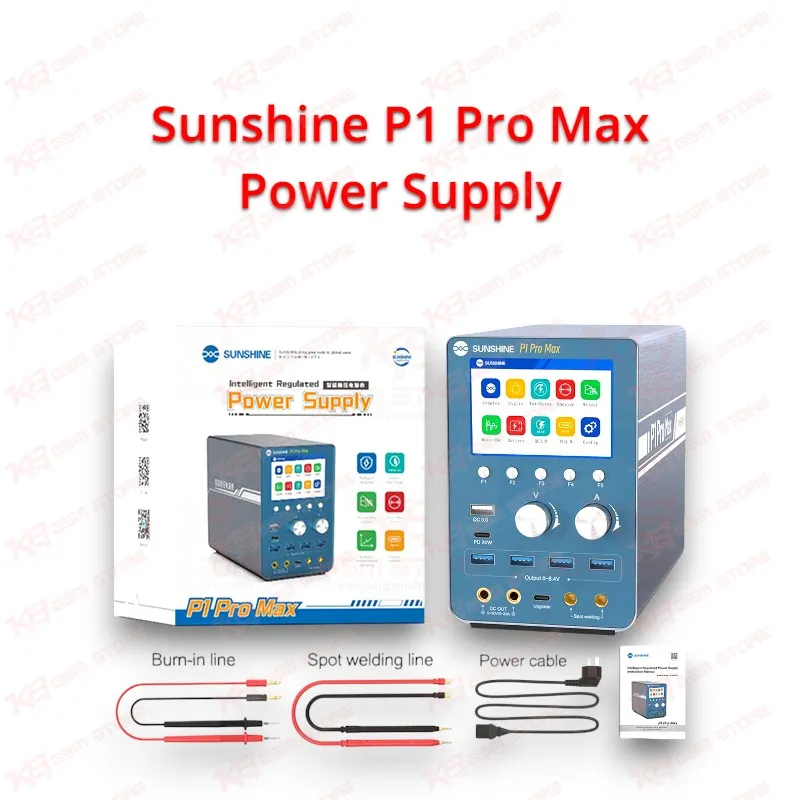
The Sunshine P1 Pro Max is an intelligent regulated power supply for mobile phone and electronic repair benches. You get a 0–30V, 0–20A main output, a separate 0–8.4V, 0–6A startup output, a power meter and waveform display. It also adds burn-in, battery testing, battery spot welding and QC/PD fast charging. Use it to power dead phones, trace short-circuit faults on the motherboard and test or weld lithium batteries. It runs on 100V–240V 50/60Hz input with 250W total output power. Repair shops and service centers in Pakistan can use it as one multi-function power source.
⚖️ Weight: 2.0 kg
SKU:MST-POWER-SUPPLY-CHARGER-20
- Safe & Secure Payment
- Fast Delivery
- WhatsApp Support


Description
FAQ
What is the product name?
The product name is Sunshine P1 Pro Max Intelligent Regulated Power Supply.
What is the brand of this product?
The brand of this product is Sunshine.
What is the model of this product?
The model of this product is P1 Pro Max.
What is this product used for?
This product powers and tests mobile phone motherboards and batteries. It supports short-circuit fault diagnosis, battery testing, battery spot welding, burn-in testing and fast charging checks.
Which devices are compatible with this product?
This product serves mobile phone and electronic repair work, including motherboards and lithium batteries. Set the voltage and current to match the requirements of the board or battery you test.
Who should use this product?
This product is suitable for mobile repair technicians, repair shops, service centers, and professional users.
What are the main and startup output ranges of the Sunshine P1 Pro Max?
The main output runs from 0–30V and 0–20A. The startup power output runs from 0–8.4V and 0–6A. Total output power is 250W.
Does the Sunshine P1 Pro Max support battery spot welding and fast charging?
Yes. It includes a battery spot welding function for lithium battery repair and a QC/PD 18W fast charging port.