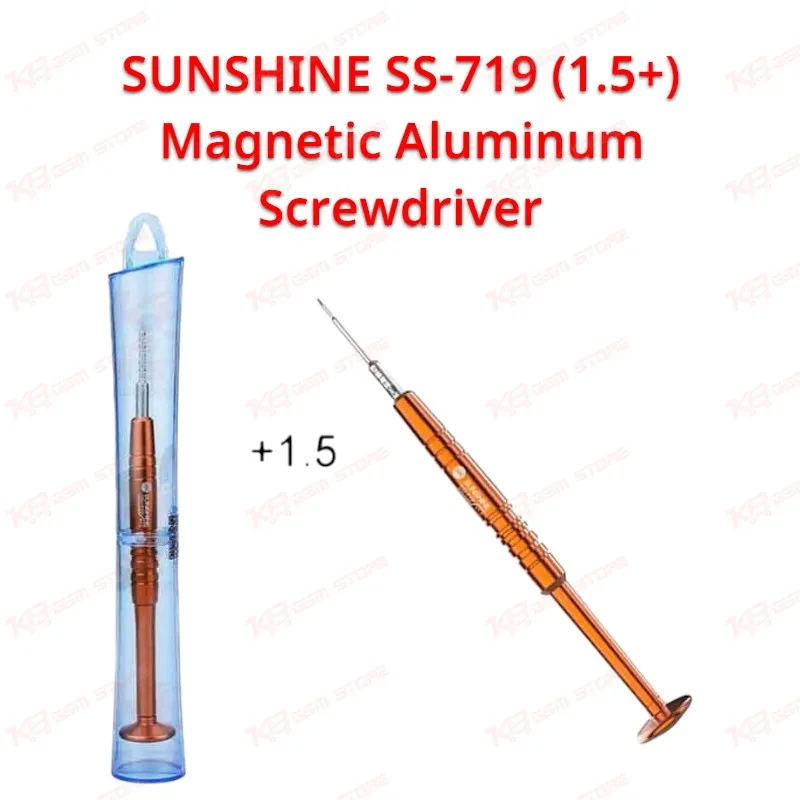
Every mobile repair technician knows the frustration of a screwdriver bit that rounds off halfway through a job, and that's exactly the problem the SUNSHINE SS-719 (1.5+) is built to solve. This precision screwdriver uses a Phillips +1.5 S2 steel bit hardened to HRC56-59, which means it holds its edge through repeated use on the small cross-head screws found across smartphone logic boards, battery brackets, camera modules, and connector housings. When you're stripping down a dead phone for diagnosis or pulling a charging port assembly for replacement, the bit needs to grip the screw head cleanly on the first try, and the hardened steel construction keeps that consistency job after job instead of degrading after a few dozen uses. The aluminum alloy handle gives the tool a light, balanced feel in hand, which matters when you're doing repetitive teardown work across multiple devices in a single shift. Anti-slip texture on the grip means you keep control even when your hands are covered in flux residue or isopropyl alcohol from board cleaning, so the driver doesn't twist or slip mid-turn on a tight screw. That kind of grip stability directly reduces the risk of cam-out, which is one of the most common causes of stripped screw heads on repair benches. Magnetic adsorption built into the tip is another practical detail technicians rely on daily. Mobile repair screws are tiny, often under a few millimeters, and losing one inside a phone chassis or off the edge of a workbench wastes real time. The magnetized bit holds the screw in place as you position and remove it, so you're not chasing loose hardware across the table between steps. This becomes especially useful during full disassembly jobs where dozens of screws come out in sequence and staying organized is part of doing the repair efficiently. The +1.5 size on this driver fits a specific but common range of Phillips screws used in phone and tablet assembly, particularly around mid-size structural screws that are larger than the ultra-fine +1.2 bits but smaller than standard electronics screws. Having the correct tip size matters more than technicians sometimes expect, since an undersized or oversized Phillips bit will chew up the screw head even under light torque. Keeping a dedicated +1.5 driver on the bench means you're not forcing a mismatched bit into a screw and creating a problem that makes the next disassembly harder. In a typical Pakistani repair workshop, this driver fits naturally into daily diagnostic and repair workflows: opening a device to check for a hardware fault, removing a board for IC change karna, freeing up brackets during a charging issue repair, or working through a full teardown when a customer reports a dead phone. The build quality is aimed at technicians who open dozens of devices a week, not occasional hobbyist use, so the combination of a hardened bit and a durable aluminum body is meant to hold up under that repeated bench workload. For any shop running FRP lock, software marna, or hardware-level repair jobs where screw removal is the first step before real diagnostic work begins, a reliable +1.5 driver like this one belongs in the standard toolkit next to your ISP pinout tools, test boxes, and PCB holders.