


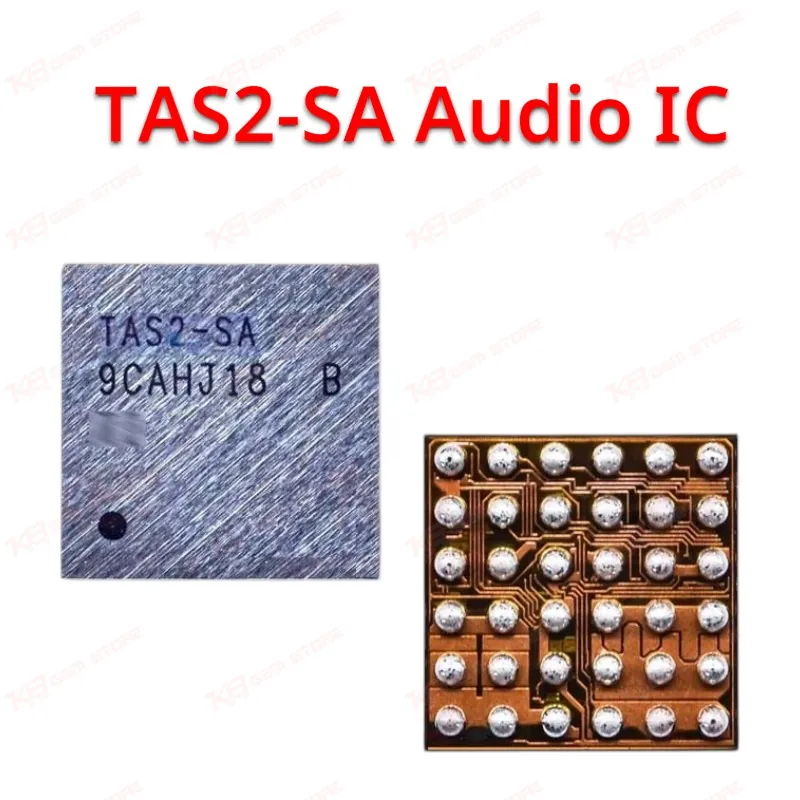
TAS2-SA Audio IC
TAS2-SA Audio IC
Regular price
Rs.450.00 PKR
Regular price
Sale price
Rs.450.00 PKR
Shipping calculated at checkout.
Quantity
Couldn't load pickup availability
TAS2-SA is the board marking for the Texas Instruments TAS2562YFPT, a 6.1W digital-input Class-D audio amplifier with integrated I/V sense and Class-H boost. Technicians find this IC on Huawei, Honor, and Xiaomi boards where the speaker output stage handles audio power delivery. When a phone has no sound, distorted audio, weak speaker output, or dead earpiece after a drop or moisture damage, this chip is one of the first things to check on the board. It comes in a compact 36-ball DSBGA package, so reballing or hot air replacement needs a steady hand and the right stencil size.
⚖️ Weight: 0.01 kg
SKU:MST-IC-275
- Safe & Secure Payment
- Fast Delivery
- WhatsApp Support


Description
FAQ
What is the product name?
The product name is TAS2-SA Audio IC.
What is the brand of this product?
The brand of this product is Texas Instruments.
What is the model of this product?
The model is TAS2562YFPT, printed on the board as TAS2-SA.
What is this product used for?
This IC is used to fix no-sound, distorted audio, and weak speaker faults on supported phone boards.
Which devices are compatible with this product?
This IC is commonly found on Huawei Honor 20, Mate 30 Pro, Nova 5i, Nova 4e, and select Xiaomi/Redmi boards — confirm the marking on your board before ordering.
Who should use this product?
This product is suitable for mobile repair technicians, repair shops, service centers, and professional users.
What voltage does the TAS2-SA IC operate at?
It operates on a supply voltage range of 1.65V to 1.95V, so always confirm the board's VSUP rail before reballing.
Can the TAS2-SA IC cause a dead speaker after water damage?
Yes, liquid exposure near the speaker mesh and charging port commonly shorts this IC's VSUP rail, causing no sound or a dead speaker.