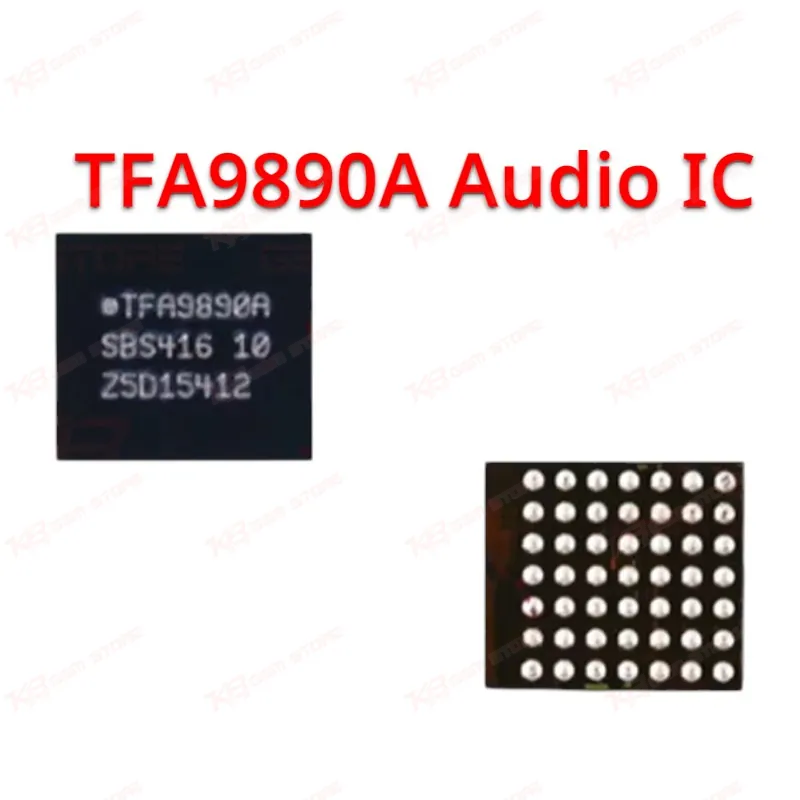
When a phone comes in with a dead speaker, distorted output, or audio that cuts out at volume, the TFA9890A is often the chip sitting behind that fault. This is NXP's boosted Class-D audio amplifier, purpose-built for mobile handsets that need more speaker output than a standard 5V rail can deliver. It takes the battery supply and boosts it internally up to 9.5V, giving the amplifier the headroom to push 7.2W of peak power into an 8Ω speaker — output that a plain 3.6V-fed amp simply cannot reach without clipping.On your repair bench, this chip covers the classic "no sound after drop" or "speaker rattling on max volume" cases. Its SpeakerBoost protection algorithm — running on an internal CoolFlux DSP — continuously models the speaker's excursion and voice-coil temperature, so it pushes the loudest safe output without blowing the diaphragm. If a customer's phone has weak or crackling audio even though the speaker itself tests fine, a damaged or misconfigured TFA9890A is a common root cause, especially after liquid damage or a board-level short near the amplifier stage.The IC runs on a wide 2.7V to 5.5V battery input and produces 3.6W RMS continuous output at 1% THD, with peaks reaching 4.5W at 10% THD. Audio comes in through I2S — the chip supports two independent I2S input paths plus a third channel for stereo setups, along with sample rates from 8kHz to 48kHz. Control and configuration happen over a standard 400kHz I2C bus, with four selectable device addresses for boards running dual amplifiers in stereo. This matters when you're diagnosing communication faults: if the host processor cannot see the IC on the I2C bus, check the ADS1/ADS2 address-select pins before condemning the chip.Protection is built in at the hardware level. The TFA9890A carries overtemperature, overvoltage, undervoltage, overcurrent, and invalid-data protection, plus 15kV ESD protection on the speaker output — no external ESD components needed in a typical layout. This is why board-level ESD events near the speaker connector often take out this chip specifically rather than surrounding passives. It's fully short-circuit proof across the load and to the supply rails, which helps when you're troubleshooting a board that shows a dead short on the amplifier output traces.For reballing and IC replacement work, the TFA9890A comes in a 49-bump WLCSP package measuring 3.37 x 2.97mm with 400µm ball pitch — this is a fine-pitch job that needs a stable hot air profile, flux (not paste) on reflow, and a microscope for alignment. Reflow-only; wave soldering is not compatible with this package. Because it's a flip-chip design, rework after initial removal is not recommended by NXP — treat a removed chip as scrap and use a fresh IC for reinstallation.This part gets pulled for boards where the audio issue traces back to the amplifier stage rather than the speaker itself, the flex cable, or the audio codec upstream. Confirm the fault with a continuity and short check on VBAT, VDDD, and the OUTA/OUTB output pins before committing to a reball — a shorted DC-to-DC boost stage on this IC is one of the more common failure signatures technicians report.