


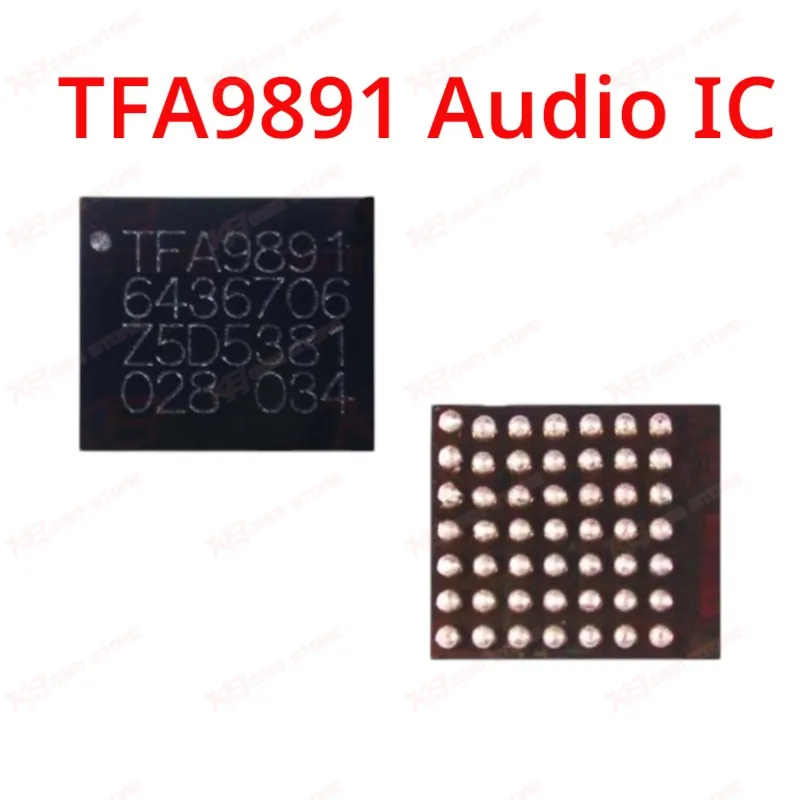
TFA9891 Audio IC
TFA9891 Audio IC
Regular price
Rs.350.00 PKR
Regular price
Sale price
Rs.350.00 PKR
Shipping calculated at checkout.
Quantity
Couldn't load pickup availability
The TFA9891 is an NXP Semiconductors Class-D smart audio amplifier IC built for mobile handsets that need clean, loud speaker output from a small board footprint. It runs an embedded CoolFlux DSP with an adaptive sound maximizer, protecting the speaker from excursion and thermal damage while boosting supply voltage internally up to 9.5V for stronger bass and volume. Technicians use this IC to fix dead speaker, no sound, and distorted audio faults on supported handsets. Genuine NXP part, tested before dispatch, ready for reballing and direct board-level replacement in any professional repair workshop.
⚖️ Weight: 0.01 kg
SKU:MST-IC-216
- Safe & Secure Payment
- Fast Delivery
- WhatsApp Support


Description
FAQ
What is the brand of this product?
The brand of this product is NXP Semiconductors.
What is the model of this product?
The model is TFA9891, also listed as TFA9891UK.
What is this product used for?
This IC drives the speaker output on mobile handsets, boosting supply voltage and protecting the speaker from excursion and thermal damage.
Which devices are compatible with this product?
Confirmed use includes the Google Pixel XL, with parts suppliers also stocking it for Xiaomi Redmi 5S, Redmi Pro, and Meizu MX6 boards.
Who should use this product?
This product is suitable for mobile repair technicians, repair shops, service centers, and professional users.
Does this IC support both I2S and PDM audio modes?
Yes, the TFA9891 supports I2S audio input/output and a separate PDM interface for audio streaming, controlled over I2C.
What output power does this amplifier deliver at 8 ohms?
It delivers up to 7.2W peak output power into an 8-ohm speaker load using its internal 9.5V boost converter.