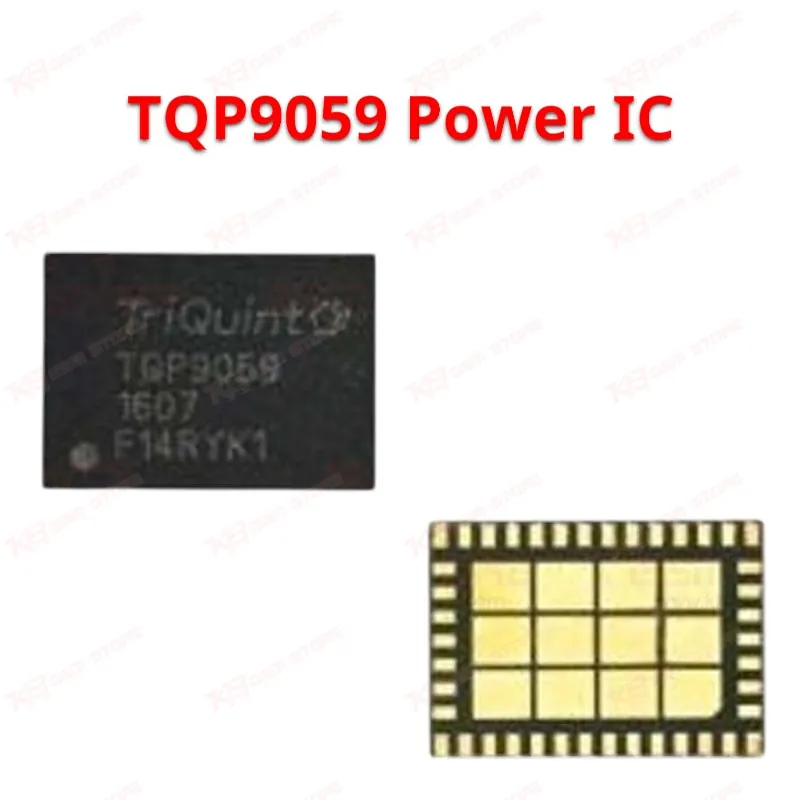
When a phone comes into your workshop with weak signal, dropped calls, or "no service" that doesn't clear after a software check, the RF power amplifier is one of the first components worth inspecting on the board. The TQP9059 is exactly that component — a fully matched multimode multiband Power Amplifier module engineered by Qorvo (previously branded under TriQuint Semiconductor before the Qorvo merger). It's built to handle Quad-band GSM/EDGE alongside W-CDMA and LTE transmission across Bands 1, 2, 3/4, 5, 8, 17, 20, and 26, giving it broad coverage across the RF configurations used in mid-range Android handsets from that generation.What sets this part apart from a basic amplifier is its dual operating mode support. In GSM/EDGE GMSK operation, the transceiver controls output power directly through a Vramp input, giving precise power step control during transmission. When the device switches to 8PSK modulation, that same Vramp input shifts roles — instead of setting output power, it's used to optimize current draw and linearity, which matters directly for battery efficiency during data-heavy transmission. On the WCDMA side, the module runs a 2-gain-state design across Low Power Mode (LPM) and High Power Mode (HPM), a setup aimed at stretching talk time across varying signal conditions rather than running at a fixed power draw regardless of need.The TQP9059 also carries a built-in regulator, which reduces the external support circuitry a board designer needs around the PA — a detail that matters when you're tracing a board and trying to understand why a fault isolates to this specific component rather than surrounding passives. Physically, it's built on Qorvo's GaAs HBT (Gallium Arsenide Heterojunction Bipolar Transistor) process with CuFlip assembly, a combination the manufacturer positions for better reliability, temperature stability, and mechanical ruggedness compared to older PA packaging approaches — useful information when you're deciding whether a reflow or reball attempt is worth it versus a straight IC replacement.On the repair bench, this part shows up in cases involving no signal, weak signal, intermittent network drop, or failed network registration after a drop or liquid exposure, especially where the fault traces to the RF section rather than the baseband IC or antenna connector. Replacement calls for a hot air rework station with accurate temperature control, proper board preheating, and ESD precautions given the sensitivity of GaAs-based RF components to static discharge and thermal stress. After reflow, verify the phone registers on network and holds a stable signal reading across GSM and LTE bands before closing the job — this confirms the amplifier stage rather than just the solder joints.Worth noting for sourcing: Qorvo's own distributor records list the TQP9059 as a discontinued part on the OEM side, which is part of why it circulates through the repair parts market rather than authorized component distributors. That makes verified sourcing — confirming the part traces back to genuine Qorvo/TriQuint fabrication rather than a relabeled substitute — a real factor in whether the replacement holds up after the repair. This listing reflects the component's actual RF PA function, its documented operating modes, and its practical repair role, giving you what you need to confirm fit before ordering rather than relying on the generic "Power IC" label alone.