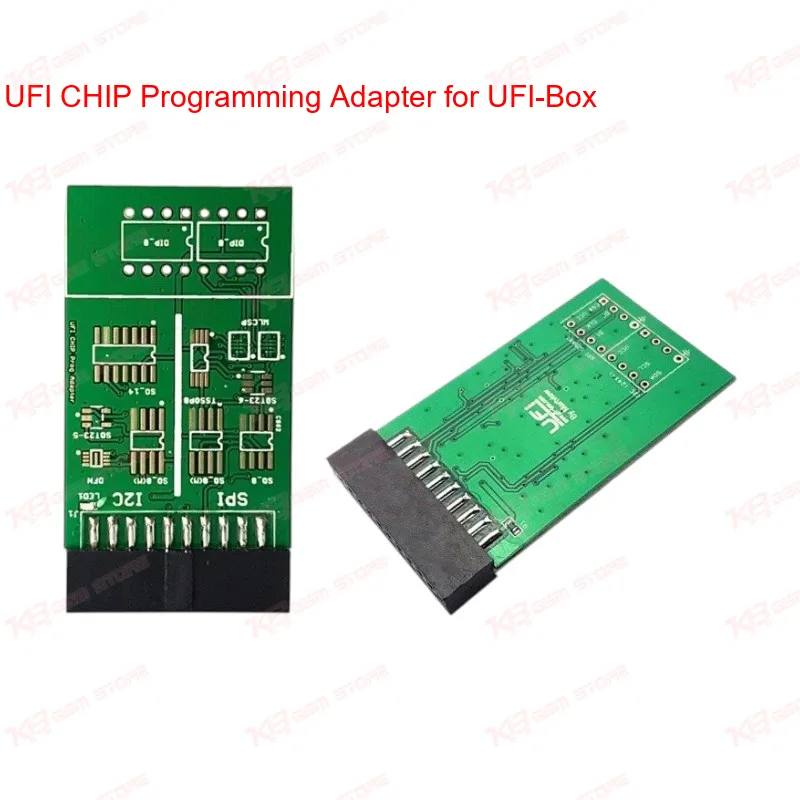
The UFI CHIP Programming Adapter is a dedicated hardware accessory built exclusively for the UFI-Box eMMC service tool. Every mobile repair workshop that handles dead phones, corrupted firmware, or chip-level board repair eventually reaches a point where software-only solutions stop working. This adapter fills that gap by giving your UFI-Box a direct physical connection to the eMMC chip itself, bypassing the phone's motherboard entirely when needed. At its core, the adapter routes signal and power lines from the UFI-Box to the eMMC chip's programming interface. This lets the box perform full read/write operations, resize partitions, erase corrupted blocks, format the chip, and update firmware — all functions the UFI-Box already offers through its software, now made accessible for direct chip-level work rather than through the phone's onboard test points. For a board that's dead after flash, stuck on logo, or affected by a boot loop the phone can't recover from on its own, this direct connection often becomes the only reliable path forward. Chip-level recovery work depends heavily on stable, accurate connections. A worn or incompatible adapter introduces read errors, failed writes, and in worst cases, permanent damage to both the chip and the UFI-Box hardware itself. This is why the adapter is designed and sold strictly as a genuine UFI-Box accessory. Using a cloned or copied version voids the reliability the UFI-Box depends on and can damage the box's internal circuitry — a risk that outweighs any short-term cost saving from unofficial alternatives. The adapter supports eMMC chips manufactured by Samsung, SK Hynix, Toshiba, Kingston, Micron, and other brands commonly found in China-market phones as well as branded devices. This wide manufacturer coverage means a single adapter handles the majority of eMMC chips a technician encounters across daily repair work, without needing separate hardware for each chip brand. In a typical repair workflow, this adapter sits between the diagnostic stage and the actual data operation. After identifying that a board's software issue traces back to eMMC corruption — whether from a failed flash, a bad software update, or physical chip degradation — the technician connects the adapter to the UFI-Box and initiates the required operation through the UFI software interface. Common scenarios include recovering user data from a dead phone before a board swap, repairing corrupted partitions causing a hang on logo, restoring factory firmware after a failed unlock attempt, and resizing eMMC storage following chip replacement during an IC change procedure. This adapter is not a standalone programmer. It has no independent software or driver requirement and depends entirely on the UFI-Box for operation, which keeps the workshop's toolkit simpler — one license, one piece of software, and this adapter extends what that setup can already do. Its role in the repair chain sits alongside BGA soldering adapters and ISP tools, each covering a different access method to the same eMMC chip depending on whether the chip is still mounted on the board or has been removed for bench-level work. For repair shops, service centers, and technical training environments in Pakistan working through high volumes of dead phone and software-fault cases, the UFI CHIP Programming Adapter reduces the guesswork in a stage of the repair where guesswork is costly. It gives technicians a dependable, purpose-built connection point that keeps chip-level operations consistent across different phone brands and different eMMC chip manufacturers, without adding complexity to an already established UFI-Box workflow.