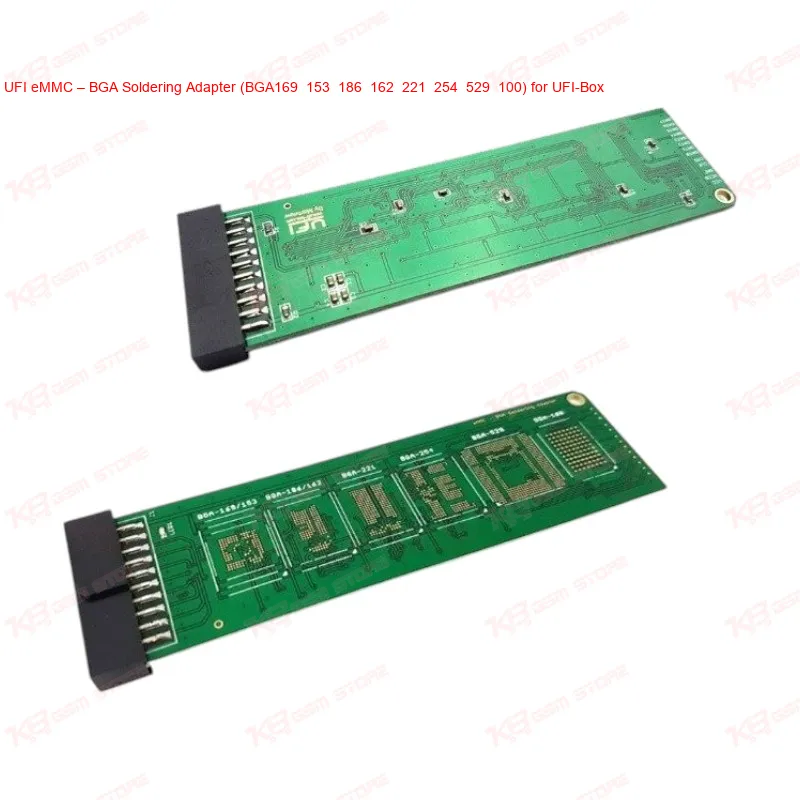
When a phone comes in completely dead — no charging response, no fastboot, no USB detection at all — your ISP pins and cables stop being useful. That's the point where you need a direct line to the eMMC chip itself, and that's exactly what this adapter gives your UFI-Box. The UFI eMMC BGA Soldering Adapter is a chip-off style interface board. Instead of relying on in-circuit ISP pads on the motherboard, you solder wires from the removed eMMC chip straight onto the adapter's contact points, then plug the adapter into your UFI-Box. This bypasses damaged board traces, corrupted CPU-to-eMMC communication, and dead power rails that block a normal ISP session. For microsoldering benches doing chip-off data recovery, this adapter turns into one of the most-used accessories on the desk. It supports eight BGA package sizes: BGA169, BGA153, BGA186, BGA162, BGA221, BGA254, BGA529, and BGA100. Each number refers to the ball count and pitch layout of the eMMC package, and different chip vendors use different footprints depending on chip generation and storage capacity. Samsung, SK Hynix, Toshiba, Kingston, Micron, and various China-brand phone manufacturers all ship eMMC chips that fall into one of these package families, which is why a single adapter covering all eight sizes saves you from stocking separate tools per brand. Once wired to the UFI-Box software, you get access to the full range of eMMC service operations: reading user data partitions for recovery, repairing corrupted controller firmware, resizing and reformatting the chip when the logical capacity reports incorrectly, erasing locked or bricked partitions, and rewriting firmware after a failed flash. For dead-after-flash cases, boot loop issues that survive a normal reflash attempt, and hang-on-logo situations tied to corrupted eMMC firmware, this adapter often becomes the only path to a working repair. A common workflow looks like this: the phone is confirmed dead with no software-side fix possible, you desolder the eMMC chip from the board, tin and prep the pads, solder fine wires from the chip to the matching BGA points on this adapter, then connect the adapter to your UFI-Box and run a read or repair session from the software. Data recovery shops use this exact process to pull user partitions before a board swap, and repair labs use it to restore boot partitions when standard USB flashing tools can't reach a bricked chip. One detail matters more than most: UFI explicitly warns against using copy or clone versions of this adapter, since incorrect pinout mapping or poor-quality traces on cloned boards can send bad signals into your UFI-Box and damage the hardware. A genuine adapter keeps signal timing and pin mapping accurate across all eight BGA sizes, which protects both your data recovery success rate and your box itself. This isn't a beginner tool — soldering directly to BGA pads at this scale needs a steady hand, a good hot air station, and comfort working under a microscope. But for technicians already doing board-level repair, it closes a gap that ISP cables and USB-based tools simply can't reach. If your workshop takes on dead phone cases, water damage recovery, or boot loop repairs that standard flashing has already failed on, this adapter extends what your UFI-Box can actually fix.