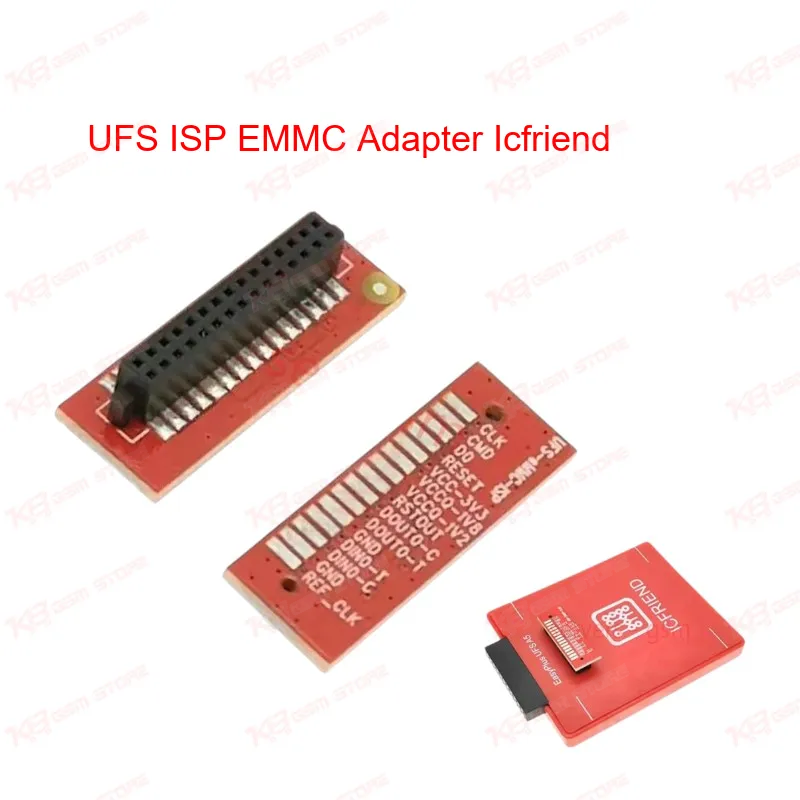
When a phone won't boot and the test points are too damaged or too tight for a socket-based connection, you need a direct route into the memory chip. The ICFRIEND ISP eMMC/UFS Adapter gives you exactly that. Instead of seating the chip in a mechanical socket, this adapter breaks out clearly marked ISP contact pads that you solder directly to the device's test points or straight onto the eMMC/UFS chip itself. This removes the socket from the equation entirely, which matters on boards where BGA pad spacing, chip orientation, or physical damage makes socket seating unreliable or impossible. The adapter is built for technicians already running an ICFRIEND-based eMMC/UFS workflow. It plugs into your existing box and passes signal through to the soldered connection point, so you keep using the same programmer software and read/write commands you already know. The design targets ISP mode specifically, which is the go-to method when a phone is completely dead, stuck in a boot loop, or hanging on the logo screen and standard USB-based flashing tools can't reach the chip because the phone's own controller isn't responding. On the hardware side, this adapter is confirmed compatible with several widely used programming boxes in the Pakistani repair market, including Medusa Pro, Z3X, ATF, Riff, and Octoplus Pro. That cross-compatibility is useful for shops running mixed toolsets, since you're not locked into a single box brand to use this adapter. Device-side, it covers Samsung, Huawei, ZTE, LG, Motorola, Nokia, Sony, and Vodafone-branded phones, along with general China-market Android handsets, making it a broad-coverage tool rather than a single-brand accessory. In a typical workshop scenario, you'd reach for this adapter after a phone comes in dead following a failed software update, a bad flash, or physical damage that took out the standard test point access. Rather than risk further board damage trying to force a socket connection, you solder the ISP wires from this adapter directly onto the eMMC or UFS pads, connect to your box, and proceed with reading the firmware, writing a known-good image, or pulling data off a chip that's otherwise inaccessible through normal means. It's also useful in data recovery jobs where the customer's priority is contacts, photos, or business files, and destructive chip removal isn't the first option you want to try. Because the adapter routes ISP signal without an intermediate socket, connection reliability comes down to solder joint quality rather than mechanical clamp pressure. This is an advantage on chips with worn or slightly damaged BGA balls, where a socket might not make consistent contact but a direct solder point will. It's a trade-off worth knowing: you get better connection reliability on marginal chips, at the cost of needing a steady hand and a fine-tip iron for the soldering itself. At 5 grams and built around a simple, low-profile PCB, this adapter takes up almost no space on a repair bench and is easy to keep in a tool case alongside your other ICFRIEND accessories. For any GSM technician doing regular eMMC/UFS work — dead phone recovery, IC-level board repair, or data extraction — it's a practical, no-frills tool that extends what your existing box can reach.