


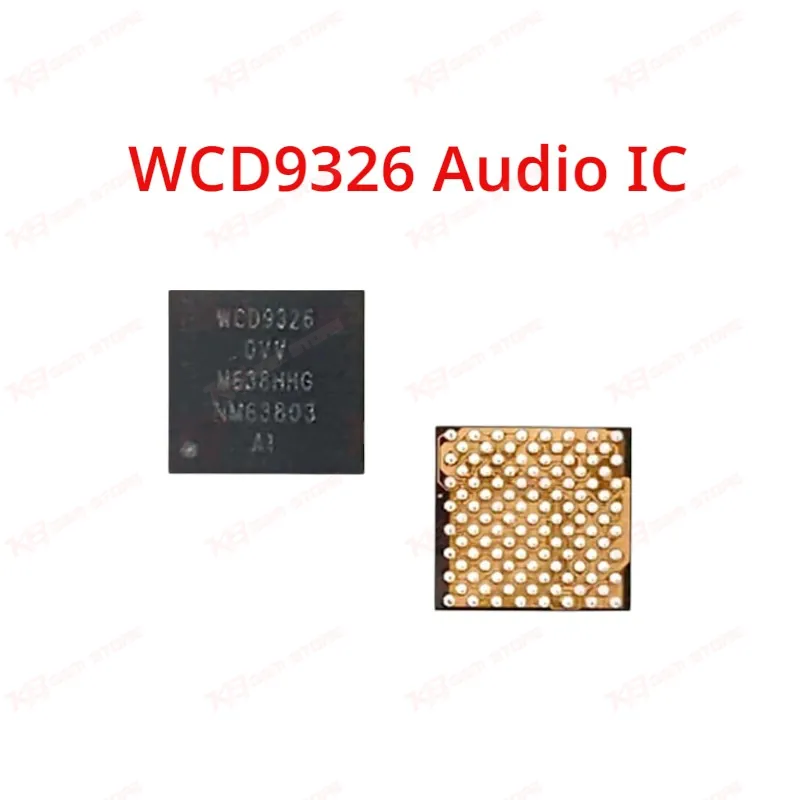
WCD9326 Audio IC
WCD9326 Audio IC
Regular price
Rs.350.00 PKR
Regular price
Sale price
Rs.350.00 PKR
Shipping calculated at checkout.
Quantity
Couldn't load pickup availability
The Qualcomm WCD9326 is a stand-alone Hi-Fi audio codec IC built for Snapdragon-based smartphones and embedded boards. It processes playback up to Hi-Res 192kHz and native 44.1kHz through a dedicated DSP, and it links to the host processor over SLIMbus, I2S, and PDM interfaces. You find this chip on boards that also carry a PM8953 or MSM8953 platform, and it's the reference part for restoring call audio, earpiece output, and microphone paths on devices like the Xiaomi Redmi Note 3 Pro and Samsung Galaxy A9 Pro. This original WCD9326 drops in as a direct replacement when the onboard codec fails.
⚖️ Weight: 0.01 kg
SKU:MST-IC-246
- Safe & Secure Payment
- Fast Delivery
- WhatsApp Support


Description
FAQ
What is the product name?
The product name is the Qualcomm WCD9326 Audio Codec IC.
What is the brand of this product?
The brand of this product is Qualcomm.
What is the model of this product?
The model of this product is WCD9326.
What is this product used for?
This product restores call audio, earpiece output, and microphone function on boards where the onboard audio codec has failed.
Which devices are compatible with this product?
This IC is compatible with the Xiaomi Redmi Note 3 / Redmi Note 3 Pro, Xiaomi Mi Max, Samsung Galaxy A9 Pro, Fairphone 3, and other Snapdragon 210/212, MSM8953, and APQ8009-based boards using a SLIMbus/I2S audio interface.
Who should use this product?
This product is suitable for mobile repair technicians, repair shops, service centers, and professional users.
Does the WCD9326 support Hi-Res audio playback?
Yes, the WCD9326 processes Hi-Res audio up to 192kHz along with native 44.1kHz through its dedicated DSP.
Can this IC fix one-sided call audio without replacing the earpiece speaker?
Yes, if continuity checks rule out the earpiece and its connector, a codec-level fault on the WCD9326 commonly causes one-sided call audio, and replacing this IC resolves it.