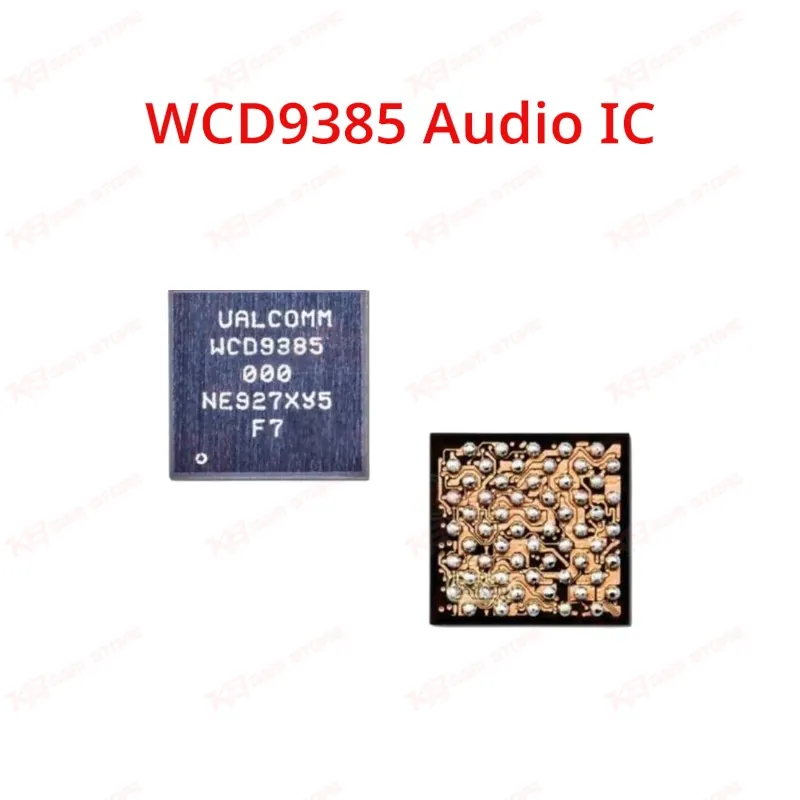
Open up a Snapdragon 865 board with a dead audio complaint, and the WCD9385 is usually the first place you check. Qualcomm built this chip as part of its Aqstic audio codec family, and it sits as a standalone Hi-Fi codec connected to the SoC over SoundWire rather than a traditional I2S bus. That distinction matters on the bench: a SoundWire fault behaves differently from a simple short, so your diagnostic approach needs to account for the digital link, not just the analog output stage.The WCD9385 actually runs as two SoundWire devices on the same package — an RX side and a TX side. The TX device holds the main control and status registers, which explains why some boards show partial audio (mic working, speaker dead) when only one side of the codec has failed or lost its connection. If you've ever chased a "no sound issue" where diagnostic mode shows mic input fine but speaker test fails, this RX/TX split is often the reason.On the hardware side, the chip packs four ADCs, ClassH amplification, dedicated earpiece and auxiliary PA outputs, two headphone amplifier channels, seven TX differential inputs, and eight digital mic inputs, along with multi-button headset control (MBHC) for wired headset detection. That's a lot of audio functionality riding on one BGA package, which is exactly why a cracked solder joint or a moisture-damaged pad under this IC can wipe out speaker, earpiece, mic, and headphone output all at once — or knock out just one path, depending on which balls lost contact.This IC ships in Snapdragon 865 platforms across several brands. OnePlus confirmed it on the Nord's board, and Qualcomm lists WCD9385 as the top-tier Aqstic codec option for the entire Snapdragon 865 platform, which covers a wide range of 2020-era flagship and near-flagship devices built on that chipset. If you're working a board and confirm it's running Snapdragon 865, check this IC first for any audio complaint that survives a software reset.On the repair floor, the common failure pattern looks like this: phone goes through water damage or a hard drop, and afterward you get complete audio dead, or a dead phone that boots but stays silent on calls and media, or a "hang on logo" board that still needs a rework pass before it'll POST cleanly. Reflow first if the board is otherwise healthy — a lot of WCD9385 faults trace back to a cold joint rather than IC death. If reflow doesn't clear it, move to a full IC change. Skip counterfeit or pulled-and-recycled chips for this job; the OTP calibration data baked into a genuine part at the factory doesn't survive a bad harvest, and you'll end up with intermittent audio or distorted output even after a textbook reball.Keep this IC stocked alongside your hot air station, BGA stencil kit, and a decent microscope, since WCD9385 work is fine-pitch reballing rather than a quick jumper fix. Pair it with an ISP box or a UFS-mode dead-phone tool if the board also needs a software restore after the hardware side is sorted — audio faults on Snapdragon 865 boards often show up bundled with a corrupted partition after water exposure, so a full workflow (hardware repair plus software restore) gets the phone back to a clean working state in one pass.